Akbari Peyman, Braber Saskia, Varasteh Soheil, Alizadeh Arash, Garssen Johan, Fink-Gremmels Johanna
Division of Veterinary Pharmacology, Pharmacotherapy and Toxicology, Institute for Risk Assessment Sciences, Utrecht University, Yalelaan 104, 3584 CM, Utrecht, The Netherlands.
Division of Pharmacology, Utrecht Institute for Pharmaceutical Sciences, Faculty of Science, Utrecht University, 3584 CG, Utrecht, The Netherlands.
Arch Toxicol. 2017 Mar;91(3):1007-1029. doi: 10.1007/s00204-016-1794-8. Epub 2016 Jul 14.
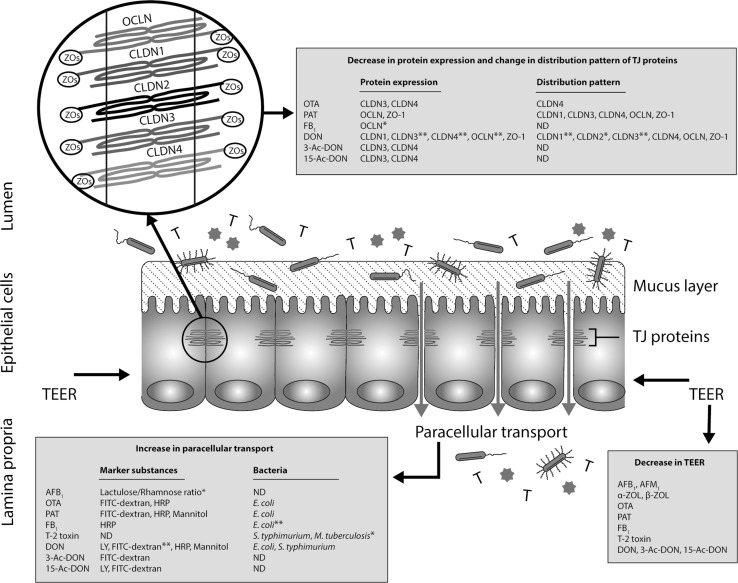
Mycotoxins, the secondary metabolites of fungal species, are the most frequently occurring natural food contaminants in human and animal diets. Risk assessment of mycotoxins focused as yet on their mutagenic, genotoxic and potential carcinogenic effects. Recently, there is an increasing awareness of the adverse effects of various mycotoxins on vulnerable structures in the intestines. In particular, an impairment of the barrier function of the epithelial lining cells and the sealing tight junction proteins has been noted, as this could result in an increased translocation of luminal antigens and pathogens and an excessive activation of the immune system. The current review aims to provide a summary of the available evidence regarding direct effects of various mycotoxins on the intestinal epithelial barrier. Available data, based on different cellular and animal studies, show that food-associated exposure to certain mycotoxins, especially trichothecenes and patulin, affects the intestinal barrier integrity and can result in an increased translocation of harmful stressors. It is therefore hypothesized that human exposure to certain mycotoxins, particularly deoxynivalenol, as the major trichothecene, may play an important role in etiology of various chronic intestinal inflammatory diseases, such as inflammatory bowel disease, and in the prevalence of food allergies, particularly in children.
霉菌毒素是真菌物种的次生代谢产物,是人类和动物饮食中最常见的天然食品污染物。霉菌毒素的风险评估迄今主要集中在其诱变、基因毒性和潜在致癌作用上。最近,人们越来越意识到各种霉菌毒素对肠道脆弱结构的不利影响。特别是,已注意到上皮衬里细胞的屏障功能和紧密连接密封蛋白受到损害,因为这可能导致腔内抗原和病原体的易位增加以及免疫系统的过度激活。本综述旨在总结关于各种霉菌毒素对肠道上皮屏障直接影响的现有证据。基于不同细胞和动物研究的现有数据表明,与食物相关的某些霉菌毒素暴露,尤其是单端孢霉烯族毒素和棒曲霉素,会影响肠道屏障的完整性,并可能导致有害应激源的易位增加。因此,据推测,人类接触某些霉菌毒素,特别是作为主要单端孢霉烯族毒素的脱氧雪腐镰刀菌烯醇,可能在各种慢性肠道炎症性疾病(如炎症性肠病)的病因以及食物过敏(尤其是儿童食物过敏)的患病率中起重要作用。