Chawla Lakhmir S, Toma Ian, Davison Danielle, Vaziri Khashayar, Lee Juliet, Lucas Raymond, Seneff Michael G, Nyhan Aoibhinn, McCaffrey Timothy A
Department of Anesthesiology and Critical Care Medicine, The George Washington University Medical Center, 2300 I Street, NW Ross 443, Washington, DC, 20037, USA.
The Department of Medicine, Veterans Affairs Medical Center, The George Washington University Medical Center, 2300 I Street, NW Ross 443, Washington, DC, 20037, USA.
BMC Med Genomics. 2016 Jul 15;9(1):40. doi: 10.1186/s12920-016-0200-y.
The diagnosis of acute appendicitis can be surprisingly difficult without computed tomography, which carries significant radiation exposure. Circulating blood cells may carry informative changes in their RNA expression profile that would signal internal infection or inflammation of the appendix.
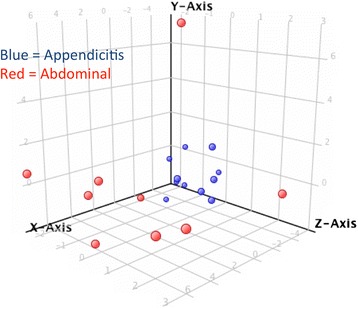
Genome-wide expression profiling was applied to whole blood RNA of acute appendicitis patients versus patients with other abdominal disorders, in order to identify biomarkers of appendicitis. From a large cohort of emergency patients, a discovery set of patients with surgically confirmed appendicitis, or abdominal pain from other causes, was identified. RNA from whole blood was profiled by microarrays, and RNA levels were filtered by a combined fold-change (>2) and p value (<0.05). A separate set of patients, including patients with respiratory infections, was used to validate a partial least squares discriminant (PLSD) prediction model.
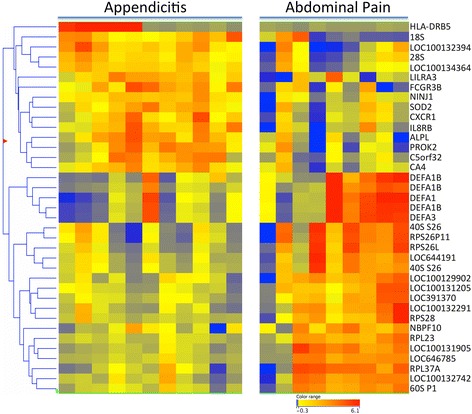
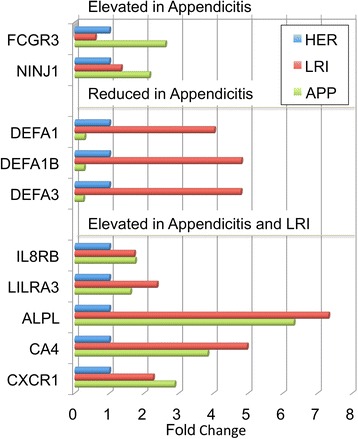
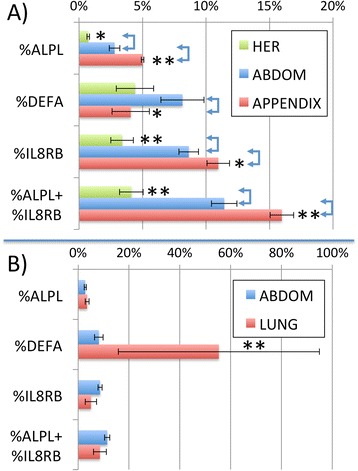
Transcript profiling identified 37 differentially expressed genes (DEG) in appendicitis versus abdominal pain patients. The DEG list contained 3 major ontologies: infection-related, inflammation-related, and ribosomal processing. Appendicitis patients had lower level of neutrophil defensin mRNA (DEFA1,3), but higher levels of alkaline phosphatase (ALPL) and interleukin-8 receptor-ß (CXCR2/IL8RB), which was confirmed in a larger cohort of 60 patients using droplet digital PCR (ddPCR).
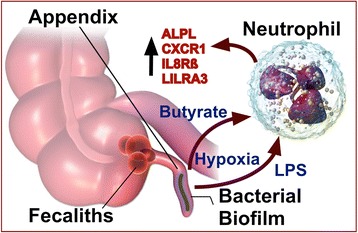
Patients with acute appendicitis have detectable changes in the mRNA expression levels of factors related to neutrophil innate defense systems. The low defensin mRNA levels suggest that appendicitis patient's immune cells are not directly activated by pathogens, but are primed by diffusible factors in the microenvironment of the infection. The detected biomarkers are consistent with prior evidence that biofilm-forming bacteria in the appendix may be an important factor in appendicitis.
在没有计算机断层扫描(CT)的情况下,急性阑尾炎的诊断可能异常困难,而CT会带来大量辐射暴露。循环血细胞的RNA表达谱可能携带信息性变化,提示阑尾内部感染或炎症。
将全基因组表达谱分析应用于急性阑尾炎患者与其他腹部疾病患者的全血RNA,以鉴定阑尾炎的生物标志物。从一大群急诊患者中,确定了一组经手术证实为阑尾炎或因其他原因腹痛的患者作为发现集。通过微阵列对全血RNA进行分析,并通过联合倍数变化(>2)和p值(<0.05)对RNA水平进行筛选。另一组患者,包括呼吸道感染患者,用于验证偏最小二乘判别(PLSD)预测模型。
转录谱分析确定了阑尾炎患者与腹痛患者之间37个差异表达基因(DEG)。DEG列表包含3个主要本体:感染相关、炎症相关和核糖体加工。阑尾炎患者中性粒细胞防御素mRNA(DEFA1,3)水平较低,但碱性磷酸酶(ALPL)和白细胞介素-8受体-β(CXCR2/IL8RB)水平较高,这在另一组60名患者中使用液滴数字PCR(ddPCR)得到了证实。
急性阑尾炎患者中性粒细胞固有防御系统相关因子的mRNA表达水平有可检测到的变化。防御素mRNA水平低表明阑尾炎患者的免疫细胞不是由病原体直接激活的,而是由感染微环境中的可扩散因子引发的。检测到的生物标志物与先前的证据一致,即阑尾中形成生物膜的细菌可能是阑尾炎的一个重要因素。