Koley Munmun, Saha Subhranil, Arya Jogendra Singh, Choubey Gurudev, Ghosh Aloke, Das Kaushik Deb, Ganguly Subhasish, Dey Samit, Saha Sangita, Singh Rakesh, Bhattacharyya Kajal, Ghosh Shubhamoy, Ali Sk Swaif
Clinical Research Unit (Homeopathy), Siliguri, under Central Council for Research in Homeopathy, Government of India, Darjeeling, West Bengal, India.
Department of Organon of Medicine and Homeopathic Philosophy, Midnapore Homeopathic Medical College and Hospital, Government of West Bengal, India.
J Tradit Complement Med. 2015 Apr 10;6(3):237-46. doi: 10.1016/j.jtcme.2015.03.001. eCollection 2016 Jul.
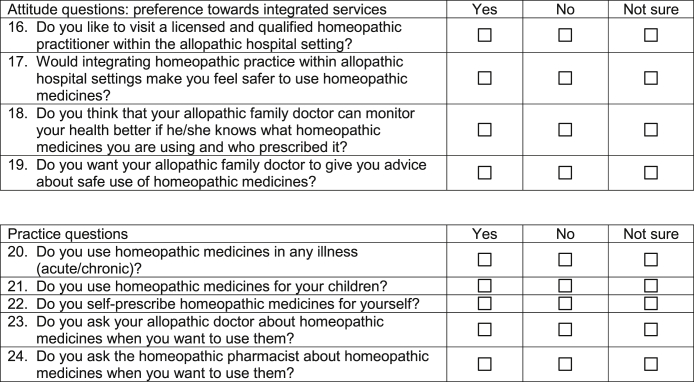
There is lack of studies assessing the preference of Indian patients for integration of homeopathy into standard therapy settings. The objectives of this study were to examine the knowledge, attitudes, and practice of homeopathy among Indian patients already availing homeopathy treatment and its integration into mainstream healthcare. A cross-sectional survey was conducted among adult patients attending the out-patients of the four government homeopathic hospitals in West Bengal, India. A self-administered 24-items questionnaire in local vernacular Bengali was developed and administered to the patients. A total of 1352 patients' responses were included in the current analysis. 40% patients thought that homeopathic medicines can be used along with standard therapy. 32.5% thought that homeopathic medicines might cause side effects, while only 13.3% believed that those might interact with other medications. Patients' knowledge ranged between 25.1 and 76.5% regarding regulations of practicing and safety of homeopathic medicine in India and abroad; while positive attitude towards the same ranged between 25.4 and 88.5%. 88.6% of the patients had favorable attitude toward integrated services. 68.2% of the patients used homeopathic medicines in any acute or chronic illness for themselves and 76.6% for their children. Preference for integrated services was significantly associated with better knowledge (P = 0.002), positive attitudes toward safety and regulations (P < 0.0001), and integration (P < 0.0001), but not with the level of practice (P = 0.515). A favorable attitude toward integrating homeopathy into conventional healthcare settings was obtained among the patients attending the homeopathic hospitals in West Bengal, India.
目前缺乏关于印度患者对顺势疗法融入标准治疗方案的偏好的研究。本研究的目的是调查已经接受顺势疗法治疗的印度患者对顺势疗法的了解、态度及实践情况,以及顺势疗法与主流医疗保健的整合情况。在印度西孟加拉邦的四家政府顺势疗法医院的门诊成年患者中开展了一项横断面调查。自行设计了一份用当地孟加拉语编写的包含24个条目的问卷,并向患者发放。本分析纳入了总共1352名患者的回复。40%的患者认为顺势疗法药物可与标准疗法同时使用。32.5%的患者认为顺势疗法药物可能会引起副作用,而只有13.3%的患者认为这些药物可能会与其他药物相互作用。患者对印度国内外顺势疗法的执业规定和安全性的了解程度在25.1%至76.5%之间;而对顺势疗法的积极态度在25.4%至88.5%之间。88.6%的患者对综合服务持积极态度。68.2%的患者在自己患有任何急慢性疾病时使用顺势疗法药物,76.6%的患者为其子女使用。对综合服务的偏好与更好的了解程度(P = 0.002)、对安全性和规定的积极态度(P < 0.0001)以及整合情况(P < 0.0001)显著相关,但与实践水平无关(P = 0.515)。在印度西孟加拉邦的顺势疗法医院就诊的患者中,对将顺势疗法融入传统医疗保健环境持积极态度。