Siebald Caroline, Khandaker Golam M, Zammit Stanley, Lewis Glyn, Jones Peter B
Department of Psychiatry, University of Cambridge, UK.
Department of Psychiatry, University of Cambridge, UK; Cambridgeshire and Peterborough NHS Foundation Trust, Cambridge, UK.
Compr Psychiatry. 2016 Aug;69:45-52. doi: 10.1016/j.comppsych.2016.05.004. Epub 2016 May 6.
Adolescent psychotic experiences (PEs) are common, and are associated with both psychotic and non-psychotic illnesses. In order to examine psychopathological and cognitive antecedents of adolescent PEs, we have conducted a longitudinal study of common childhood psychiatric disorders and subsequent adolescent PEs in the population-based prospective ALSPAC birth cohort.
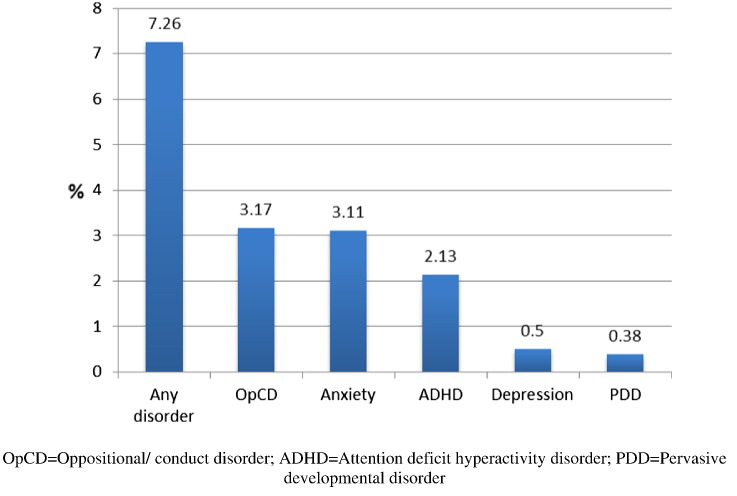
Depression, anxiety, attention deficit hyperactivity disorder, oppositional defiant or conduct disorder, and pervasive developmental disorder were diagnosed according to DSM-IV criteria in 8253 participants at age 8years. IQ was assessed by WISC-III also at 8years. PEs, depressive and anxiety symptoms were assessed at 13years. Logistic regression calculated odds ratio (OR) for PEs at 13years associated with psychiatric disorders at 8years. Linear regression calculated mean difference in IQ between groups with and without psychiatric disorder. Mediating effects of IQ, mood and anxiety symptoms on the psychiatric disorder-PEs relationship were examined.
In total, 599 children were assessed to have a DSM-IV psychiatric disorder at 8years (7.2%). These children compared with those without any psychiatric disorder performed worse on all measures of IQ; adjusted mean difference in total IQ -6.17 (95% CI, -7.86, -4.48). Childhood psychiatric disorders were associated with PEs subsequently in adolescence; adjusted OR 1.96 (95% CI, 1.47-2.68). The association between psychiatric disorder and subsequent PEs was partly mediated by, independently, IQ deficit at 8years and depressive and anxiety symptoms at 13years.
The findings indicate that adolescent PEs are associated with general cognitive ability and past and present psychopathological factors.
青少年精神病性体验(PEs)很常见,且与精神病性和非精神病性疾病均有关联。为了探究青少年PEs的精神病理学和认知前驱因素,我们在基于人群的前瞻性阿冯纵向父母与儿童发育研究(ALSPAC)出生队列中,对常见儿童期精神障碍及随后的青少年PEs进行了一项纵向研究。
根据《精神疾病诊断与统计手册》第四版(DSM-IV)标准,在8253名8岁参与者中诊断出抑郁症、焦虑症、注意力缺陷多动障碍、对立违抗性或品行障碍以及广泛性发育障碍。智商(IQ)也在8岁时通过韦氏儿童智力量表第三版(WISC-III)进行评估。在13岁时评估PEs、抑郁和焦虑症状。采用逻辑回归计算8岁时的精神障碍与13岁时PEs相关的比值比(OR)。采用线性回归计算有和没有精神障碍的组之间IQ的平均差异。研究了IQ、情绪和焦虑症状对精神障碍与PEs关系的中介作用。
总共有599名儿童在8岁时被评估患有DSM-IV精神障碍(7.2%)。与没有任何精神障碍的儿童相比,这些儿童在所有IQ测量指标上表现更差;总IQ的调整后平均差异为-6.17(95%可信区间,-7.86,-4.48)。儿童期精神障碍随后与青少年期的PEs相关;调整后的OR为1.96(95%可信区间,1.47 - 2.68)。精神障碍与随后PEs之间的关联部分分别由8岁时的IQ缺陷以及13岁时的抑郁和焦虑症状介导。
研究结果表明,青少年PEs与一般认知能力以及过去和现在的精神病理学因素有关。