Shi Xudan, Doycheva Desislava Met, Xu Liang, Tang Jiping, Yan Min, Zhang John H
Department of Anesthesiology, The Second Affiliated Hospital, School of Medicine, Zhejiang University, Hangzhou, Zhejiang 310000, China; Department of Anesthesiology and Basic Sciences, Loma Linda University School of Medicine, Loma Linda, CA 92354, USA.
Department of Anesthesiology and Basic Sciences, Loma Linda University School of Medicine, Loma Linda, CA 92354, USA.
Neurobiol Dis. 2016 Nov;95:111-21. doi: 10.1016/j.nbd.2016.07.016. Epub 2016 Jul 16.
Hypoxic ischemic (HI) encephalopathy remains the leading cause of perinatal brain injury resulting in long term disabilities. Stabilization of blood brain barrier (BBB) after HI is an important target, therefore, in this study we aim to determine the role of sestrin2, a stress inducible protein which is elevated after various insults, on BBB stabilization after moderate and severe HI injuries.
Rat pups underwent common carotid artery ligation followed by either 150min (severe model) or 100min (moderate model) of hypoxia. 1h post HI, rats were intranasally administered with recombinant human sestrin2 (rh-sestrin2) and sacrificed for infarct area, brain water content, righting reflex and geotaxis reflex. Sestrin2 was silenced using siRNA and an activator/inhibitor of hypoxia inducible factor1α (HIF1α) was used to examine their roles on BBB permeability.
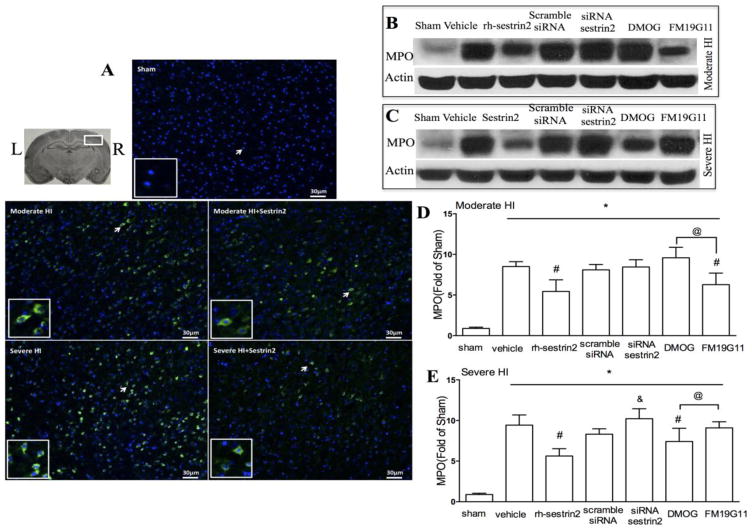
Rats subjected to severe HI exhibited larger infarct area and higher sestrin2 expression compared to rats in the moderate HI group. rh-sestrin2 attenuated brain infarct and edema, while silencing sestrin2 reversed these protective effects after severe HI. HIF1α induced sestrin2 activation in severe HI but not in moderate HI groups. A HIF1a agonist was shown to increase permeability of the BBB via vascular endothelial growth factor (VEGF) after moderate HI. However, after severe HI, HIF1α activated both VEGF and sestrin2. But HIF1α dependent sestrin2 activation was the predominant pathway after severe HI which inhibited VEGF and attenuated BBB permeability.
rh-sestrin2 attenuated BBB permeability via upregulation of endogenous sestrin2 which was induced by HIF1α after severe HI. However, HIF1α's effects as a prodeath or prosurvival signal were influenced by the severity of HI injury.
缺氧缺血性(HI)脑病仍然是围产期脑损伤导致长期残疾的主要原因。因此,HI后血脑屏障(BBB)的稳定是一个重要靶点,在本研究中,我们旨在确定丝氨酸蛋白酶抑制剂2(sestrin2)在中度和重度HI损伤后对BBB稳定的作用,sestrin2是一种在各种损伤后水平升高的应激诱导蛋白。
将新生大鼠进行颈总动脉结扎,随后分别进行150分钟(重度模型)或100分钟(中度模型)的缺氧处理。HI后1小时,经鼻给大鼠注射重组人丝氨酸蛋白酶抑制剂2(rh-sestrin2),然后处死大鼠,检测梗死面积、脑含水量、翻正反射和趋地性反射。使用小干扰RNA(siRNA)使sestrin2沉默,并使用缺氧诱导因子1α(HIF1α)的激活剂/抑制剂来研究它们对BBB通透性的作用。
与中度HI组大鼠相比,重度HI大鼠的梗死面积更大,sestrin2表达更高。rh-sestrin2减轻了脑梗死和脑水肿,而沉默sestrin2则逆转了重度HI后的这些保护作用。在重度HI组中,HIF1α诱导sestrin2激活,但在中度HI组中未出现。在中度HI后,一种HIF1α激动剂通过血管内皮生长因子(VEGF)增加了BBB的通透性。然而,在重度HI后,HIF1α同时激活了VEGF和sestrin2。但在重度HI后,HIF1α依赖性sestrin2激活是主要途径,其抑制了VEGF并减弱了BBB通透性。
rh-sestrin2通过上调内源性sestrin2减轻了BBB通透性,内源性sestrin2是在重度HI后由HIF1α诱导产生的。然而,HIF1α作为促死亡或促生存信号的作用受HI损伤严重程度的影响。