Henderson C, Robinson E, Evans-Lacko S, Corker E, Rebollo-Mesa I, Rose D, Thornicroft G
Health Service and Population Research Department, King's College London, Institute of Psychiatry, Psychology and Neuroscience, London, UK.
Biostatistics Department, King's College London, Institute of Psychiatry, Psychology and Neuroscience, London, UK.
Acta Psychiatr Scand. 2016 Aug;134 Suppl 446(Suppl Suppl 446):23-33. doi: 10.1111/acps.12607.
To investigate whether public knowledge, attitudes, desire for social distance and reported contact in relation to people with mental health problems have improved in England during the Time to Change (TTC) programme to reduce stigma and discrimination 2009-2015.
Using data from an annual face-to-face survey of a nationally representative sample of adults, we analysed longitudinal trends in the outcomes with regression modelling using standardised scores of the measures overall and by age and gender subgroups.
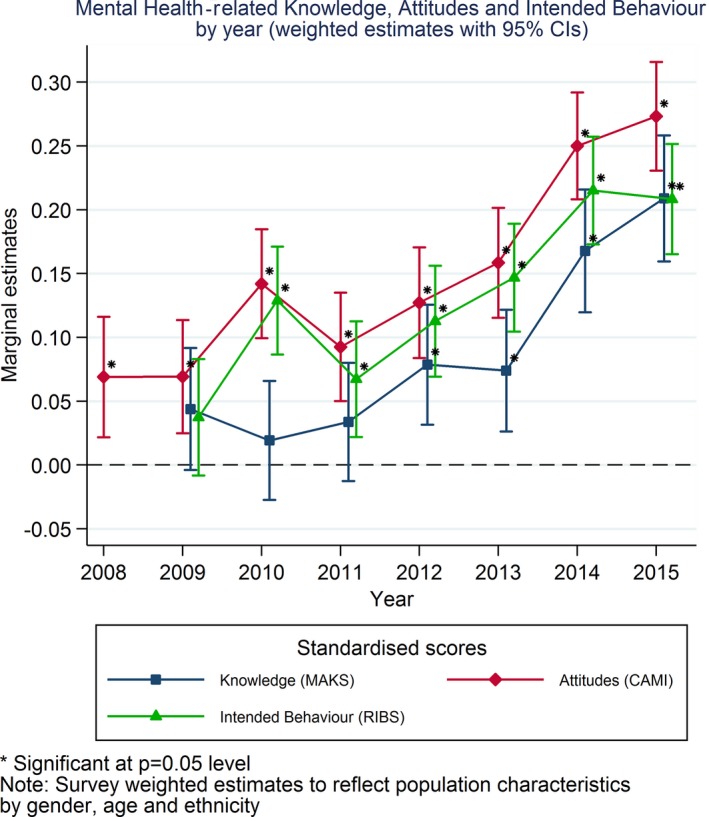
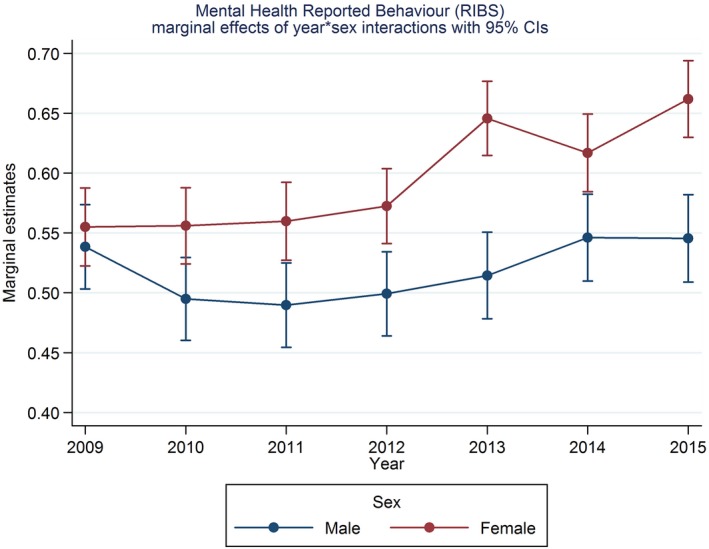
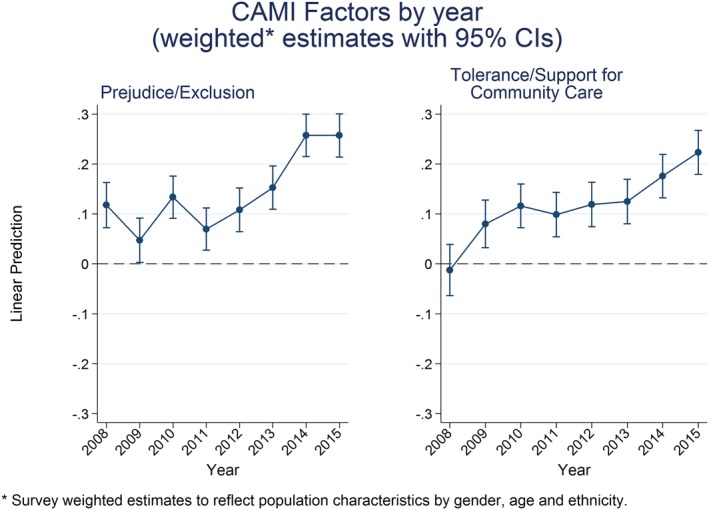
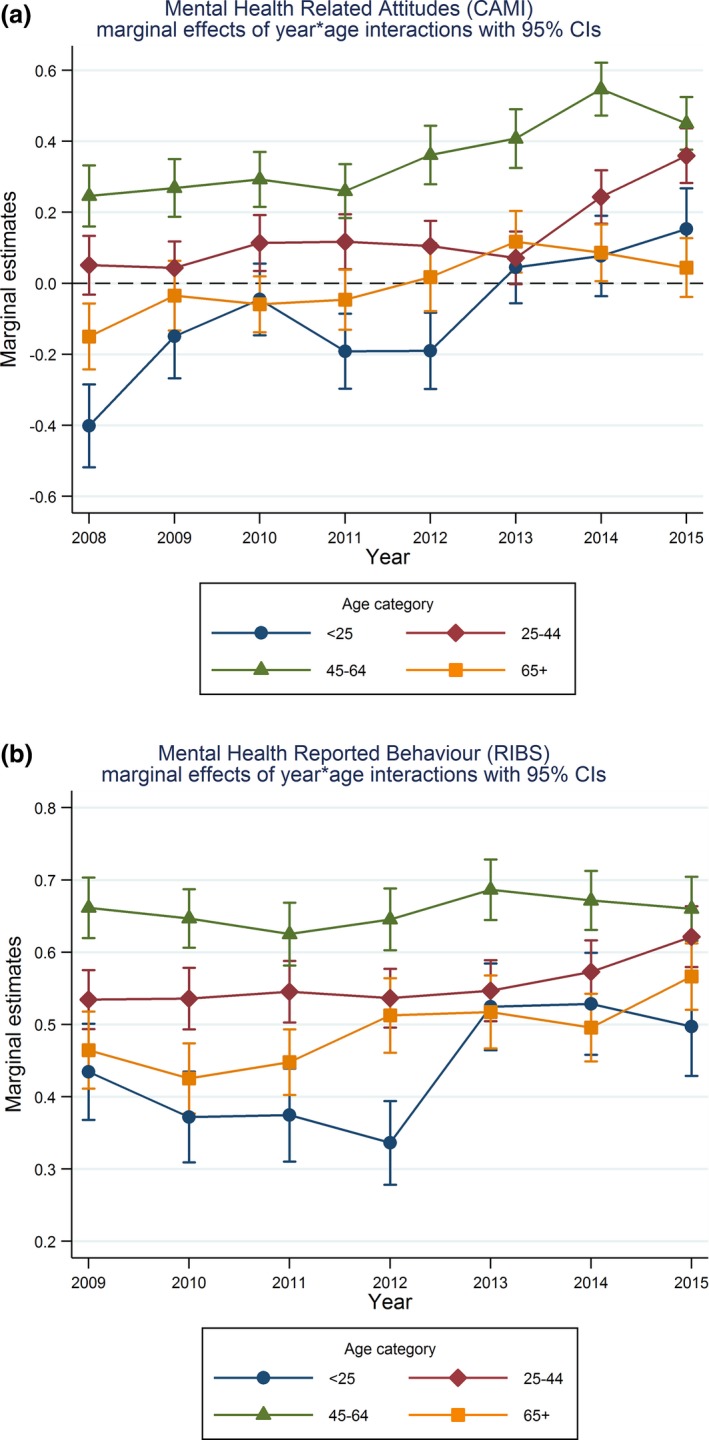
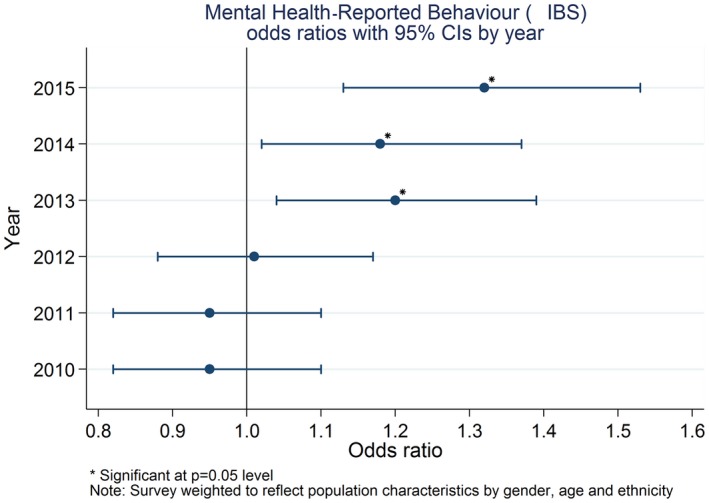
There were improvements in all outcomes. The improvement for knowledge was 0.17 standard deviation units in 2015 compared to 2009 (95% CI 0.10, 0.23); for attitudes 0.20 standard deviation units (95% CI 0.14, 0.27) and for social distance 0.17 standard deviation units (95% CI 0.11, 0.24). Survey year for 2015 vs. 2009 was associated with a higher likelihood of reported contact (OR 1.32, 95% CI 1.13, 1.53). Statistically significant interactions between year and age suggest the campaign had more impact on the attitudes of the target age group (25-45) than those aged over 65 or under 25. Women's reported contact with people with mental health problems increased more than did men's.
The results provide support for the effectiveness of TTC.
调查在2009 - 2015年“改变时刻”(TTC)减少耻辱感和歧视的项目期间,英格兰公众对于有心理健康问题的人群的认知、态度、社交距离意愿以及报告的接触情况是否有所改善。
我们使用对全国具有代表性的成年样本进行年度面对面调查的数据,通过对总体测量指标以及按年龄和性别亚组的标准化分数进行回归建模,分析结果的纵向趋势。
所有结果均有改善。与2009年相比,2015年知识方面的改善为0.17个标准差单位(95%可信区间0.10, 0.23);态度方面为0.20个标准差单位(95%可信区间0.14, 0.27),社交距离方面为0.17个标准差单位(95%可信区间0.11, 0.24)。2015年与2009年相比,调查年份与报告接触的可能性更高相关(比值比1.32,95%可信区间1.13, 1.53)。年份与年龄之间具有统计学意义的交互作用表明,该活动对目标年龄组(25 - 45岁)态度的影响大于65岁以上或25岁以下人群。女性报告与有心理健康问题人群的接触增加幅度大于男性。
结果为TTC的有效性提供了支持。