Tiberio Stacey S, Capaldi Deborah M, Kerr David C R, Bertrand Maria, Pears Katherine C, Owen Lee
Oregon Social Learning Center.
Oberlin College.
Dev Psychopathol. 2016 Aug;28(3):837-53. doi: 10.1017/S0954579416000341.
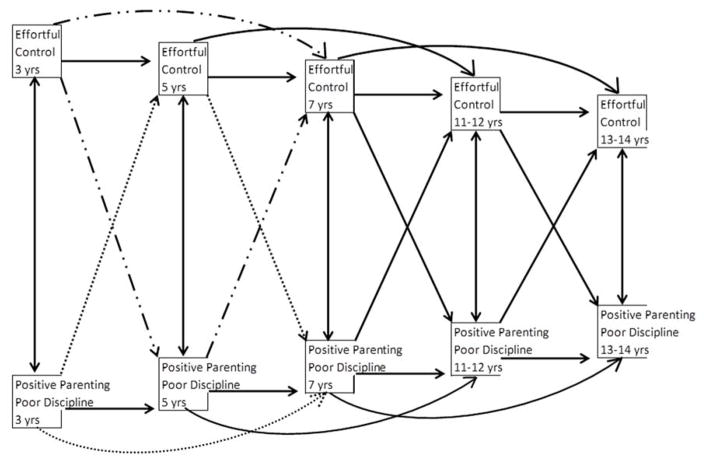
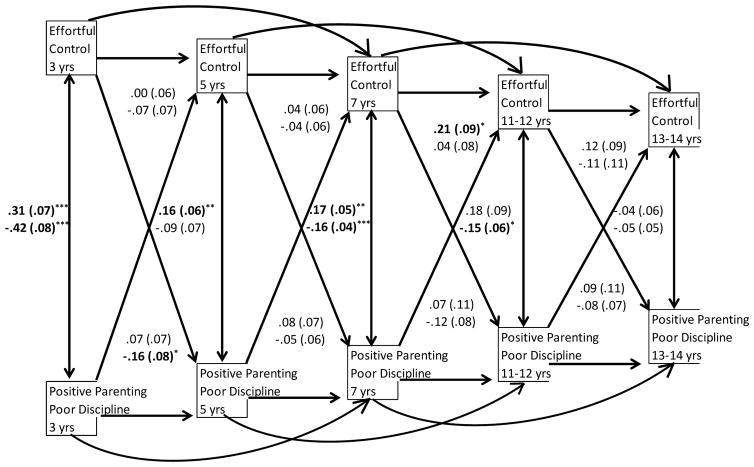
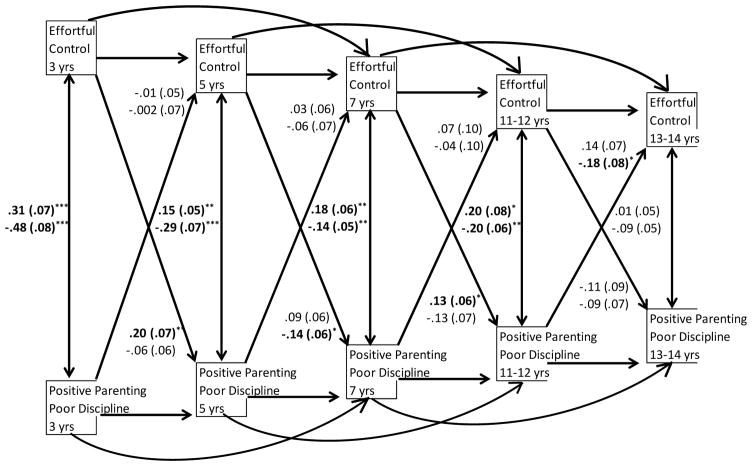
Poor effortful control is a key temperamental factor underlying behavioral problems. The bidirectional association of child effortful control with both positive parenting and negative discipline was examined from ages approximately 3 to 13-14 years, involving five time points, and using data from parents and children in the Oregon Youth Study-Three Generational Study (N = 318 children from 150 families). Based on a dynamic developmental systems approach, it was hypothesized that there would be concurrent associations between parenting and child effortful control and bidirectional effects across time from each aspect of parenting to effortful control and from effortful control to each aspect of parenting. It was also hypothesized that associations would be more robust in early childhood, from ages 3 to 7 years, and would diminish as indicated by significantly weaker effects at the older ages, 11-12 to 13-14 years. Longitudinal feedback or mediated effects were also tested. The findings supported (a) stability in each construct over multiple developmental periods; (b) concurrent associations, which were significantly weaker at the older ages;
较差的努力控制是行为问题背后的一个关键气质因素。从大约3岁到13 - 14岁,涉及五个时间点,利用俄勒冈青少年研究——三代人研究(来自150个家庭的318名儿童)中父母和孩子的数据,考察了儿童努力控制与积极养育和消极管教之间的双向关联。基于动态发展系统方法,研究假设养育方式与儿童努力控制之间存在同步关联,并且从养育方式的各个方面到努力控制以及从努力控制到养育方式的各个方面,随着时间推移存在双向影响。研究还假设这种关联在幼儿期(3至7岁)会更强,而在较大年龄(11 - 12岁至13 - 14岁)会显著减弱。同时也测试了纵向反馈或中介效应。研究结果支持:(a)每个构念在多个发展阶段的稳定性;(b)同步关联,这种关联在较大年龄时显著减弱;