Cox Andrew G, Hwang Katie L, Brown Kristin K, Evason Kimberley, Beltz Sebastian, Tsomides Allison, O'Connor Keelin, Galli Giorgio G, Yimlamai Dean, Chhangawala Sagar, Yuan Min, Lien Evan C, Wucherpfennig Julia, Nissim Sahar, Minami Akihiro, Cohen David E, Camargo Fernando D, Asara John M, Houvras Yariv, Stainier Didier Y R, Goessling Wolfram
Brigham and Women's Hospital, Harvard Medical School, Boston, MA.
Harvard/MIT MD-PhD Program, Harvard Medical School, Boston, MA.
Nat Cell Biol. 2016 Aug;18(8):886-896. doi: 10.1038/ncb3389. Epub 2016 Jul 18.
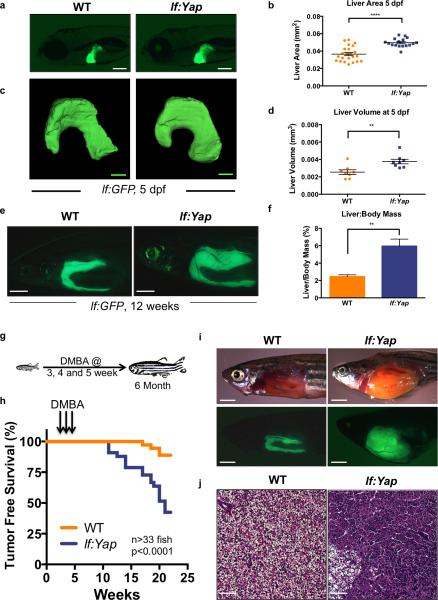
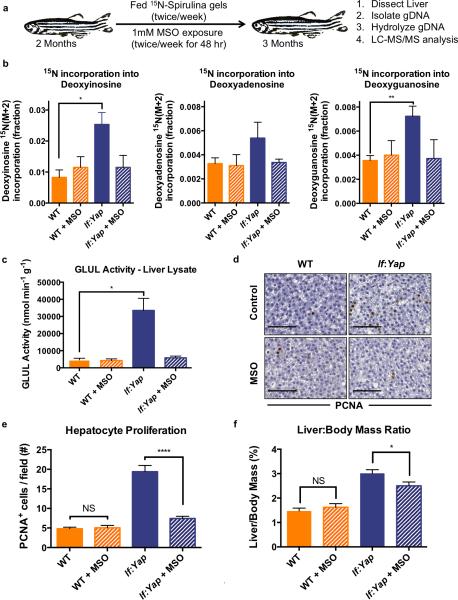
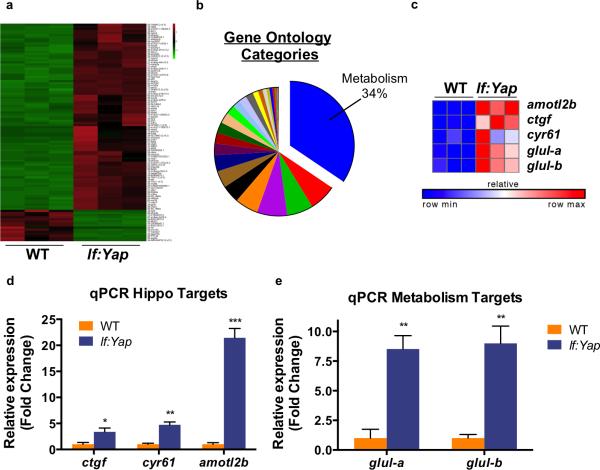
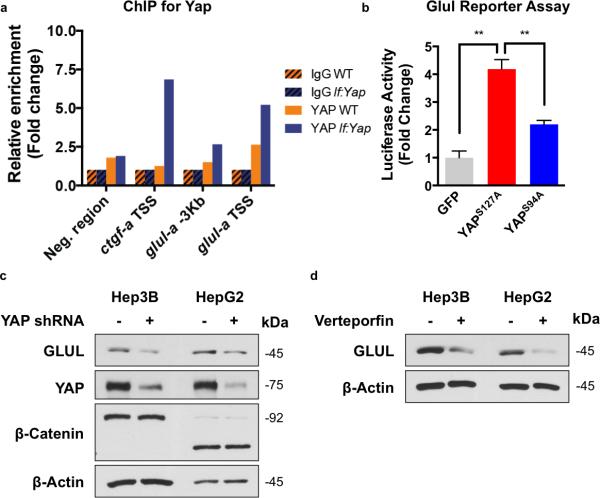
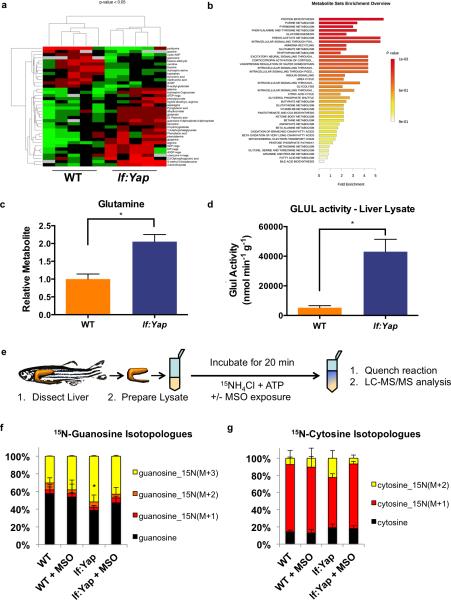
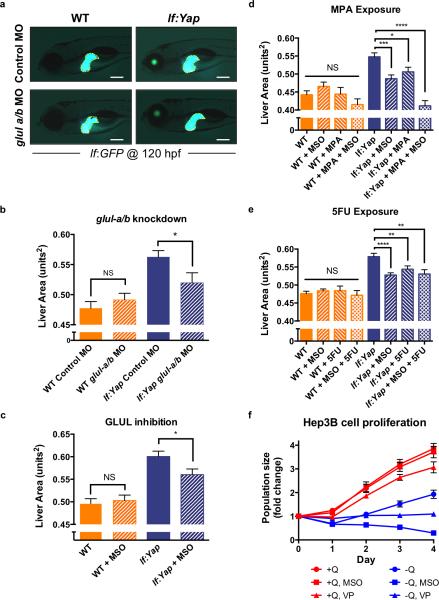
The Hippo pathway is an important regulator of organ size and tumorigenesis. It is unclear, however, how Hippo signalling provides the cellular building blocks required for rapid growth. Here, we demonstrate that transgenic zebrafish expressing an activated form of the Hippo pathway effector Yap1 (also known as YAP) develop enlarged livers and are prone to liver tumour formation. Transcriptomic and metabolomic profiling identify that Yap1 reprograms glutamine metabolism. Yap1 directly enhances glutamine synthetase (glul) expression and activity, elevating steady-state levels of glutamine and enhancing the relative isotopic enrichment of nitrogen during de novo purine and pyrimidine biosynthesis. Genetic or pharmacological inhibition of GLUL diminishes the isotopic enrichment of nitrogen into nucleotides, suppressing hepatomegaly and the growth of liver cancer cells. Consequently, Yap-driven liver growth is susceptible to nucleotide inhibition. Together, our findings demonstrate that Yap1 integrates the anabolic demands of tissue growth during development and tumorigenesis by reprogramming nitrogen metabolism to stimulate nucleotide biosynthesis.
河马通路是器官大小和肿瘤发生的重要调节因子。然而,尚不清楚河马信号如何提供快速生长所需的细胞组成部分。在这里,我们证明,表达河马通路效应因子Yap1(也称为YAP)激活形式的转基因斑马鱼会出现肝脏肿大,并容易形成肝肿瘤。转录组学和代谢组学分析表明,Yap1可重新编程谷氨酰胺代谢。Yap1直接增强谷氨酰胺合成酶(glul)的表达和活性,提高谷氨酰胺的稳态水平,并在从头嘌呤和嘧啶生物合成过程中增强氮的相对同位素富集。对GLUL进行基因或药理学抑制会减少氮进入核苷酸的同位素富集,抑制肝肿大和肝癌细胞的生长。因此,Yap驱动的肝脏生长易受核苷酸抑制的影响。总之,我们的研究结果表明,Yap1通过重新编程氮代谢以刺激核苷酸生物合成,整合了发育和肿瘤发生过程中组织生长的合成代谢需求。