Translational Immunology Section, Office of Science Technology (OST), NIAMS, NIH.
Systemic Autoimmunity Branch, NIAMS, NIH.
Arthritis Rheumatol. 2017 Jan;69(1):148-160. doi: 10.1002/art.39818.
Dysregulation of innate and adaptive immune responses contributes to the pathogenesis of systemic lupus erythematosus (SLE) and its associated premature vascular damage. No drug to date targets both systemic inflammatory disease and the cardiovascular complications of SLE. Tofacitinib is a JAK inhibitor that blocks signaling downstream of multiple cytokines implicated in lupus pathogenesis. While clinical trials have shown that tofacitinib exhibits significant clinical efficacy in various autoimmune diseases, its role in SLE and the associated vascular pathology remains to be characterized.
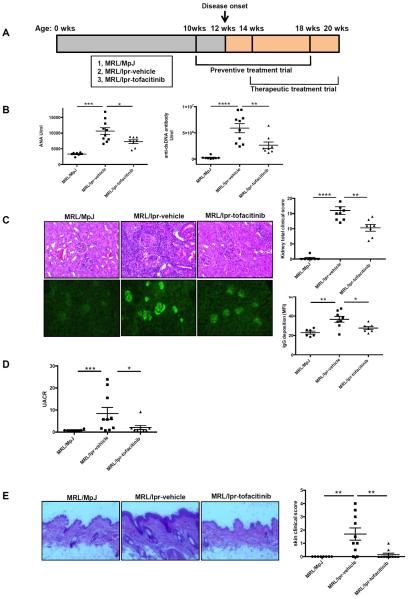
MRL/lpr lupus-prone mice were administered tofacitinib or vehicle by gavage for 6 weeks (therapeutic arm) or 8 weeks (preventive arm). Nephritis, skin inflammation, serum levels of autoantibodies and cytokines, mononuclear cell phenotype and gene expression, neutrophil extracellular traps (NETs) release, endothelium-dependent vasorelaxation, and endothelial differentiation were compared in treated and untreated mice.
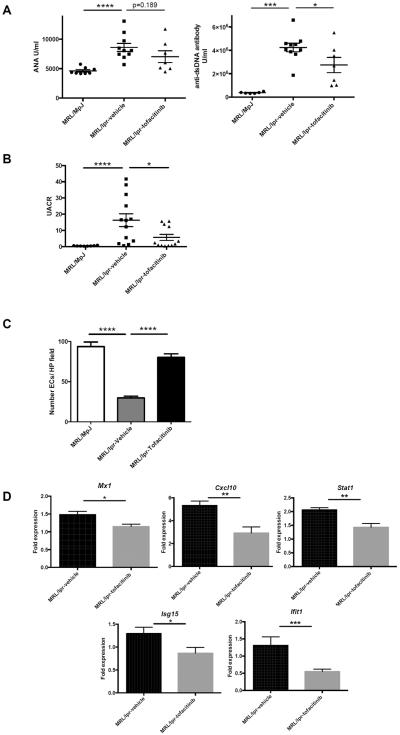
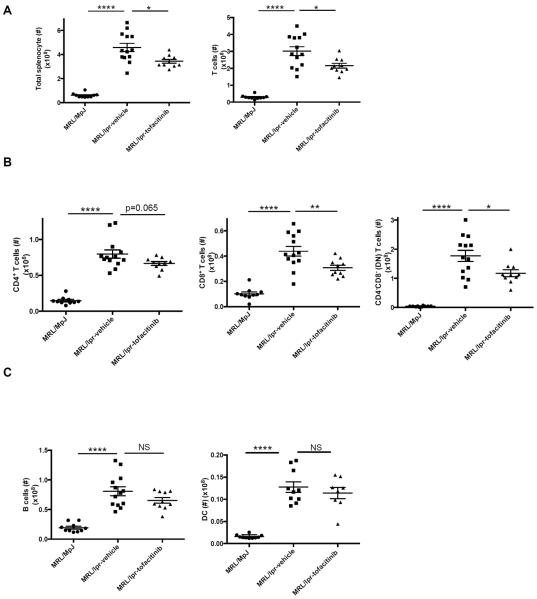
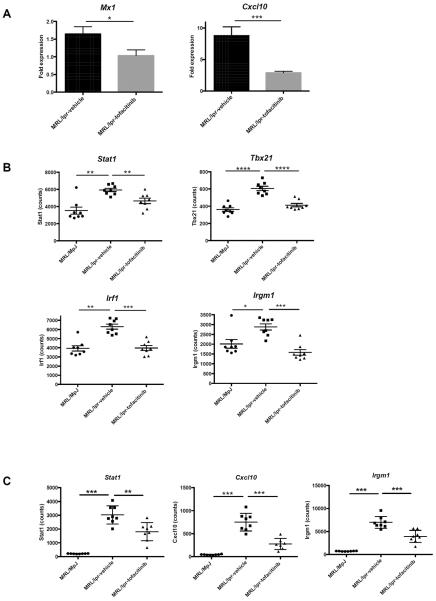
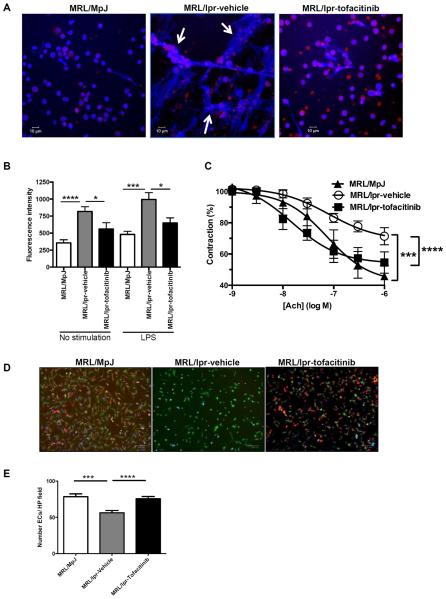
Treatment with tofacitinib led to significant improvement in measures of disease activity, including nephritis, skin inflammation, and autoantibody production. In addition, tofacitinib treatment reduced serum levels of proinflammatory cytokines and interferon responses in splenocytes and kidney tissue. Tofacitinib also modulated the formation of NETs and significantly increased endothelium-dependent vasorelaxation and endothelial differentiation. The drug was effective in both preventive and therapeutic strategies.
Tofacitinib modulates the innate and adaptive immune responses, ameliorates murine lupus, and improves vascular function. These results indicate that JAK inhibitors have the potential to be beneficial in SLE and its associated vascular damage.
固有免疫和适应性免疫反应的失调导致全身性红斑狼疮(SLE)及其相关的早期血管损伤的发病机制。迄今为止,尚无药物能够同时针对系统性炎症性疾病和 SLE 的心血管并发症。托法替尼是一种 JAK 抑制剂,可阻断多种细胞因子信号通路,这些细胞因子在狼疮发病机制中起作用。虽然临床试验表明托法替尼在多种自身免疫性疾病中表现出显著的临床疗效,但它在 SLE 及其相关血管病理学中的作用仍有待研究。
用灌胃法给 MRL/lpr 狼疮易感小鼠施用托法替尼或载体 6 周(治疗组)或 8 周(预防组)。比较治疗和未治疗小鼠的肾炎、皮肤炎症、血清自身抗体和细胞因子水平、单核细胞表型和基因表达、中性粒细胞胞外陷阱(NETs)释放、内皮依赖性血管舒张和内皮分化。
托法替尼治疗可显著改善疾病活动的衡量指标,包括肾炎、皮肤炎症和自身抗体产生。此外,托法替尼治疗降低了脾细胞和肾脏组织中促炎细胞因子和干扰素反应的血清水平。托法替尼还调节 NETs 的形成,并显著增加内皮依赖性血管舒张和内皮分化。该药物在预防和治疗策略中均有效。
托法替尼调节固有免疫和适应性免疫反应,改善小鼠狼疮,并改善血管功能。这些结果表明 JAK 抑制剂有可能对 SLE 及其相关的血管损伤有益。