Martinez Nic, Campbell Bill, Franek Madison, Buchanan Laura, Colquhoun Ryan
Exercise Science Program, Performance & Physique Enhancement Laboratory, College of Education, University of South Florida, Tampa, FL 33620 USA.
J Int Soc Sports Nutr. 2016 Jul 16;13:29. doi: 10.1186/s12970-016-0138-7. eCollection 2016.
Consumption of pre-workout dietary supplements by both recreational and competitive athletes has increased dramatically in recent years. The purpose of this study was to determine the acute effects of a caffeine-containing pre-workout dietary supplement on various measures of performance including anaerobic power, upper and lower body power, and upper body strength in recreationally trained males.
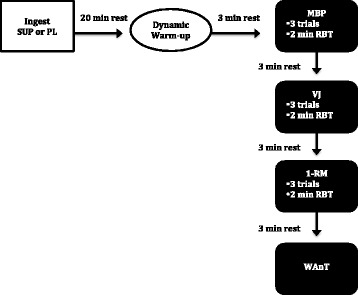
Thirteen males (mean ± SD age = 24 ± 6 yrs; height = 180.3 ± 5 cm; body mass = 83.4 ± 9 kg) participated in this investigation in which they reported to the laboratory on four separate occasions, each separated by one week. Each subject underwent an initial familiarization session on week one followed by baseline (BA) performance testing on week two. Performance testing included a medicine ball put (MBP) to determine upper body explosive power, vertical jump test (VJ) to determine lower body explosive power, one-rep maximum bench press (1-RM) for determining upper body strength, and a Wingate Anaerobic Power Test (WAnT) to determine measures of anaerobic power. On week three, subjects were randomly assigned to ingest either a pre-workout supplement (SUP) or a placebo (PL) and again complete the performance testing protocol. Subjects were provided with the crossover treatment on the fourth and final week. Performance testing commenced 20-minute following ingestion of both treatments, which was similar to previous investigations.
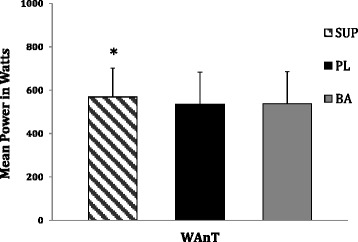
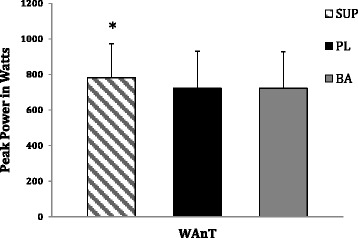
Significant differences in anaerobic peak power relative to the WAnT were observed following ingestion of the SUP (782 ± 191 W) in comparison to the PL (722 ± 208 W; p = 0.003; effect size = 0.30) and BA (723 ± 205 W; p = 0.011; effect size = 0.28). Significant differences were also observed for anaerobic mean power following ingestion of the SUP (569 ± 133 W) in comparison to the PL (535 ± 149 W; p = 0.006; effect size = 0.24) and BA (538 ± 148 W; p = 0.020; effect size = 0.22). No significant differences between trials were observed for upper body power, lower body power, or upper body strength.
Ingestion of the pre-workout dietary supplement led to significant improvements in anaerobic peak and mean power values in comparison to the placebo and baseline treatments. No improvements were observed in upper and lower body power or upper body strength. Taken prior to exercise, a caffeine-containing pre-workout dietary supplement may improve anaerobic power performance.
近年来,休闲运动员和竞技运动员对运动前膳食补充剂的消费量急剧增加。本研究的目的是确定含咖啡因的运动前膳食补充剂对休闲训练男性的各种运动表现指标的急性影响,包括无氧功率、上半身和下半身力量以及上半身力量。
13名男性(平均±标准差年龄=24±6岁;身高=180.3±5厘米;体重=83.4±9千克)参与了本研究,他们在四个不同的时间到实验室报到,每次间隔一周。每个受试者在第一周进行了一次初始熟悉训练,然后在第二周进行基线(BA)表现测试。表现测试包括药球投掷(MBP)以确定上半身爆发力、垂直跳跃测试(VJ)以确定下半身爆发力、一次重复最大卧推(1-RM)以确定上半身力量,以及温盖特无氧功率测试(WAnT)以确定无氧功率指标。在第三周,受试者被随机分配摄入运动前补充剂(SUP)或安慰剂(PL),并再次完成表现测试方案。在第四周也是最后一周,受试者接受交叉治疗。在摄入两种治疗药物后20分钟开始进行表现测试,这与之前的研究相似。
与PL(722±208瓦;p=0.003;效应大小=0.30)和BA(723±205瓦;p=0.011;效应大小=0.28)相比,摄入SUP(782±191瓦)后,观察到相对于WAnT的无氧峰值功率有显著差异。与PL(535±149瓦;p=0.006;效应大小=0.24)和BA(538±148瓦;p=0.020;效应大小=0.22)相比,摄入SUP(569±133瓦)后,无氧平均功率也有显著差异。在上半身力量、下半身力量或上半身力量方面,各试验之间未观察到显著差异。
与安慰剂和基线治疗相比,摄入运动前膳食补充剂可显著提高无氧峰值和平均功率值。在上半身和下半身力量或上半身力量方面未观察到改善。在运动前服用含咖啡因 的运动前膳食补充剂可能会提高无氧运动表现。