Chen Peiqing, Zhao Wenjuan, Guo Yanjie, Xu Juan, Yin Ming
School of Pharmacy, Shanghai Jiao Tong University, 800 Dongchuan Road, Shanghai 200240, China.
Department of Neurology, Shanghai General Hospital, Shanghai Jiao Tong University School of Medicine, No. 100 Haining Road, Shanghai 200080, China.
Biomed Res Int. 2016;2016:8090918. doi: 10.1155/2016/8090918. Epub 2016 Jun 27.
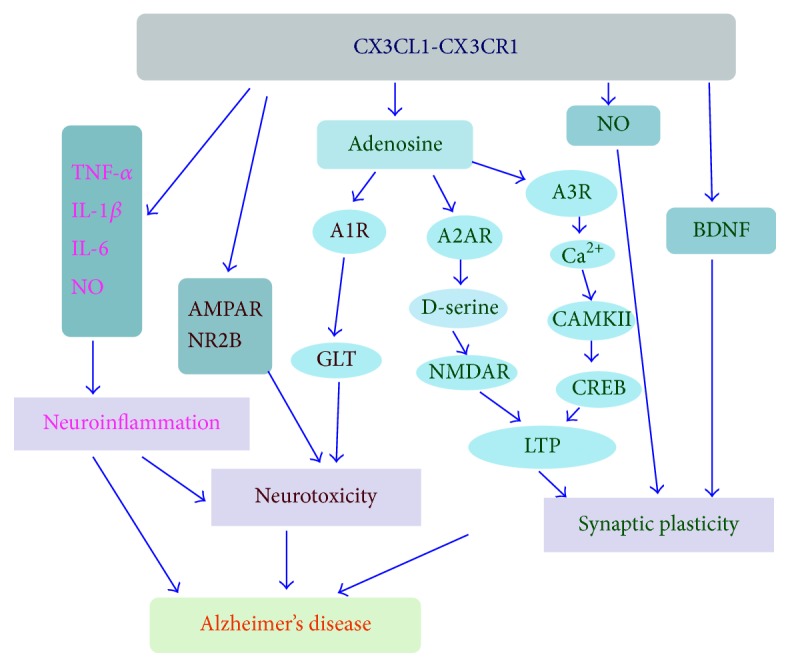
CX3C chemokine ligand 1 (CX3CL1) is an intriguing chemokine belonging to the CX3C family. CX3CL1 is secreted by neurons and plays an important role in modulating glial activation in the central nervous system after binding to its sole receptor CX3CR1 which mainly is expressed on microglia. Emerging data highlights the beneficial potential of CX3CL1-CX3CR1 in the pathogenesis of Alzheimer's disease (AD), a common progressive neurodegenerative disease, and in the progression of which neuroinflammation plays a vital role. Even so, the importance of CX3CL1/CX3CR1 in AD is still controversial and needs further clarification. In this review, we make an attempt to present a concise map of CX3CL1-CX3CR1 associated with AD to find biomarkers for early diagnosis or therapeutic interventions.
CX3C趋化因子配体1(CX3CL1)是一种属于CX3C家族的有趣趋化因子。CX3CL1由神经元分泌,在与主要表达于小胶质细胞上的唯一受体CX3CR1结合后,在调节中枢神经系统中的胶质细胞激活方面发挥重要作用。新出现的数据凸显了CX3CL1 - CX3CR1在阿尔茨海默病(AD,一种常见的进行性神经退行性疾病)发病机制中的有益潜力,且神经炎症在其进展中起着至关重要的作用。即便如此,CX3CL1/CX3CR1在AD中的重要性仍存在争议,需要进一步阐明。在本综述中,我们试图呈现一幅与AD相关的CX3CL1 - CX3CR1简明图谱,以寻找早期诊断或治疗干预的生物标志物。