Deng Wenjie, Wang Yueyuan, Gu Luo, Duan Biao, Cui Jie, Zhang Yujie, Chen Yan, Sun Shixiu, Dong Jing, Du Jun
Department of Physiology, Nanjing Medical University, Nanjing, 211166, China.
Jiangsu Key Lab of Cancer Biomarkers, Prevention and Treatment, Collaborative Innovation Center For Cancer Personalized Medicine, Nanjing Medical University, Nanjing, 211166, China.
BMC Cancer. 2016 Jul 18;16:489. doi: 10.1186/s12885-016-2553-1.
Molecules Interacting with CasL (MICAL1), a multidomain flavoprotein monoxygenase, is strongly involved in the mechanisms that promote cancer cell proliferation and survival. Activation of MICAL1 causes an up-regulation of reactive oxygen species (ROS) in HeLa cells. ROS can function as a signaling molecule that modulates protein phosphorylation, leading to malignant phenotypes of cancer cells such as invasion and metastasis. Herein, we tested whether MICAL1 could control cell migration and invasion through regulating ROS in breast cancer cell lines.
The effects of depletion/overexperssion of MICAL1 on cell invasion rate were measured by matrigel-based transwell assays. The contents of ROS in breast cancer cells were evaluated by CM2-DCFHDA staining and enhanced lucigenin chemiluminescence method. RAB35 activity was assessed by pulldown assay. The relationship of RAB35 and MICAL1 was evaluated by immunofluorescence, coimmunoprecipitation, immunoblotting and co-transfection techniques. Immunoblotting assays were also used to analyze Akt phosphorylation level.
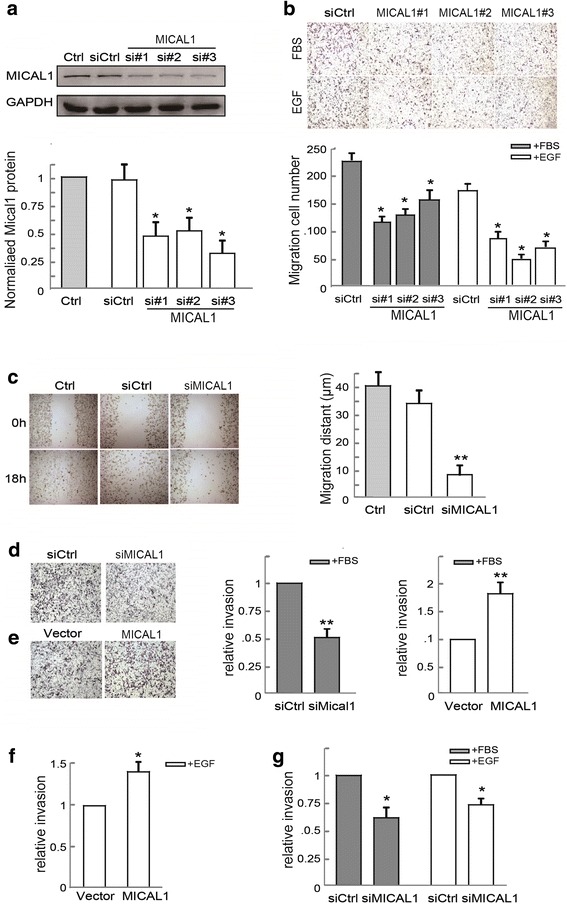
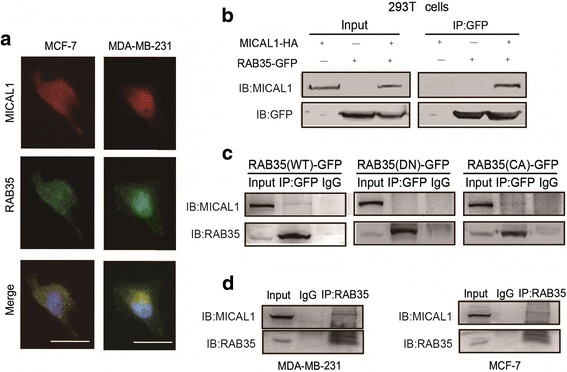
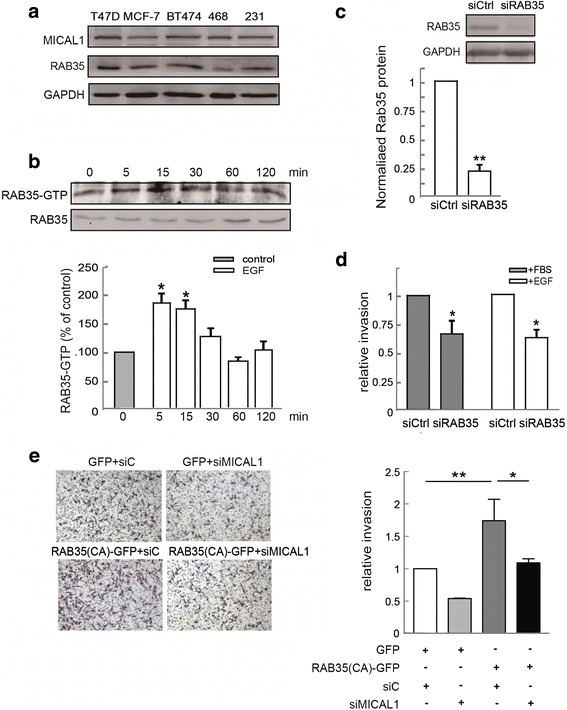
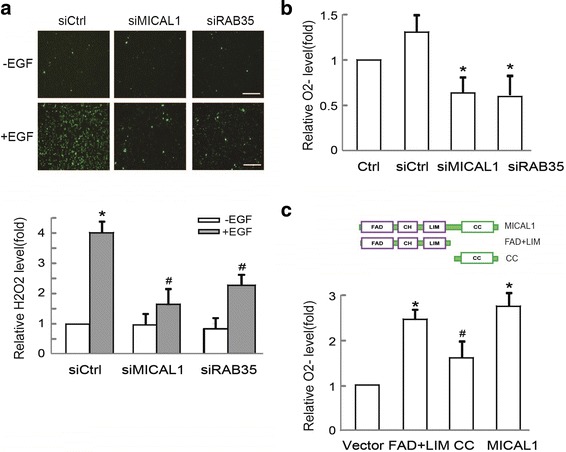
In this study, we found that depletion of MICAL1 reduced cell migration and invasion as well as ROS generation. Phosphorylation of Akt was also attenuated by MICAL1 depletion. Likewise, the over-expression of MICAL1 augmented the generation of ROS, increased Akt phosphorylation, and favored invasive phenotype of breast cancer cells. Moreover, we investigated the effect of EGF signaling on MICAL1 function. We demonstrated that EGF increased RAB35 activation and activated form of RAB35 could bind to MICAL1. Silencing of RAB35 repressed ROS generation, prevented Akt phosphorylation and inhibited cell invasion in response to EGF.
Taken together, our results provide evidence that MICAL1 plays an essential role in the activation of ROS/Akt signaling and cell invasive phenotype and identify a novel link between RAB35 and MICAL1 in regulating breast cancer cell invasion. These findings may provide a basis for designing future therapeutic strategy for blocking breast cancer metastasis.
与CasL相互作用的分子(MICAL1)是一种多结构域黄素蛋白单加氧酶,强烈参与促进癌细胞增殖和存活的机制。MICAL1的激活会导致HeLa细胞中活性氧(ROS)上调。ROS可作为调节蛋白磷酸化的信号分子,导致癌细胞出现侵袭和转移等恶性表型。在此,我们测试了MICAL1是否可通过调节乳腺癌细胞系中的ROS来控制细胞迁移和侵袭。
通过基于基质胶的Transwell实验检测MICAL1缺失/过表达对细胞侵袭率的影响。采用CM2-DCFHDA染色和增强型光泽精化学发光法评估乳腺癌细胞中的ROS含量。通过下拉实验评估RAB35活性。采用免疫荧光、免疫共沉淀、免疫印迹和共转染技术评估RAB35与MICAL1的关系。免疫印迹实验还用于分析Akt磷酸化水平。
在本研究中,我们发现MICAL1缺失会降低细胞迁移和侵袭以及ROS生成。MICAL1缺失也会减弱Akt磷酸化。同样,MICAL1过表达会增加ROS生成,增加Akt磷酸化,并有利于乳腺癌细胞的侵袭表型。此外,我们研究了表皮生长因子(EGF)信号对MICAL1功能的影响。我们证明EGF会增加RAB35激活,且RAB35的激活形式可与MICAL1结合。RAB35沉默会抑制ROS生成,阻止Akt磷酸化,并抑制对EGF的细胞侵袭。
综上所述,我们的结果提供了证据表明MICAL1在ROS/Akt信号激活和细胞侵袭表型中起关键作用,并确定了RAB35与MICAL1在调节乳腺癌细胞侵袭中的新联系。这些发现可能为设计未来阻断乳腺癌转移的治疗策略提供依据。