Rajan Sudeepa, Terman Jonathan R, Reisler Emil
Department of Chemistry and Biochemistry, University of California, Los Angeles, Los Angeles, CA, United States.
Departments of Neuroscience and Pharmacology, University of Texas Southwestern Medical Center, Dallas, TX, United States.
Front Cell Dev Biol. 2023 Feb 17;11:1124202. doi: 10.3389/fcell.2023.1124202. eCollection 2023.
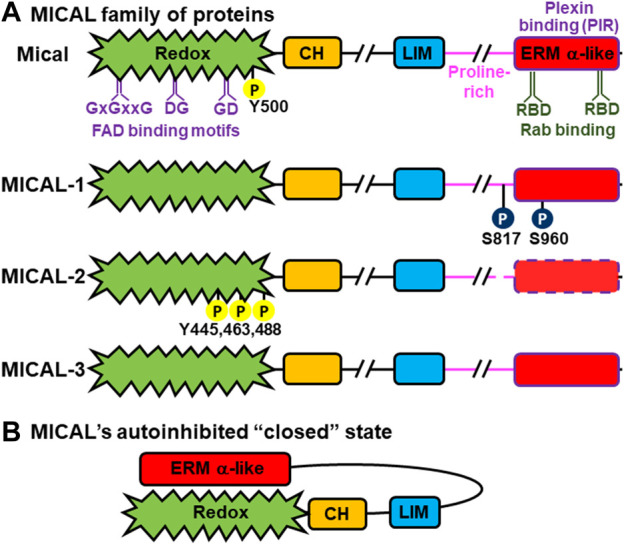
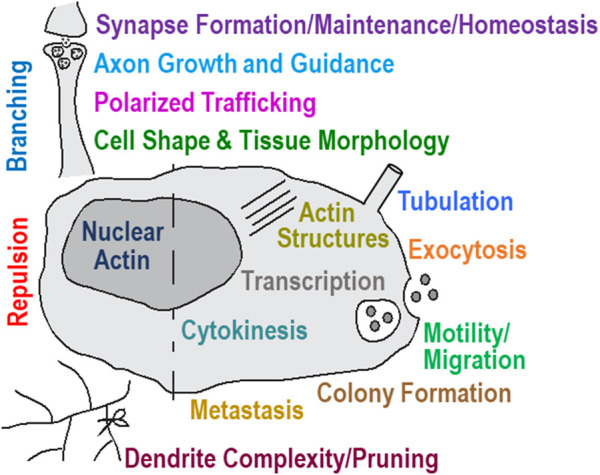
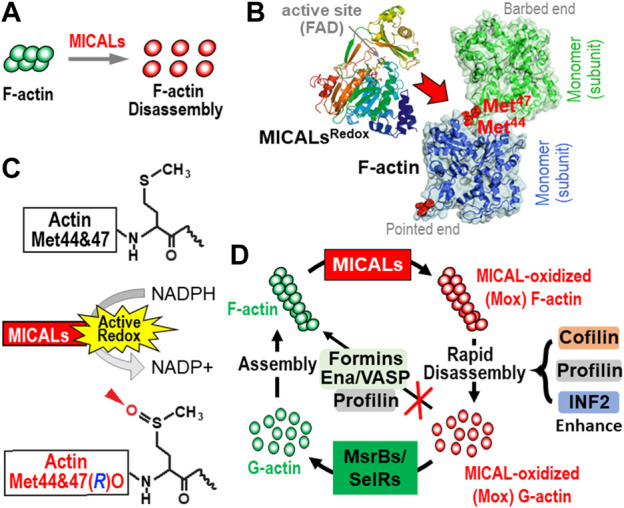
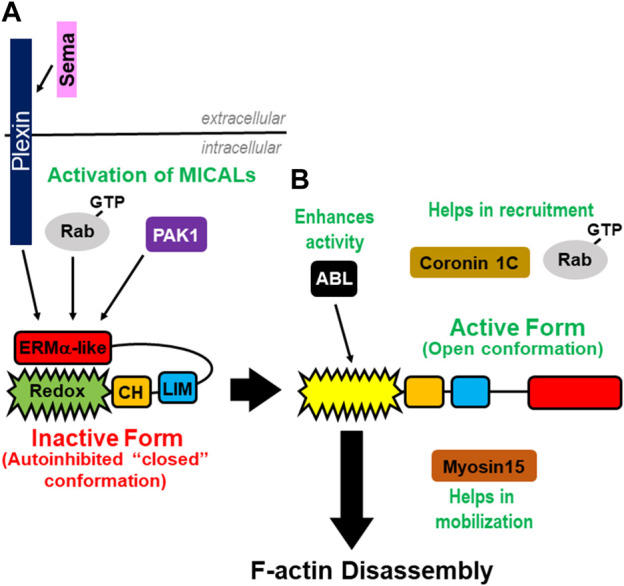
Actin and its dynamic structural remodelings are involved in multiple cellular functions, including maintaining cell shape and integrity, cytokinesis, motility, navigation, and muscle contraction. Many actin-binding proteins regulate the cytoskeleton to facilitate these functions. Recently, actin's post-translational modifications (PTMs) and their importance to actin functions have gained increasing recognition. The MICAL family of proteins has emerged as important actin regulatory oxidation-reduction (Redox) enzymes, influencing actin's properties both and . MICALs specifically bind to actin filaments and selectively oxidize actin's methionine residues 44 and 47, which perturbs filaments' structure and leads to their disassembly. This review provides an overview of the MICALs and the impact of MICAL-mediated oxidation on actin's properties, including its assembly and disassembly, effects on other actin-binding proteins, and on cells and tissue systems.
肌动蛋白及其动态结构重塑参与多种细胞功能,包括维持细胞形状和完整性、胞质分裂、运动、导航和肌肉收缩。许多肌动蛋白结合蛋白调节细胞骨架以促进这些功能。最近,肌动蛋白的翻译后修饰(PTM)及其对肌动蛋白功能的重要性越来越受到认可。MICAL蛋白家族已成为重要的肌动蛋白调节氧化还原酶,在体内和体外都影响肌动蛋白的特性。MICALs特异性结合肌动蛋白丝并选择性氧化肌动蛋白的44位和47位甲硫氨酸残基,这会扰乱丝的结构并导致其解聚。本文综述了MICALs以及MICAL介导的氧化对肌动蛋白特性的影响,包括其组装和解聚、对其他肌动蛋白结合蛋白的影响以及对细胞和组织系统的影响。