Mirelman Anat, Bernad-Elazari Hagar, Thaler Avner, Giladi-Yacobi Eytan, Gurevich Tanya, Gana-Weisz Mali, Saunders-Pullman Rachel, Raymond Deborah, Doan Nancy, Bressman Susan B, Marder Karen S, Alcalay Roy N, Rao Ashwini K, Berg Daniela, Brockmann Kathrin, Aasly Jan, Waro Bjørg Johanne, Tolosa Eduardo, Vilas Dolores, Pont-Sunyer Claustre, Orr-Urtreger Avi, Hausdorff Jeffrey M, Giladi Nir
Laboratory for Early Markers of Neurodegeneration, Tel Aviv Medical Center, Tel Aviv, Israel.
Sackler School of Medicine, Tel Aviv University, Tel Aviv, Israel.
Mov Disord. 2016 Oct;31(10):1527-1534. doi: 10.1002/mds.26720.
Reduced arm swing is a well-known clinical feature of Parkinson's disease (PD), often observed early in the course of the disease. We hypothesized that subtle changes in arm swing and axial rotation may also be detectable in the prodromal phase.
The purpose of this study was to evaluate the relationship between the LRRK2-G2019S mutation, arm swing, and axial rotation in healthy nonmanifesting carriers and noncarriers of the G2019S mutation and in patients with PD.
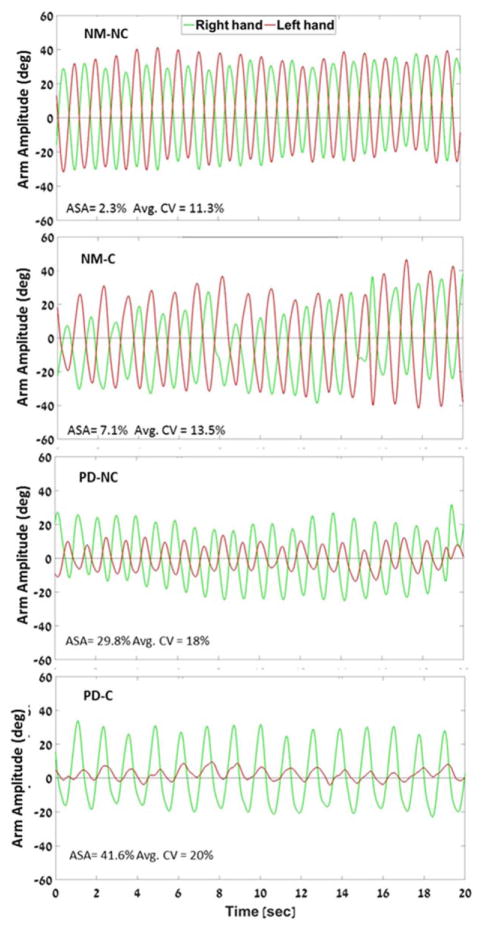
A total of 380 participants (186 healthy nonmanifesting controls and 194 PD patients) from 6 clinical sites underwent gait analysis while wearing synchronized 3-axis body-fixed sensors on the lower back and bilateral wrists. Participants walked for 1 minute under the following 2 conditions: (1) usual walking and (2) dual-task walking. Arm swing amplitudes, asymmetry, variability, and smoothness were calculated for both arms along with measures of axial rotation.
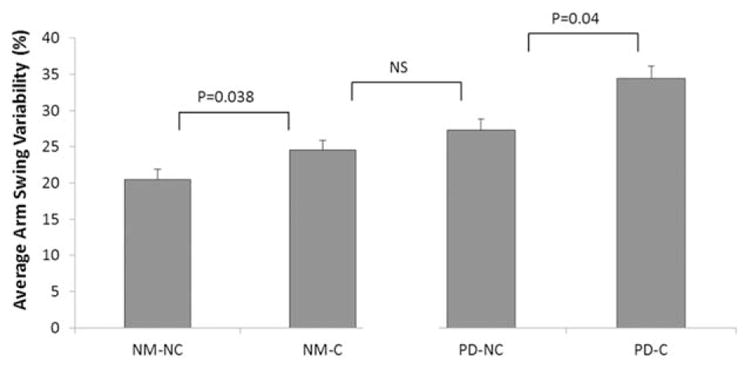
A total of 122 nonmanifesting participants and 67 PD patients were carriers of the G2019S mutation. Nonmanifesting mutation carriers walked with greater arm swing asymmetry and variability and lower axial rotation smoothness under the dual task condition when compared with noncarriers (P < .04). In the nonmanifesting mutation carriers, arm swing asymmetry was associated with gait variability under dual task (P = .003). PD carriers showed greater asymmetry and variability of movement than PD noncarriers, even after controlling for disease severity (P < .009).
The G2019S mutation is associated with increased asymmetry and variability among nonmanifesting participants and patients with PD. Prospective studies should determine if arm swing asymmetry and axial rotation smoothness may be used as motor markers of prodromal PD. © 2016 International Parkinson and Movement Disorder Society.
手臂摆动减少是帕金森病(PD)的一个众所周知的临床特征,常在疾病病程早期出现。我们推测在前驱期也可检测到手臂摆动和轴向旋转的细微变化。
本研究旨在评估LRRK2 - G2019S突变、手臂摆动和轴向旋转在健康的G2019S突变非显性携带者和非携带者以及PD患者之间的关系。
来自6个临床地点的380名参与者(186名健康非显性对照者和194名PD患者)在腰部和双侧手腕佩戴同步的三轴身体固定传感器时进行步态分析。参与者在以下两种条件下行走1分钟:(1)正常行走和(2)双任务行走。计算双臂的手臂摆动幅度、不对称性、变异性和平滑度以及轴向旋转的测量值。
共有122名非显性参与者和67名PD患者为G2019S突变携带者。与非携带者相比,非显性突变携带者在双任务条件下行走时手臂摆动不对称性和变异性更大,轴向旋转平滑度更低(P < 0.04)。在非显性突变携带者中,手臂摆动不对称性与双任务下的步态变异性相关(P = 0.003)。即使在控制疾病严重程度后,PD携带者的运动不对称性和变异性仍高于PD非携带者(P < 0.009)。
G2019S突变与非显性参与者和PD患者的不对称性和变异性增加有关。前瞻性研究应确定手臂摆动不对称性和轴向旋转平滑度是否可作为前驱期PD的运动标志物。© 2016国际帕金森和运动障碍协会。