Snezhkina Anastasiya V, Krasnov George S, Lipatova Anastasiya V, Sadritdinova Asiya F, Kardymon Olga L, Fedorova Maria S, Melnikova Nataliya V, Stepanov Oleg A, Zaretsky Andrew R, Kaprin Andrey D, Alekseev Boris Y, Dmitriev Alexey A, Kudryavtseva Anna V
Engelhardt Institute of Molecular Biology, Russian Academy of Sciences, Moscow 119991, Russia.
Engelhardt Institute of Molecular Biology, Russian Academy of Sciences, Moscow 119991, Russia; Orekhovich Institute of Biomedical Chemistry, Russian Academy of Medical Sciences, Moscow 119121, Russia.
Oxid Med Cell Longev. 2016;2016:2353560. doi: 10.1155/2016/2353560. Epub 2016 Jun 28.
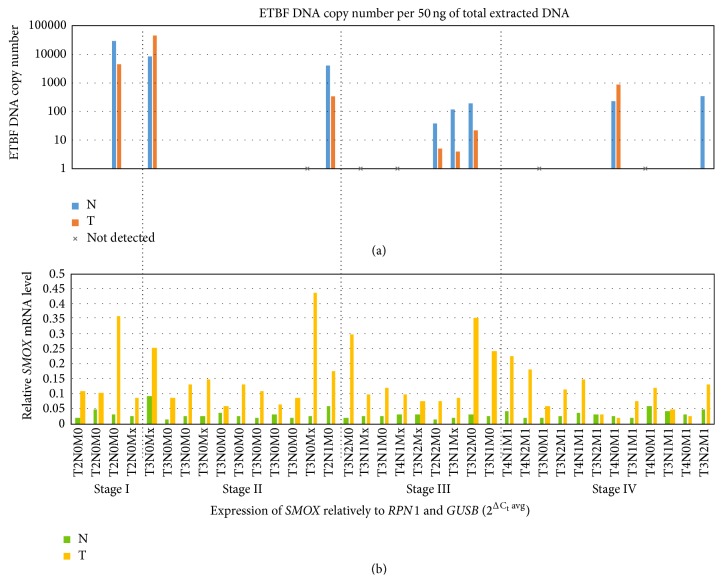
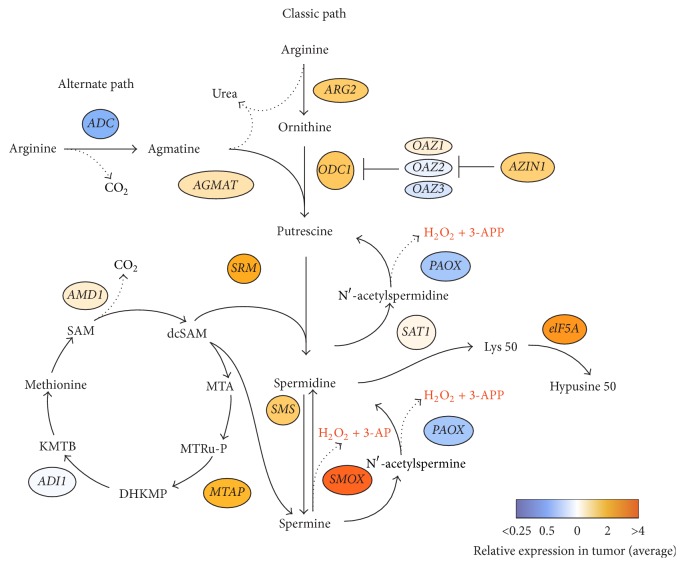
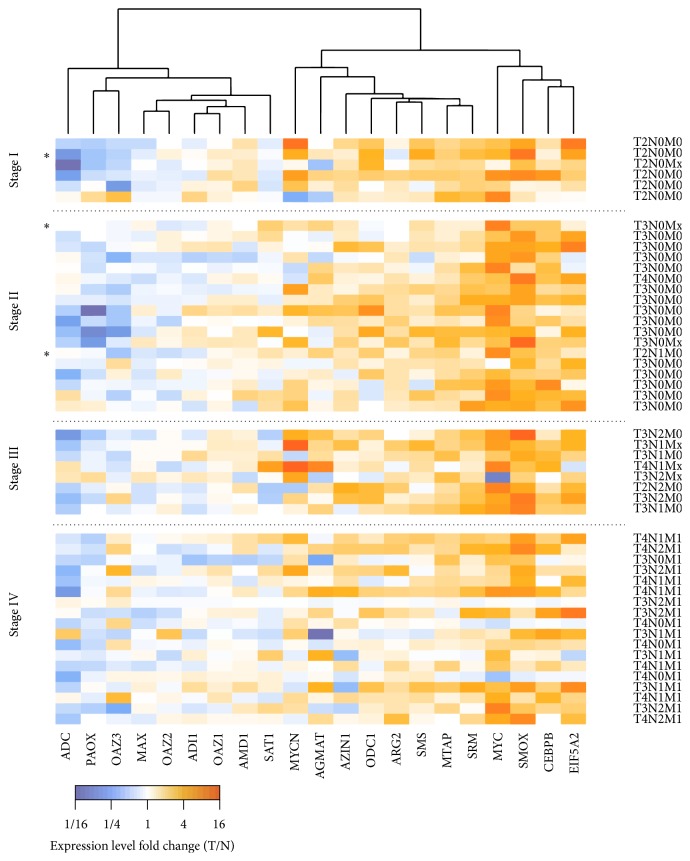
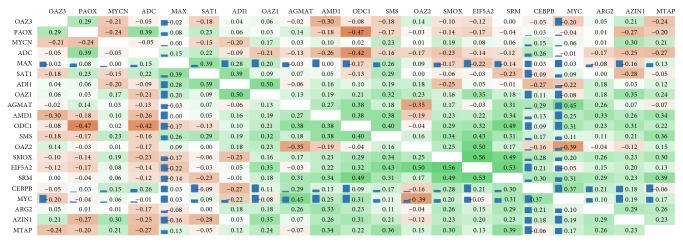
Colorectal cancer is one of the most common cancers in the world. It is well known that the chronic inflammation can promote the progression of colorectal cancer (CRC). Recently, a number of studies revealed a potential association between colorectal inflammation, cancer progression, and infection caused by enterotoxigenic Bacteroides fragilis (ETBF). Bacterial enterotoxin activates spermine oxidase (SMO), which produces spermidine and H2O2 as byproducts of polyamine catabolism, which, in turn, enhances inflammation and tissue injury. Using qPCR analysis, we estimated the expression of SMOX gene and ETBF colonization in CRC patients. We found no statistically significant associations between them. Then we selected genes involved in polyamine metabolism, metabolic reprogramming, and inflammation regulation and estimated their expression in CRC. We observed overexpression of SMOX, ODC1, SRM, SMS, MTAP, c-Myc, C/EBPβ (CREBP), and other genes. We found that two mediators of metabolic reprogramming, inflammation, and cell proliferation c-Myc and C/EBPβ may serve as regulators of polyamine metabolism genes (SMOX, AZIN1, MTAP, SRM, ODC1, AMD1, and AGMAT) as they are overexpressed in tumors, have binding site according to ENCODE ChIP-Seq data, and demonstrate strong coexpression with their targets. Thus, increased polyamine metabolism in CRC could be driven by c-Myc and C/EBPβ rather than ETBF infection.
结直肠癌是世界上最常见的癌症之一。众所周知,慢性炎症会促进结直肠癌(CRC)的进展。最近,一些研究揭示了结直肠炎症、癌症进展与产肠毒素脆弱拟杆菌(ETBF)感染之间的潜在关联。细菌肠毒素激活精胺氧化酶(SMO),其产生亚精胺和H2O2作为多胺分解代谢的副产物,进而加剧炎症和组织损伤。我们使用qPCR分析估计了CRC患者中SMOX基因的表达和ETBF定植情况。我们发现它们之间没有统计学上的显著关联。然后我们选择了参与多胺代谢、代谢重编程和炎症调节的基因,并估计了它们在CRC中的表达。我们观察到SMOX、ODC1、SRM、SMS、MTAP、c-Myc、C/EBPβ(CREBP)和其他基因的过表达。我们发现代谢重编程、炎症和细胞增殖的两个介质c-Myc和C/EBPβ可能作为多胺代谢基因(SMOX、AZIN1、MTAP、SRM、ODC1、AMD1和AGMAT)的调节因子,因为它们在肿瘤中过表达,根据ENCODE ChIP-Seq数据有结合位点,并与其靶标表现出强共表达。因此,CRC中多胺代谢的增加可能是由c-Myc和C/EBPβ驱动的,而不是由ETBF感染驱动的。