Park Sun Hee, Kim Woo Joo, Yoo Jin-Hong, Choi Jung-Hyun
Division of Infectious Diseases, Department of Internal Medicine, College of Medicine, The Catholic University of Korea, Seoul, Korea.
Division of Infectious Diseases, Department of Internal Medicine, Guro Hospital, Korea University College of Medicine, Seoul, Korea.
Infect Chemother. 2016 Jun;48(2):108-17. doi: 10.3947/ic.2016.48.2.108. Epub 2016 Jun 30.
Epidemiologic parameters are important in planning infection control policies during the outbreak of emerging infections. Korea experienced an outbreak of Middle East Respiratory Syndrome coronavirus (MERS-CoV) infection in 2015, which was characterized by superspreading events in healthcare settings. We aimed to estimate the epidemiologic parameters over time during the outbreak to assess the effectiveness of countermeasures.
Publicly available data pertaining to the MERS outbreak in Korea were collected. We estimated the incubation periods of 162 cases whose sources of exposure were identified and the temporal trend was evaluated. Factors influencing incubation duration were analyzed. The generational reproduction number (Rg ) and case reproduction number (R(c) ) were estimated over time.
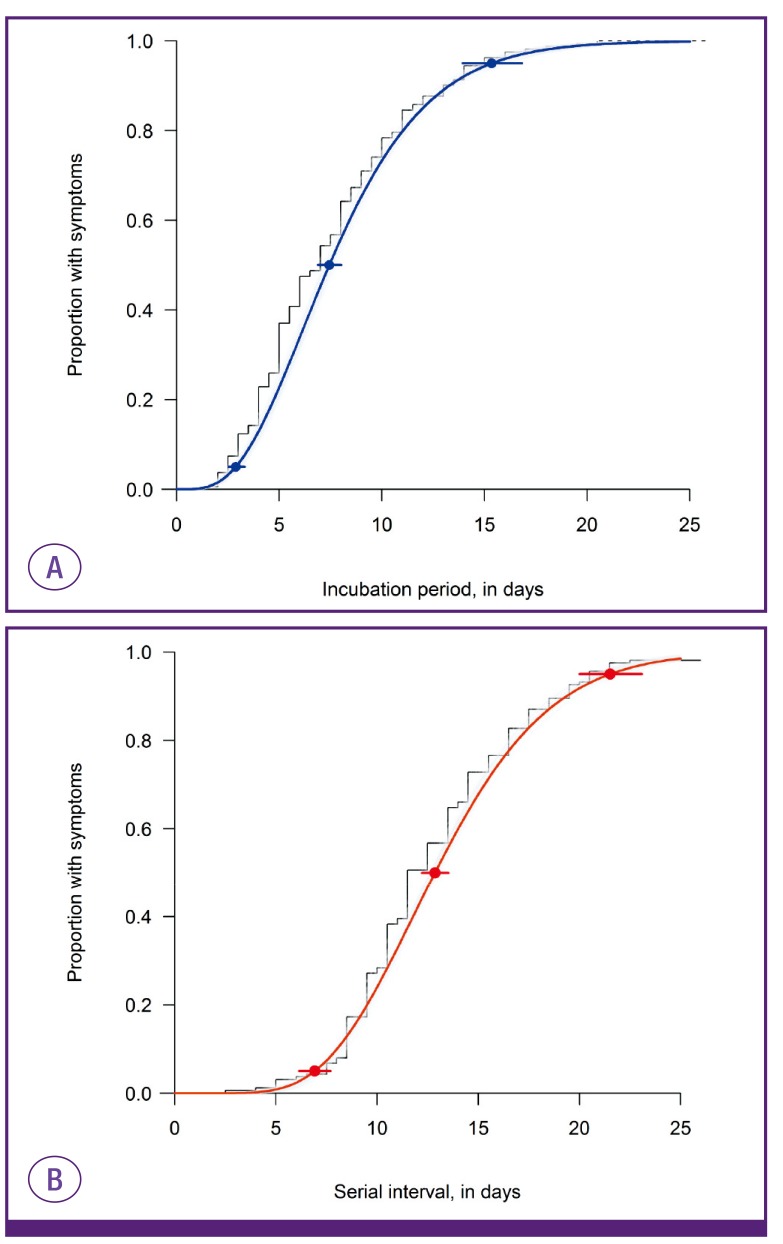
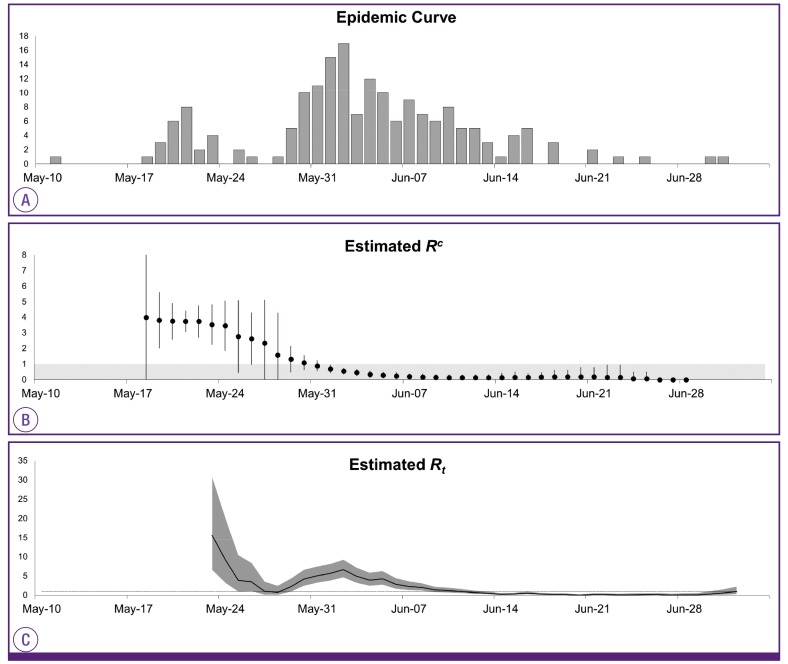
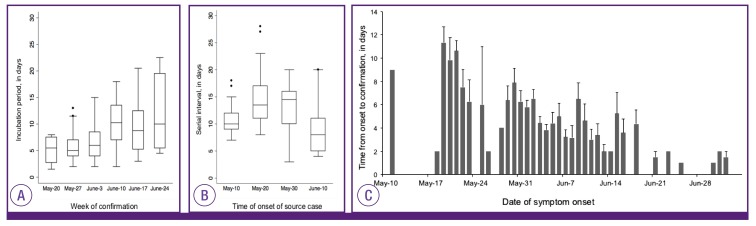
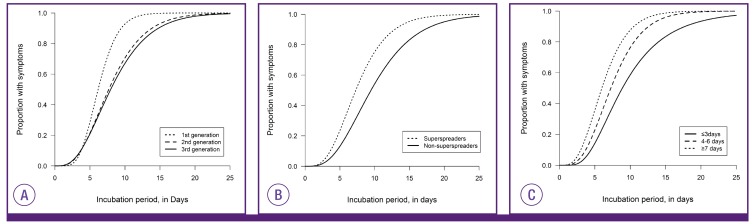
The estimated median incubation period was 7.4 days (95% CI, 6.9-8.0). Median incubation periods tended to be longer over time as the disease generation progressed: 6.16 days (95% CI, 5.38-6.97), 7.68 days (95% CI, 7.04-8.44), and 7.95 days (95% CI, 6.25-9.88) in the first, second, and third generations, respectively. The number of days of illness in the source cases at the time of exposure inversely correlated with the incubation periods in the receiving cases (HR 0.91 [95% CI, 0.84-0.99] per one illness day increase; P=0.026). This relationship was consistent (HR 0.83 [95% CI, 0.74-0.93] per one illness day increase) in the multivariable analysis incorporating clinical characteristics, the order of generation, and a link to superspreaders. Because the third generation cases were exposed to their source cases in the early stage (median one day) compared to the second generation cases (median 6 days), the temporal trend of incubation periods appears to be influenced by early isolation of symptomatic cases and reduction of potential exposure to source cases in the later stage. Rg declined rapidly from 28 to 0.23 in two generations. R(c) dropped below the epidemic threshold at one on May 31, 2015, which approximately coincided with the initiation of the stringent countermeasures.
Despite the initial delay, the stringent countermeasures targeted towards second generation cases appeared to effectively contain the MERS outbreak in Korea as suggested by the decline of R(c) shortly after implementation. Except for superspreading events, the transmission potential for MERS-CoV seems to be low. Further research should be focused on characterizing superspreaders in comparison to non-transmitting cases with regard to environmental, behavioral, and virologic and host genetic factors in order to better prepare for future outbreaks of MERS-CoV.
在新发传染病暴发期间,流行病学参数对于制定感染控制策略至关重要。韩国在2015年经历了中东呼吸综合征冠状病毒(MERS-CoV)感染的暴发,其特点是在医疗机构中出现了超级传播事件。我们旨在估计暴发期间不同时间的流行病学参数,以评估应对措施的有效性。
收集了韩国MERS疫情的公开可用数据。我们估计了162例暴露源已确定的病例的潜伏期,并评估了时间趋势。分析了影响潜伏期的因素。随时间估计了代际繁殖数(Rg)和病例繁殖数(R(c))。
估计的中位潜伏期为7.4天(95%置信区间,6.9 - 8.0)。随着疾病代际的进展,中位潜伏期随时间推移有变长的趋势:第一代、第二代和第三代的中位潜伏期分别为6.16天(95%置信区间,5.38 - 6.97)、7.68天(95%置信区间,7.04 - 8.44)和7.95天(95%置信区间,6.25 - 9.88)。暴露时源病例的患病天数与受染病例的潜伏期呈负相关(每增加一天患病时间,风险比为0.91 [95%置信区间,0.84 - 0.99];P = 0.026)。在纳入临床特征、代际顺序和与超级传播者的关联的多变量分析中,这种关系是一致的(每增加一天患病时间,风险比为0.83 [95%置信区间,0.74 - 0.93])。由于第三代病例在早期(中位1天)接触其源病例,而第二代病例为(中位6天),潜伏期的时间趋势似乎受到有症状病例的早期隔离以及后期潜在暴露于源病例减少的影响。Rg在两代中从28迅速降至0.23。R(c)在2015年5月31日降至疫情阈值以下,这大约与严格应对措施的启动时间一致。
尽管初期有延迟,但针对第二代病例的严格应对措施似乎有效地控制了韩国的MERS疫情,实施后不久R(c)下降表明了这一点。除超级传播事件外,MERS-CoV的传播潜力似乎较低。未来的研究应集中于将超级传播者与非传播病例在环境、行为、病毒学和宿主遗传因素方面进行特征对比,以便更好地应对未来的MERS-CoV疫情暴发。