Sieswerda Elske, Font-Gonzalez Anna, Reitsma Johannes B, Dijkgraaf Marcel G W, Heinen Richard C, Jaspers Monique W, van der Pal Helena J, van Leeuwen Flora E, Caron Huib N, Geskus Ronald B, Kremer Leontien C
Department of Pediatric Oncology, Emma Children's Hospital / Academic Medical Center, Amsterdam, the Netherlands.
Julius Center for Health Sciences and Primary Care, University Medical Center, Utrecht, the Netherlands.
PLoS One. 2016 Jul 19;11(7):e0159518. doi: 10.1371/journal.pone.0159518. eCollection 2016.
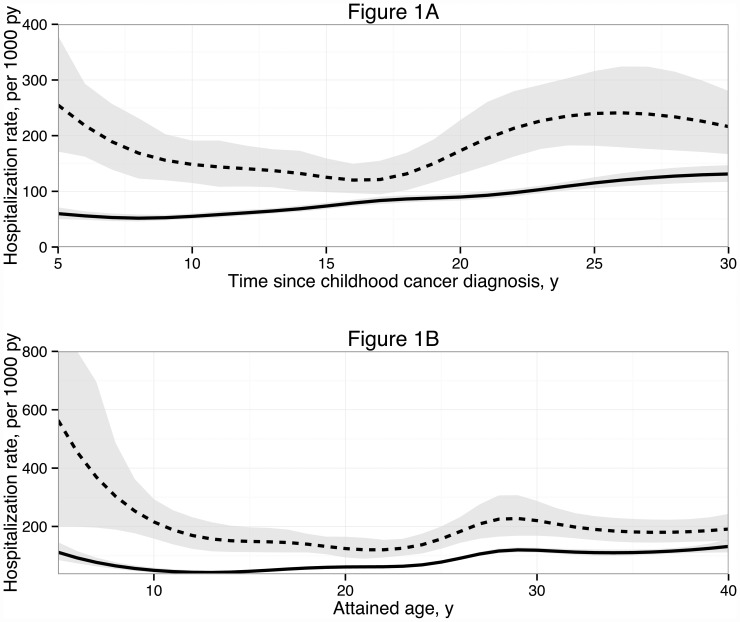
Hospitalization rates over time of childhood cancer survivors (CCS) provide insight into the burden of unfavorable health conditions on CCS and health care resources. The objective of our study was to examine trends in hospitalizations of CCS and risk factors in comparison with the general population. We performed a medical record linkage study of a cohort of 1564 ≥five-year CCS with national registers. We obtained a random sample of the general population matched on year of birth, gender and calendar year per CCS retrieved. We quantified and compared hospitalization rates of CCS and reference persons from 1995 until 2005, and we analyzed risk factors for hospitalization within the CCS cohort with multivariable Poisson models. We retrieved hospitalization information from 1382 CCS and 25583 reference persons. The overall relative hospitalization rate (RHR) was 2.2 (95%CI:1.9-2.5) for CCS compared to reference persons. CCS with central nervous system and solid tumors had highest RHRs. Hospitalization rates in CCS were increased compared to reference persons up to at least 30 years after primary diagnosis, with highest rates 5-10 and 20-30 years after primary cancer. RHRs were highest for hospitalizations due to neoplasms (10.7; 95%CI:7.1-16.3) and endocrine/nutritional/metabolic disorders (7.3; 95%CI:4.6-11.7). Female gender (P<0.001), radiotherapy to head and/or neck (P<0.001) or thorax and/or abdomen (P = 0.03) and surgery (P = 0.01) were associated with higher hospitalization rates in CCS. In conclusion, CCS have increased hospitalization rates compared to the general population, up to at least 30 years after primary cancer treatment. These findings imply a high and long-term burden of unfavorable health conditions after childhood cancer on survivors and health care resources.
儿童癌症幸存者(CCS)随时间的住院率有助于深入了解其不良健康状况及医疗资源负担。我们研究的目的是对比儿童癌症幸存者与普通人群的住院趋势及危险因素。我们对1564名年龄≥5岁的儿童癌症幸存者队列与国家登记册进行了病历关联研究。我们获取了按每位儿童癌症幸存者的出生年份、性别和日历年份匹配的普通人群随机样本。我们对1995年至2005年期间儿童癌症幸存者和对照人群的住院率进行了量化和比较,并使用多变量泊松模型分析了儿童癌症幸存者队列中的住院危险因素。我们获取了1382名儿童癌症幸存者和25583名对照人群的住院信息。与对照人群相比,儿童癌症幸存者的总体相对住院率(RHR)为2.2(95%CI:1.9 - 2.5)。患有中枢神经系统肿瘤和实体瘤的儿童癌症幸存者的相对住院率最高。与对照人群相比,儿童癌症幸存者在初次诊断后至少30年内的住院率都有所上升,在初次患癌后5 - 10年和20 - 30年时住院率最高。因肿瘤(10.7;95%CI:7.1 - 16.3)以及内分泌/营养/代谢紊乱(7.3;95%CI:4.6 - 11.7)导致的住院,其相对住院率最高。女性(P<0.001)、头部和/或颈部放疗(P<0.001)或胸部和/或腹部放疗(P = 0.03)以及手术(P = 0.01)与儿童癌症幸存者较高的住院率相关。总之,与普通人群相比,儿童癌症幸存者在初次癌症治疗后至少30年内的住院率都有所上升。这些发现表明儿童癌症后不良健康状况给幸存者和医疗资源带来了长期的沉重负担。