School of Biological Sciences, University of Adelaide, Adelaide, South Australia 5005, Australia.
Department of Biogeography and Global Change, National Museum of Natural Sciences-Spanish Research Council (CSIC), c/José Gutiérrez Abascal 2, 28006 Madrid, Spain.
Sci Data. 2016 Jul 19;3:160053. doi: 10.1038/sdata.2016.53.
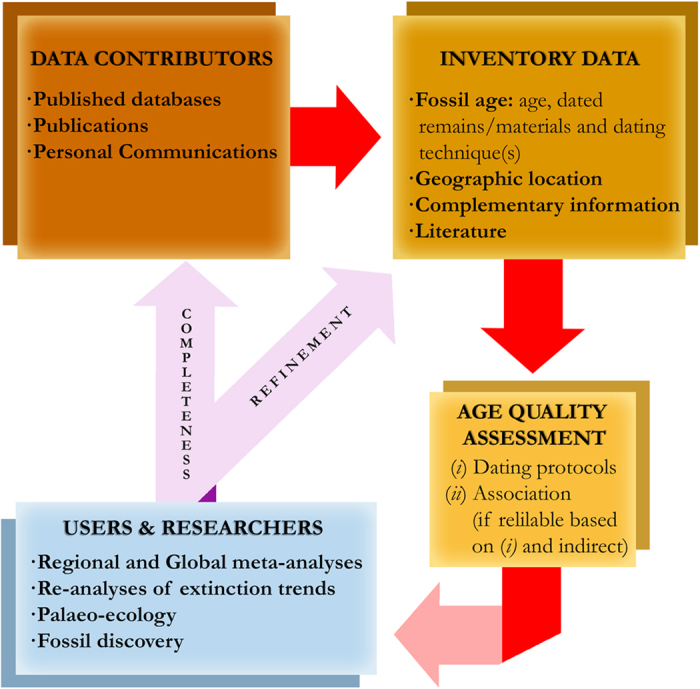
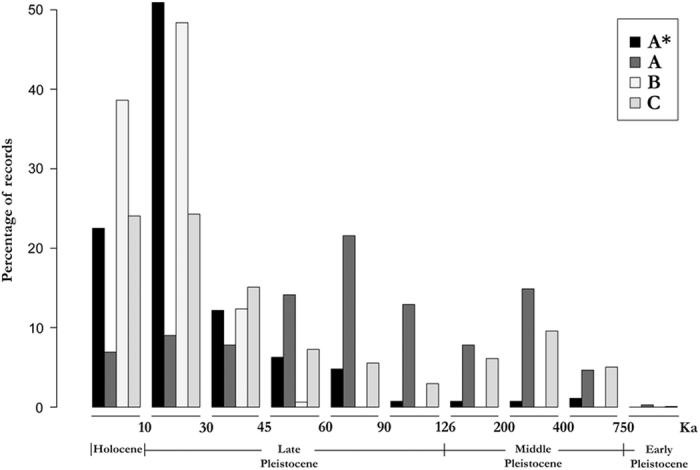
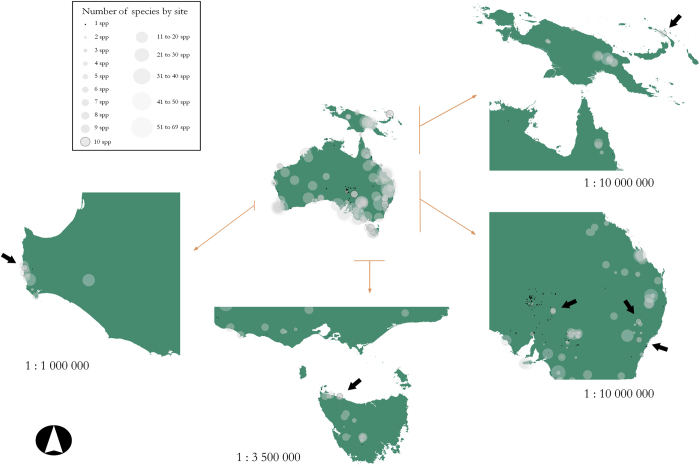
The study of palaeo-chronologies using fossil data provides evidence for past ecological and evolutionary processes, and is therefore useful for predicting patterns and impacts of future environmental change. However, the robustness of inferences made from fossil ages relies heavily on both the quantity and quality of available data. We compiled Quaternary non-human vertebrate fossil ages from Sahul published up to 2013. This, the FosSahul database, includes 9,302 fossil records from 363 deposits, for a total of 478 species within 215 genera, of which 27 are from extinct and extant megafaunal species (2,559 records). We also provide a rating of reliability of individual absolute age based on the dating protocols and association between the dated materials and the fossil remains. Our proposed rating system identified 2,422 records with high-quality ages (i.e., a reduction of 74%). There are many applications of the database, including disentangling the confounding influences of hypothetical extinction drivers, better spatial distribution estimates of species relative to palaeo-climates, and potentially identifying new areas for fossil discovery.
使用化石数据研究古年代学为过去的生态和进化过程提供了证据,因此有助于预测未来环境变化的模式和影响。然而,从化石年龄中得出的推论的可靠性在很大程度上取决于可用数据的数量和质量。我们汇编了截至 2013 年在沙乌发表的第四纪非人类脊椎动物化石年龄。这个名为 FosSahul 的数据库包含了 363 个沉积物中的 9302 个化石记录,共有 215 属 478 种,其中 27 种来自已灭绝和现存的巨型动物物种(2559 个记录)。我们还根据定年协议和定年材料与化石遗骸之间的关系,对单个绝对年龄的可靠性进行了评分。我们提出的评分系统确定了 2422 个具有高质量年龄的记录(即减少了 74%)。该数据库有许多应用,包括厘清假设灭绝驱动因素的复杂影响、更好地估计相对于古气候的物种的空间分布,以及可能确定新的化石发现区域。