Warkentin Sarah, Mais Laís Amaral, Latorre Maria do Rosário Dias de Oliveira, Carnell Susan, Taddei José Augusto de Aguiar Carrazedo
Department of Pediatrics, Discipline of Nutrology, Federal University of São Paulo (UNIFESP), Rua Loefgreen, 1647, CEP: 04040-032, São Paulo, SP, Brazil.
Department of Epidemiology, University of São Paulo (USP), School of Public Health, São Paulo, SP, Brazil.
BMC Public Health. 2016 Jul 19;16:603. doi: 10.1186/s12889-016-3282-8.
Recent national surveys in Brazil have demonstrated a decrease in the consumption of traditional food and a parallel increase in the consumption of ultra-processed food, which has contributed to a rise in obesity prevalence in all age groups. Environmental factors, especially familial factors, have a strong influence on the food intake of preschool children, and this has led to the development of psychometric scales to measure parents' feeding practices. The aim of this study was to test the validity of a translated and adapted Comprehensive Feeding Practices Questionnaire in a sample of Brazilian preschool-aged children enrolled in private schools.
A transcultural adaptation process was performed in order to develop a modified questionnaire (43 items). After piloting, the questionnaire was sent to parents, along with additional questions about family characteristics. Test-retest reliability was assessed in one of the schools. Factor analysis with oblique rotation was performed. Internal reliability was tested using Cronbach's alpha and correlations between factors, discriminant validity using marker variables of child's food intake, and convergent validity via correlations with parental perceptions of perceived responsibility for feeding and concern about the child's weight were also performed.
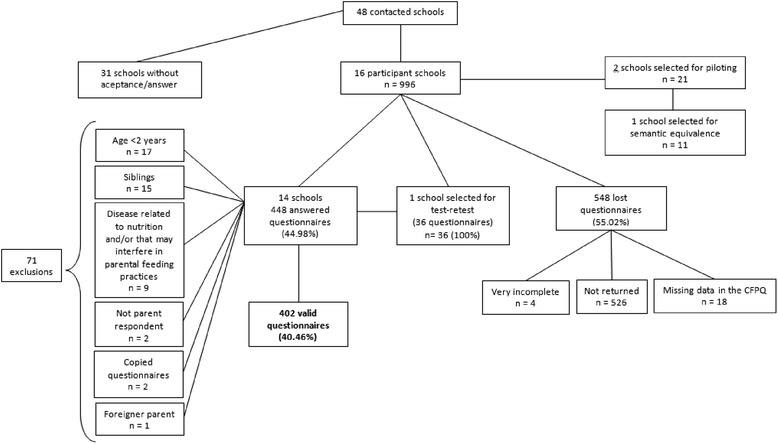
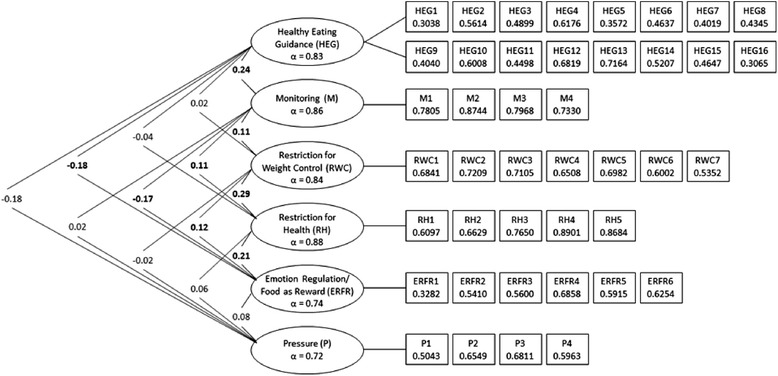
The final sample consisted of 402 preschool children. Factor analysis resulted in a final questionnaire of 43 items distributed over 6 factors. Cronbach alpha values were adequate (0.74 to 0.88), between-factor correlations were low, and discriminant validity and convergent validity were acceptable.
The modified CFPQ demonstrated significant internal reliability in this urban Brazilian sample. Scale validation within different cultures is essential for a more comprehensive understanding of parental feeding practices for preschoolers.
巴西近期的全国性调查表明,传统食品的消费量有所下降,而超加工食品的消费量则相应增加,这导致了各年龄组肥胖患病率的上升。环境因素,尤其是家庭因素,对学龄前儿童的食物摄入量有很大影响,这促使人们开发了心理测量量表来衡量父母的喂养行为。本研究的目的是在一所私立学校就读的巴西学龄前儿童样本中,检验一份翻译并改编后的综合喂养行为问卷的有效性。
进行了跨文化适应过程,以开发一份修改后的问卷(43个项目)。在预试验之后,问卷被发送给家长,同时还包括关于家庭特征的其他问题。在其中一所学校评估了重测信度。进行了斜交旋转的因子分析。使用克朗巴哈系数检验内部信度,通过儿童食物摄入量的标记变量检验区分效度,并通过与父母对喂养责任的感知以及对孩子体重的关注之间的相关性检验聚合效度。
最终样本包括402名学龄前儿童。因子分析得出一份最终问卷,包含43个项目,分布在6个因子上。克朗巴哈系数值合适(0.74至0.88),因子间相关性较低,区分效度和聚合效度均可接受。
修改后的CFPQ在这个巴西城市样本中显示出显著的内部信度。在不同文化中进行量表验证对于更全面地了解学龄前儿童父母的喂养行为至关重要。