Chanchal Sanjay K, Mahajan Umesh B, Siddharth Sumit, Reddy Navyya, Goyal Sameer N, Patil Prakash H, Bommanahalli Basavaraj P, Kundu Chanakya N, Patil Chandragouda R, Ojha Shreesh
Department of Pharmacology, R. C. Patel Institute of Pharmaceutical Education and Research, Shirpur, Dist-Dhule-425405, Maharashtra, India.
Department of Pathology, Gadag Institute of Medical Sciences, Bommanahalli, Gadag-582101, Karnataka, India.
Sci Rep. 2016 Jul 20;6:30007. doi: 10.1038/srep30007.
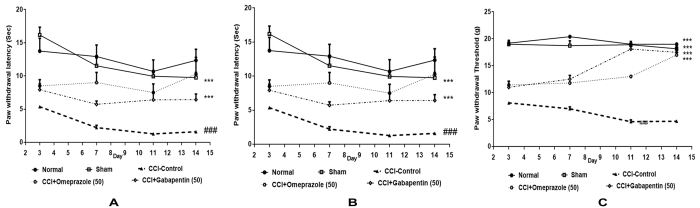
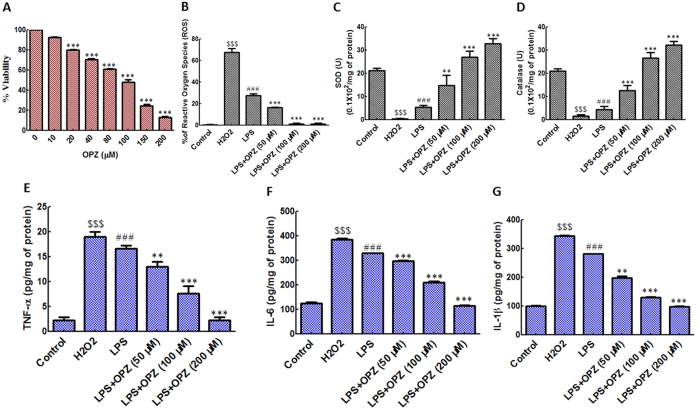
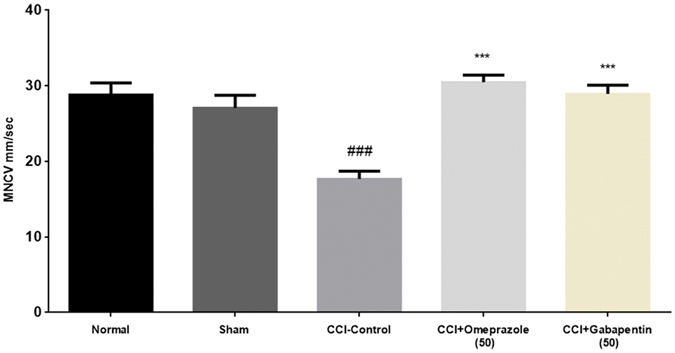
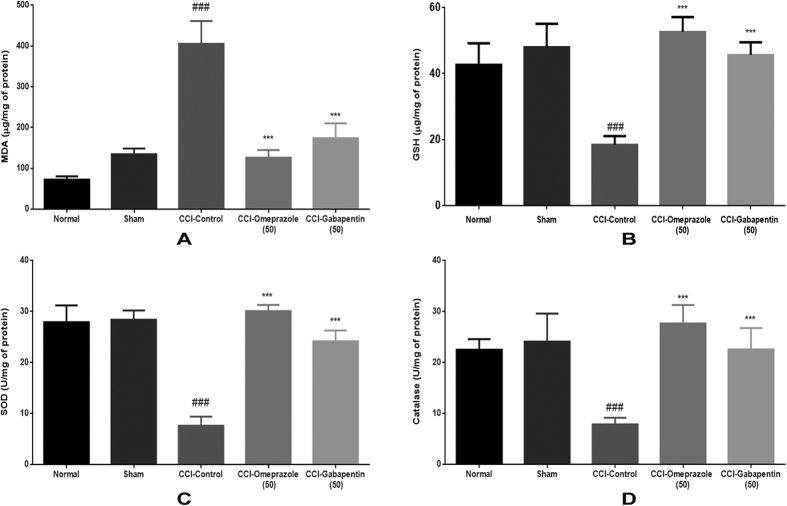
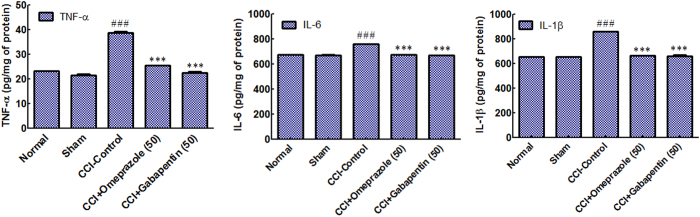
Apart from reducing the acid secretion, omeprazole inhibits activation of the nuclear factor-κB, release of inflammatory cytokines, and chemotaxis of neutrophils. These mechanisms prompted us to evaluate antineuropathic effect of omeprazole in the chronic constriction injury (CCI)-induced rat model of neuropathic pain and LPS mediated ROS-induced U-87 cells. Omeprazole at 50 mg/kg/day/oral for 14 days significantly reduced the intensity of neuropathic pain estimated as paw withdrawal latency, withdrawal pressure threshold and restored the motor nerve conduction velocity in the constricted nerve, when compared with respective groups. The histological findings revealed the protective effect of omeprazole against the CCI-induced damage. Omeprazole significantly decreased the levels of tumor necrosis factor (TNF-α), interleukin-1β (IL-1β) and interleukin-6 (IL-6) as compared to their respective control groups. It also reduced the oxidative stress by up regulating the SOD, catalase activity and decreasing MDA content. Similarly, in-vitro study, LPS mediated ROS-induced U-87 cells, omeprazole reduced the oxidative stress as well as the release of TNF-α, IL-1β and IL-6. Altogether, these results suggest that, neuroprotective effect of omeprazole is mediated through preventing release of proinflammatory cytokines, augmenting endogenous anti-oxidant defense system, and maintain the structural integrity of sciatic nerve from the CCI-induced structural damage and inflammatory changes.
除了减少胃酸分泌外,奥美拉唑还可抑制核因子-κB的激活、炎性细胞因子的释放以及中性粒细胞的趋化作用。这些机制促使我们评估奥美拉唑在慢性缩窄性损伤(CCI)诱导的神经性疼痛大鼠模型和脂多糖介导的活性氧诱导的U-87细胞中的抗神经病理性作用。与各相应组相比,奥美拉唑以50mg/kg/天的剂量口服给药14天,可显著降低以爪部退缩潜伏期、退缩压力阈值评估的神经性疼痛强度,并恢复受压迫神经的运动神经传导速度。组织学结果显示奥美拉唑对CCI诱导的损伤具有保护作用。与各自的对照组相比,奥美拉唑显著降低了肿瘤坏死因子(TNF-α)、白细胞介素-1β(IL-1β)和白细胞介素-6(IL-6)的水平。它还通过上调超氧化物歧化酶(SOD)、过氧化氢酶活性并降低丙二醛(MDA)含量来减轻氧化应激。同样,在体外研究中,在脂多糖介导的活性氧诱导的U-87细胞中,奥美拉唑也减轻了氧化应激以及TNF-α、IL-1β和IL-6的释放。总之,这些结果表明,奥美拉唑的神经保护作用是通过阻止促炎细胞因子的释放、增强内源性抗氧化防御系统以及维持坐骨神经免受CCI诱导的结构损伤和炎症变化来介导的。