Institut für Theoretische Physik, Lehrstuhl IV: Weltraum- &Astrophysik, Ruhr-Universität, Bochum, Germany.
Institute of Optics and Quantum Electronics, University of Jena, Germany.
Sci Rep. 2016 Jul 20;6:29402. doi: 10.1038/srep29402.
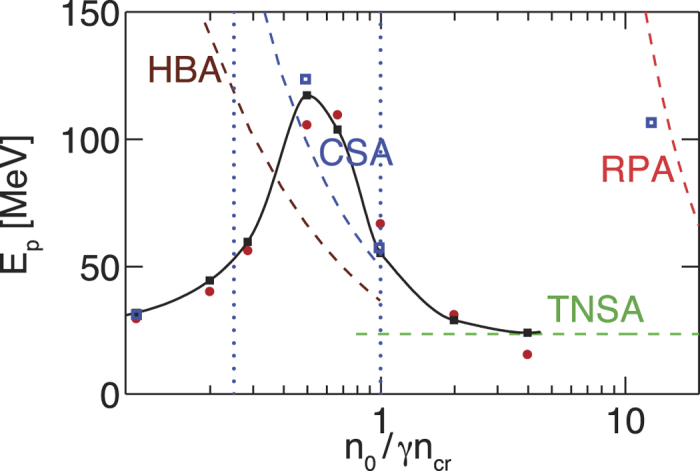
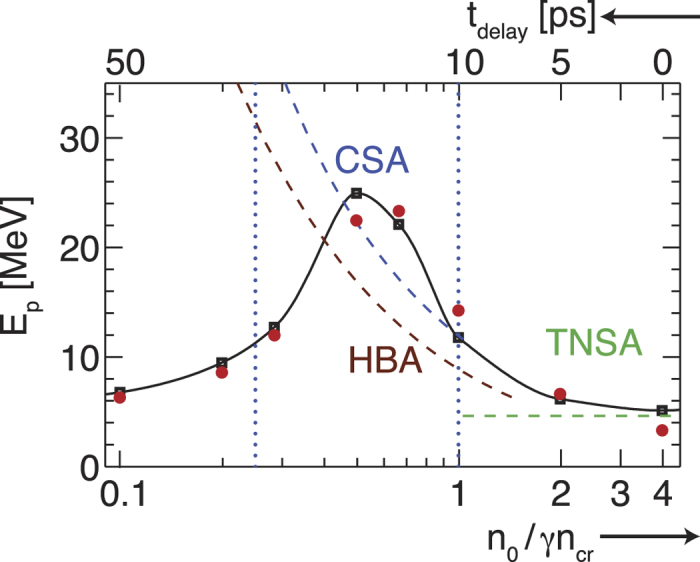
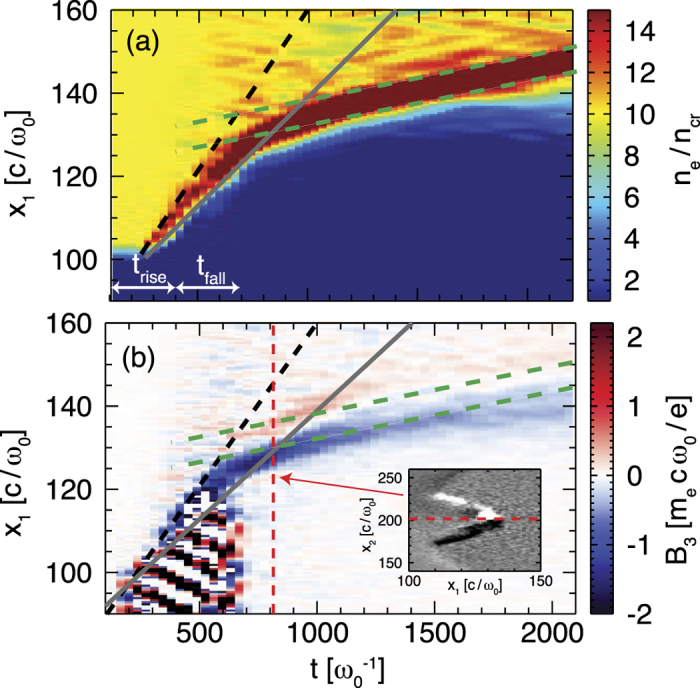
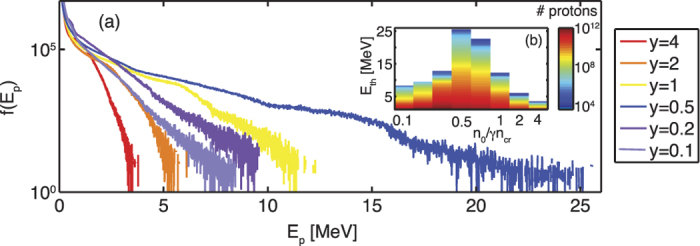
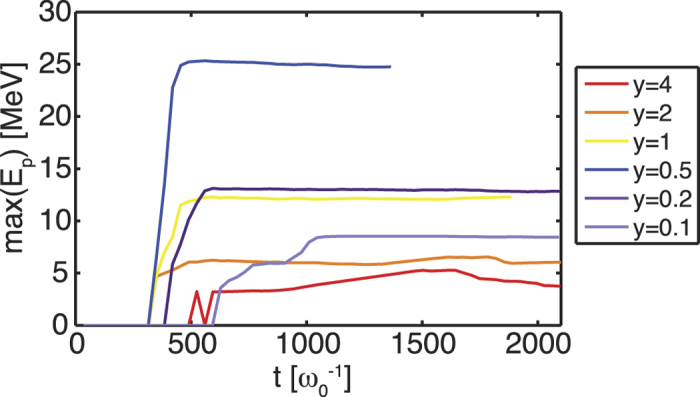
We demonstrate how to tune the main ion acceleration mechanism in laser-plasma interactions to collisionless shock acceleration, thus achieving control over the final ion beam properties (e. g. maximum energy, divergence, number of accelerated ions). We investigate this technique with three-dimensional particle-in-cell simulations and illustrate a possible experimental realisation. The setup consists of an isolated solid density target, which is preheated by a first laser pulse to initiate target expansion, and a second one to trigger acceleration. The timing between the two laser pulses allows to access all ion acceleration regimes, ranging from target normal sheath acceleration, to hole boring and collisionless shock acceleration. We further demonstrate that the most energetic ions are produced by collisionless shock acceleration, if the target density is near-critical, ne ≈ 0.5 ncr. A scaling of the laser power shows that 100 MeV protons may be achieved in the PW range.
我们展示了如何调整激光-等离子体相互作用中的主要离子加速机制,使其变为无碰撞激波加速,从而实现对最终离子束特性(例如最大能量、发散度、加速离子数量)的控制。我们使用三维粒子模拟研究了这种技术,并说明了一种可能的实验实现方式。该设置由一个孤立的固体密度靶组成,首先用第一束激光脉冲预热以启动靶的膨胀,然后用第二束激光脉冲触发加速。两束激光脉冲之间的时间间隔允许访问所有的离子加速模式,范围从靶法线鞘加速到孔钻取和无碰撞激波加速。我们进一步证明,如果目标密度接近临界密度 ne ≈ 0.5 ncr,则通过无碰撞激波加速可以产生能量最高的离子。激光功率的标度表明,在 PW 范围内可以实现 100 MeV 的质子。