Landsberg Adina, Kerr Thomas, Milloy Michael-John, Dong Huiru, Nguyen Paul, Wood Evan, Hayashi Kanna
British Columbia Centre for Excellence in HIV/AIDS, St. Paul's Hospital, Vancouver, BC, Canada.
Faculty of Health Sciences, McMaster University, Hamilton, ON, Canada.
J Int AIDS Soc. 2016 Jul 18;19(4 Suppl 3):20729. doi: 10.7448/IAS.19.4.20729. eCollection 2016.
In 2006, the Vancouver Police Department (VPD) developed an organization-wide drug policy approach, which included endorsing harm reduction strategies for people who inject drugs (PWID). We sought to examine rates of potentially harmful policing exposures and associated HIV risk behaviour among PWID in Vancouver, Canada before and after the VPD policy change.
Data were derived from two prospective cohort studies of PWID. Multivariable generalized estimating equation models were used to examine changes in the risk of confiscation of drug use paraphernalia and physical violence by the police, as well as changes in the relationship between exposures to the two policing practices and sharing of drug use paraphernalia, before and after the policy change.
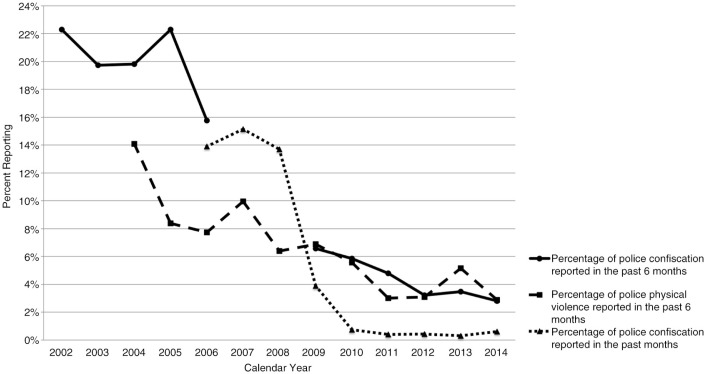
Among 2193 participants, including 757 (34.5%) women, the rates of experiencing police confiscation of drug use paraphernalia declined from 22.3% in 2002 to 2.8% in 2014, and the rates of reporting experiencing physical violence by the police also declined from 14.1% in 2004 to 2.9% in 2014. In multivariable analyses, the post-policy change period remained independently and negatively associated with reports of confiscation of drug use paraphernalia (adjusted odds ratio (AOR): 0.25; 95% confidence interval (CI): 0.21 to 0.31) and reported physical violence by the police (AOR: 0.76; 95% CI: 0.63 to 0.91). However, experiencing both confiscation of drug use paraphernalia and physical violence by the police (AOR: 1.92; 95% CI: 1.10 to 3.33) and experiencing only confiscation of drug use paraphernalia (AOR: 1.71; 95% CI: 1.34 to 2.19) remained independently and positively associated with sharing of drug use paraphernalia during the post-policy change period.
In our study, two policing practices known to increase HIV risk among PWID have declined significantly since the local police launched an evidence-based drug policy approach. However, these practices remained independently associated with elevated HIV risk after the post-policy change. Although there remains a continued need to ensure that policing activities do not undermine public health efforts, these findings demonstrate that a major shift towards a public health approach to policing is possible for a municipal police force.
2006年,温哥华警察局(VPD)制定了一项全部门范围的毒品政策方针,其中包括支持针对注射吸毒者(PWID)的减少伤害策略。我们试图调查在温哥华警察局政策变化前后,加拿大温哥华注射吸毒者中潜在有害的治安接触率以及相关的艾滋病毒风险行为。
数据来自两项针对注射吸毒者的前瞻性队列研究。使用多变量广义估计方程模型来研究警察没收吸毒用具和实施身体暴力风险的变化,以及政策变化前后这两种治安行为接触与吸毒用具共享之间关系的变化。
在2193名参与者中,包括757名(34.5%)女性,警察没收吸毒用具的发生率从2002年的22.3%降至2014年的2.8%,报告遭受警察身体暴力的发生率也从2004年的14.1%降至2014年的2.9%。在多变量分析中,政策变化后的时期与吸毒用具没收报告(调整优势比(AOR):0.25;95%置信区间(CI):0.21至0.31)和警察报告的身体暴力(AOR:0.76;95%CI:0.63至0.91)仍保持独立且呈负相关。然而,在政策变化后的时期,同时经历警察没收吸毒用具和身体暴力(AOR:1.92;95%CI:1.10至3.33)以及仅经历吸毒用具没收(AOR:1.71;95%CI:1.34至2.19)仍与吸毒用具共享独立且呈正相关。
在我们的研究中,自当地警方推出基于证据的毒品政策方针以来,两种已知会增加注射吸毒者艾滋病毒风险的治安行为已显著下降。然而,在政策变化后,这些行为仍与艾滋病毒风险升高独立相关。尽管仍持续需要确保治安活动不会破坏公共卫生努力,但这些发现表明,一支市政警察部队向公共卫生治安方法的重大转变是可能的。