Lichtenstein Bronwen, Barber Brad Wayne
Department of Criminal Justice, The University of Alabama, Tuscaloosa, AL, USA;
Tuscaloosa Probation and Parole Office, Tuscaloosa, AL, USA School of Social Work, The University of Alabama, Tuscaloosa, AL, USA.
J Int AIDS Soc. 2016 Jul 18;19(4 Suppl 3):20868. doi: 10.7448/IAS.19.4.20868. eCollection 2016.
HIV in the United States is concentrated in the South, an impoverished region with marked health disparities and high rates of incarceration, particularly among African Americans. In the Deep South state of Alabama, a policy directive to reduce prison overcrowding has diverted large numbers of convicted felons to community supervision. Probation and parole offices have yet to provide the HIV education and testing services that are offered in state prisons. This study sought to implement on-site HIV services for probationers and parolees through an intersectoral programme involving law enforcement, university and HIV agency employees. The three main objectives were to (1) involve probation/parole officers in planning, execution and assessment of the programme, (2) provide HIV education to the officers and (3) offer voluntary pretest HIV counselling and testing to probationers and parolees.
The partnered programme was conducted between October and December 2015. Offenders who were recently sentenced to probation ("new offenders"), received HIV education during orientation. Offenders already under supervision prior to the programme ("current offenders") learned about the on-site services during scheduled office visits. Outcomes were measured through officer assessments, informal feedback and uptake of HIV services among offenders.
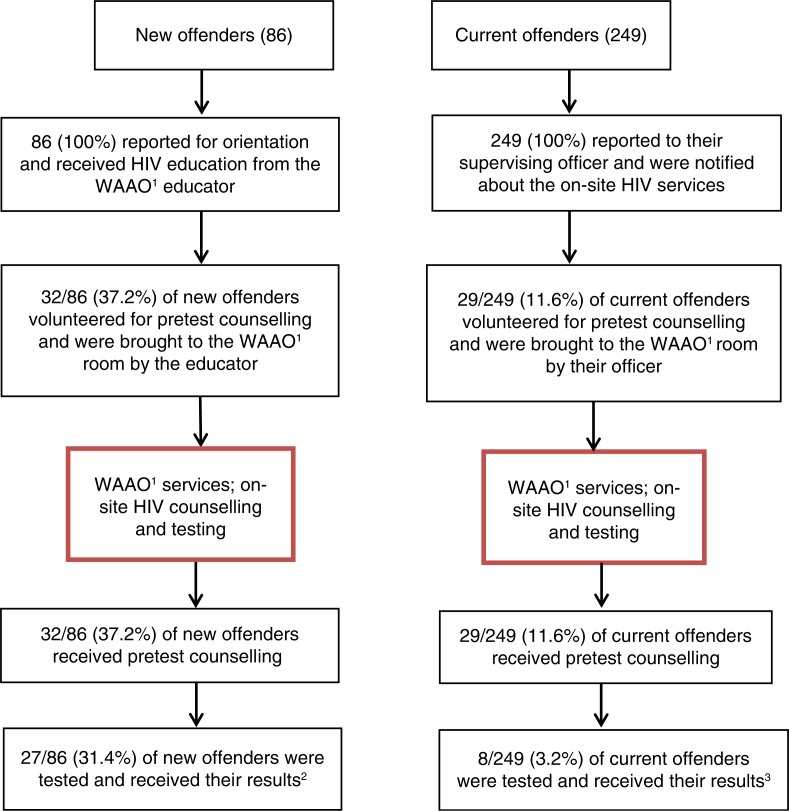
A total of 86 new and 249 current offenders reported during the programme (N=335). Almost one-third (31.4%) of new offenders sought HIV testing, while only 3.2% of current offenders were screened for HIV. Refusals among current offenders invoked monogamy, time pressures, being tested in prison, fear of positive test results and concerns about being labelled as gay or unfaithful to women partners. Officers rated the programme as worthwhile and feasible to implement at other offices.
The partnership approach ensured support from law enforcement and intersectoral cooperation throughout the programme. HIV training for officers reduced discomfort over HIV and fostered their willingness to be active agents for referral to HIV services. Voluntary testing was enhanced by the HIV employee's educational role, particularly during orientation sessions for new offenders. The almost one-third success rate in HIV testing among new offenders suggests that future efforts should concentrate on this group in order to maximize participation at the probation and parole office.
美国的艾滋病毒主要集中在南部,这是一个贫困地区,存在显著的健康差距且监禁率很高,尤其是在非裔美国人中。在南部腹地的阿拉巴马州,一项旨在减少监狱过度拥挤的政策指令将大量已定罪的重罪犯转移到社区监管。缓刑和假释办公室尚未提供州立监狱所提供的艾滋病毒教育和检测服务。本研究旨在通过一项涉及执法人员、大学和艾滋病毒机构员工的跨部门计划,为缓刑人员和假释人员提供现场艾滋病毒服务。三个主要目标是:(1)让缓刑/假释官员参与该计划的规划、执行和评估;(2)为官员提供艾滋病毒教育;(3)为缓刑人员和假释人员提供自愿的艾滋病毒检测前咨询和检测。
该合作项目于2015年10月至12月开展。最近被判处缓刑的罪犯(“新罪犯”)在入职培训期间接受了艾滋病毒教育。在该项目实施之前就已处于监管之下的罪犯(“现有罪犯”)在预定的办公室探访期间了解了现场服务情况。通过官员评估、非正式反馈以及罪犯对艾滋病毒服务的接受情况来衡量结果。
该项目期间共有86名新罪犯和249名现有罪犯进行了报告(N = 335)。近三分之一(31.4%)的新罪犯寻求艾滋病毒检测,而只有3.2%的现有罪犯接受了艾滋病毒筛查。现有罪犯拒绝检测的原因包括实行一夫一妻制、时间压力、已在监狱接受过检测、害怕检测结果呈阳性以及担心被贴上同性恋或对女性伴侣不忠的标签。官员们认为该项目值得开展且在其他办公室实施可行。
合作方式确保了整个项目期间执法部门的支持和跨部门合作。对官员进行艾滋病毒培训减少了他们对艾滋病毒的不适感,并增强了他们积极转介罪犯接受艾滋病毒服务的意愿。艾滋病毒工作人员的教育作用,特别是在新罪犯入职培训期间,提高了自愿检测率。新罪犯中近三分之一的艾滋病毒检测成功率表明,未来的努力应集中在这一群体上,以便在缓刑和假释办公室最大限度地提高参与率。