van der Gijp A, Ravesloot C J, Jarodzka H, van der Schaaf M F, van der Schaaf I C, van Schaik J P J, Ten Cate Th J
Radiology Department, University Medical Center Utrecht, E01.132, Heidelberglaan 100, 3584 CX, Utrecht, The Netherlands.
Center for Learning Science and Technologies, Open University of the Netherlands, Heerlen, The Netherlands.
Adv Health Sci Educ Theory Pract. 2017 Aug;22(3):765-787. doi: 10.1007/s10459-016-9698-1. Epub 2016 Jul 19.
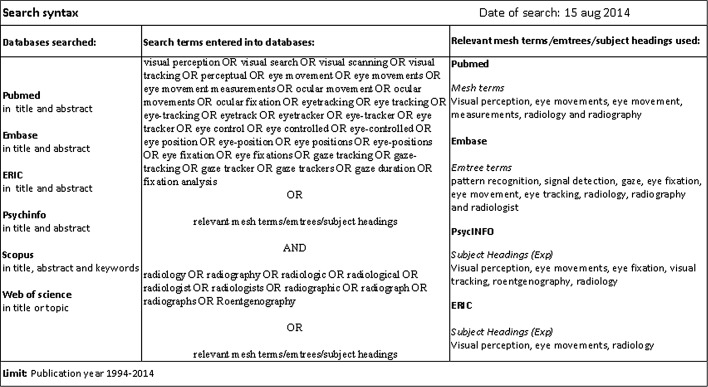
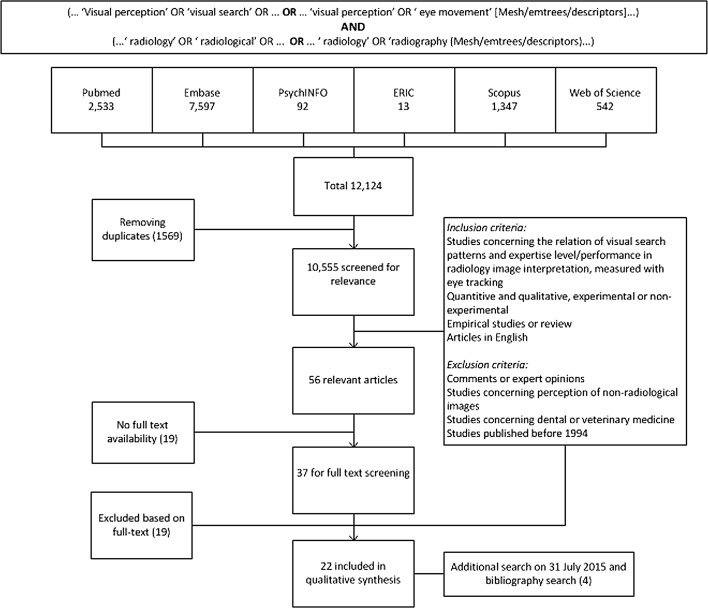
Eye tracking research has been conducted for decades to gain understanding of visual diagnosis such as in radiology. For educational purposes, it is important to identify visual search patterns that are related to high perceptual performance and to identify effective teaching strategies. This review of eye-tracking literature in the radiology domain aims to identify visual search patterns associated with high perceptual performance. Databases PubMed, EMBASE, ERIC, PsycINFO, Scopus and Web of Science were searched using 'visual perception' OR 'eye tracking' AND 'radiology' and synonyms. Two authors independently screened search results and included eye tracking studies concerning visual skills in radiology published between January 1, 1994 and July 31, 2015. Two authors independently assessed study quality with the Medical Education Research Study Quality Instrument, and extracted study data with respect to design, participant and task characteristics, and variables. A thematic analysis was conducted to extract and arrange study results, and a textual narrative synthesis was applied for data integration and interpretation. The search resulted in 22 relevant full-text articles. Thematic analysis resulted in six themes that informed the relation between visual search and level of expertise: (1) time on task, (2) eye movement characteristics of experts, (3) differences in visual attention, (4) visual search patterns, (5) search patterns in cross sectional stack imaging, and (6) teaching visual search strategies. Expert search was found to be characterized by a global-focal search pattern, which represents an initial global impression, followed by a detailed, focal search-to-find mode. Specific task-related search patterns, like drilling through CT scans and systematic search in chest X-rays, were found to be related to high expert levels. One study investigated teaching of visual search strategies, and did not find a significant effect on perceptual performance. Eye tracking literature in radiology indicates several search patterns are related to high levels of expertise, but teaching novices to search as an expert may not be effective. Experimental research is needed to find out which search strategies can improve image perception in learners.
几十年来,人们一直在进行眼动追踪研究,以了解诸如放射学中的视觉诊断。出于教育目的,识别与高感知性能相关的视觉搜索模式以及确定有效的教学策略非常重要。这篇对放射学领域眼动追踪文献的综述旨在识别与高感知性能相关的视觉搜索模式。使用 “视觉感知” 或 “眼动追踪” 以及 “放射学” 及其同义词对数据库PubMed、EMBASE、ERIC、PsycINFO、Scopus和Web of Science进行了检索。两位作者独立筛选检索结果,并纳入了1994年1月1日至2015年7月31日期间发表的有关放射学视觉技能的眼动追踪研究。两位作者使用医学教育研究质量工具独立评估研究质量,并提取有关设计、参与者和任务特征以及变量的研究数据。进行了主题分析以提取和整理研究结果,并应用文本叙述性综合进行数据整合和解释。检索结果产生了22篇相关的全文文章。主题分析产生了六个主题,这些主题说明了视觉搜索与专业水平之间的关系:(1)任务时间,(2)专家的眼动特征,(3)视觉注意力的差异,(4)视觉搜索模式,(5)横断面堆叠成像中的搜索模式,以及(6)视觉搜索策略的教学。发现专家搜索的特征是全局-局部搜索模式,该模式代表最初的全局印象,随后是详细的局部搜索-发现模式。发现特定的与任务相关的搜索模式,如在CT扫描中钻孔和在胸部X光片中进行系统搜索,与高专家水平相关。一项研究调查了视觉搜索策略的教学,未发现对感知性能有显著影响。放射学领域的眼动追踪文献表明,几种搜索模式与高水平的专业知识相关,但教导新手像专家一样进行搜索可能并不有效。需要进行实验研究以找出哪些搜索策略可以提高学习者的图像感知能力。