Mathew R, Davies N, Manthorpe J, Iliffe S
Research Department of Primary Care & Population Health, University College London, UK.
Social Care Workforce Research Unit, King's College London, London, UK.
BMJ Open. 2016 Jul 19;6(7):e010416. doi: 10.1136/bmjopen-2015-010416.
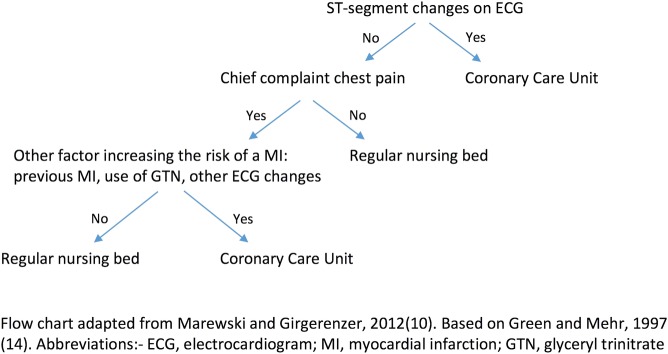
Decision-making, when providing care and treatment for a person with dementia at the end of life, can be complex and challenging. There is a lack of guidance available to support practitioners and family carers, and even those experienced in end of life dementia care report a lack of confidence in decision-making. It is thought that the use of heuristics (rules of thumb) may aid decision-making. The aim of this study is to identify whether heuristics are used in end of life dementia care, and if so, to identify the context in which they are being used.
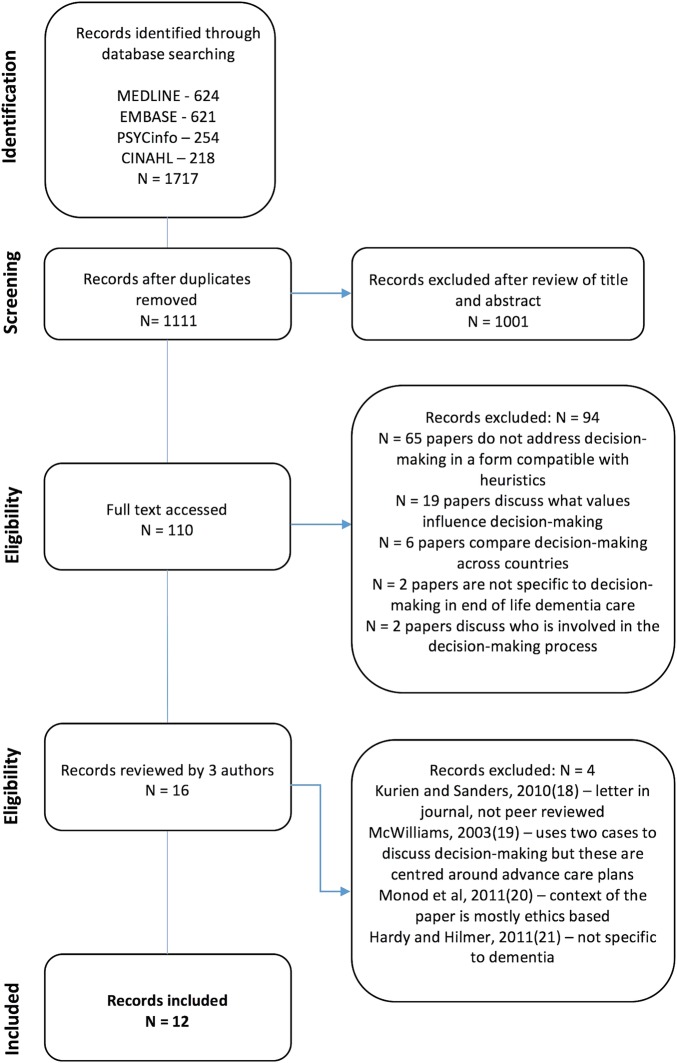
A narrative literature review was conducted taking a systematic approach to the search strategy, using the Centre for Reviews and Dissemination guidelines. Rapid appraisal methodology was used in order to source specific and relevant literature regarding the use of heuristics in end of life dementia care.
A search using terms related to dementia, palliative care and decision-making was conducted across 4 English language electronic databases (MEDLINE, EMBASE, PsycINFO and CINAHL) in 2015.
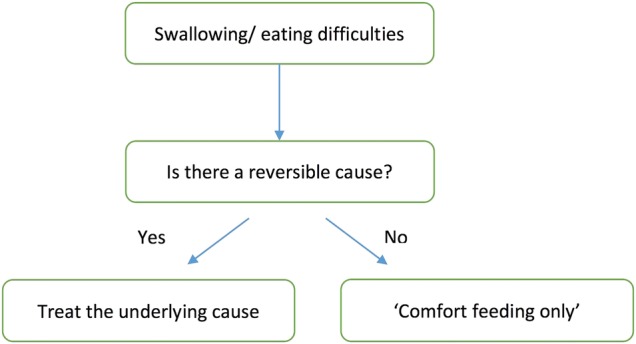
The search identified 12 papers that contained an algorithm, guideline, decision tool or set of principles that we considered compatible with heuristic decision-making. The papers addressed swallowing and feeding difficulties, the treatment of pneumonia, management of pain and agitation, rationalising medication, ending life-sustaining treatment, and ensuring a good death.
The use of heuristics in palliative or end of life dementia care is not described in the research literature. However, this review identified important decision-making principles, which are largely a reflection of expert opinion. These principles may have the potential to be developed into simple heuristics that could be used in practice.
在为临终痴呆患者提供护理和治疗时,决策可能复杂且具有挑战性。缺乏支持从业者和家庭护理人员的指导,即使是那些在临终痴呆护理方面经验丰富的人也表示在决策方面缺乏信心。人们认为使用启发法(经验法则)可能有助于决策。本研究的目的是确定启发法是否用于临终痴呆护理,如果是,则确定其使用的背景。
采用系统的搜索策略进行叙述性文献综述,遵循综述与传播中心的指南。使用快速评估方法以获取有关启发法在临终痴呆护理中使用的具体相关文献。
2015年在4个英语电子数据库(MEDLINE、EMBASE、PsycINFO和CINAHL)中使用与痴呆、姑息治疗和决策相关的术语进行搜索。
搜索确定了12篇包含算法、指南、决策工具或一组原则的论文,我们认为这些与启发式决策兼容。这些论文涉及吞咽和进食困难、肺炎治疗、疼痛和躁动管理、药物合理化、停止维持生命的治疗以及确保善终。
研究文献中未描述在姑息治疗或临终痴呆护理中使用启发法的情况。然而,本综述确定了重要的决策原则,这些原则在很大程度上反映了专家意见。这些原则可能有潜力发展为可在实践中使用的简单启发法。