Ishihara Hisamitsu, Yamaguchi Susumu, Nakao Ikko, Okitsu Akira, Asahina Seitaro
Division of Diabetes and Metabolic Diseases, Nihon University School of Medicine, Tokyo, Japan.
Astellas Pharma Inc., Tokyo, Japan.
Diabetes Obes Metab. 2016 Dec;18(12):1207-1216. doi: 10.1111/dom.12745. Epub 2016 Sep 15.
To examine the efficacy and safety of add-on ipragliflozin in Japanese patients with type 2 diabetes in the early stage of insulin therapy.
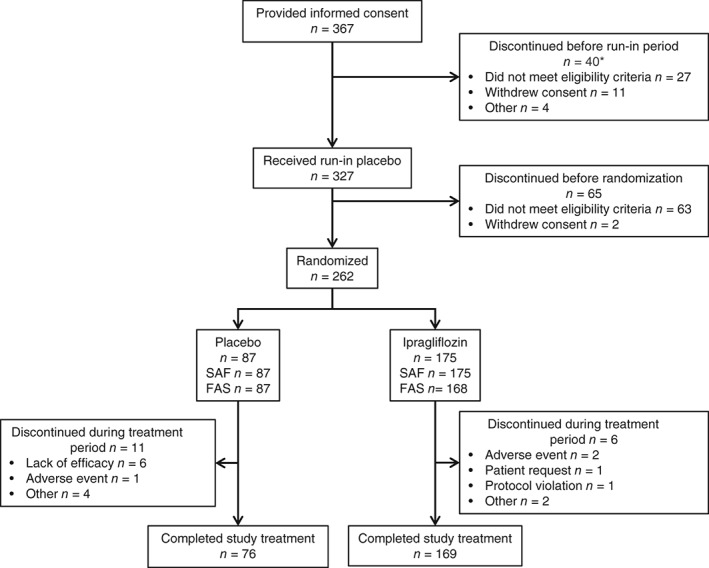
Patients treated with insulin (bolus component <30% of total daily dose) with/without a dipeptidyl peptidase-4 (DPP-4) inhibitor were randomized to receive placebo (n = 87) or ipragliflozin (n = 175) for 16 weeks. The primary endpoint was the change in glycated haemoglobin (HbA1c) from baseline. Secondary endpoints included changes in fasting plasma glucose (FPG) and metabolic hormones. Safety endpoints were also examined.
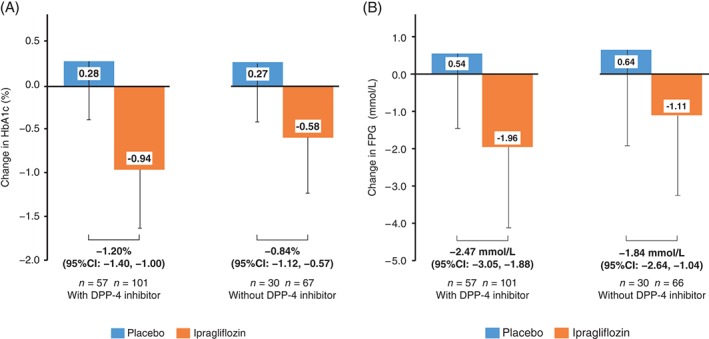
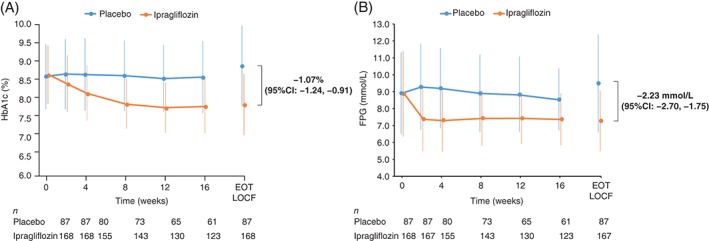
The changes in HbA1c were 0.27% and -0.79% (2.9 and -8.7 mmol/mol) in the placebo and ipragliflozin groups, respectively (baseline: 8.62% vs 8.67% [70.8 vs 71.2 mmol/mol]), corresponding to an adjusted mean difference of -1.07% (95% confidence interval -1.24, -0.91) or -11.7 mmol/mol (-13.5, -9.9), p < .001. Ipragliflozin reduced FPG and serum C-peptide levels and body weight (all p < .001), and increased serum adiponectin levels (p = .022). There was a statistically significant interaction for use/non-use of a DPP-4 inhibitor × treatment group for the change in HbA1c (p = .042). Hypoglycaemia was the only treatment-related adverse event reported in >5% of patients (14.9% vs 29.1%). Events consistent with urinary tract infection (placebo 1.1% vs ipragliflozin 2.3%) or genital infection (0.0% and 4.0%, respectively) occurred in <5% of patients.
Ipragliflozin was well tolerated and effective in insulin-treated patients, especially when used with a DPP-4 inhibitor.
研究在胰岛素治疗早期,加用依帕列净对日本2型糖尿病患者的疗效及安全性。
接受胰岛素治疗(基础胰岛素剂量<每日总剂量的30%)且使用或未使用二肽基肽酶-4(DPP-4)抑制剂的患者被随机分为两组,分别接受安慰剂(n = 87)或依帕列净(n = 175)治疗16周。主要终点为糖化血红蛋白(HbA1c)自基线的变化。次要终点包括空腹血糖(FPG)和代谢激素的变化。同时也对安全性终点进行了检查。
安慰剂组和依帕列净组的HbA1c变化分别为0.27%和-0.79%(2.9和-8.7 mmol/mol)(基线:8.62% vs 8.67% [70.8 vs 71.2 mmol/mol]),校正后的平均差异为-1.07%(95%置信区间-1.24,-0.91)或-11.7 mmol/mol(-13.5,-9.9),p <.001。依帕列净降低了FPG、血清C肽水平和体重(均p <.001),并提高了血清脂联素水平(p = 0.022)。在HbA1c变化方面,DPP-4抑制剂的使用/未使用与治疗组之间存在统计学显著的交互作用(p = 0.042)。低血糖是唯一报告的发生率超过5%的治疗相关不良事件(14.9% vs 29.1%)。符合尿路感染的事件(安慰剂组1.1% vs依帕列净组2.3%)或生殖器感染的事件(分别为0.0%和4.0%)在不到5%的患者中发生。
依帕列净在胰岛素治疗的患者中耐受性良好且有效,尤其是与DPP-4抑制剂联用时。