Pharmacy Practice and Science I, Research and Education Center for Clinical Pharmacy, Kitasato University School of Pharmacy, Kanagawa, Japan
Department of Endocrinology and Diabetes, School of Medicine, Saitama Medical University, Iruma-gun, Saitama, Japan.
BMJ Open Diabetes Res Care. 2020 Nov;8(2). doi: 10.1136/bmjdrc-2020-001856.
Sodium-glucose cotransporter 2 (SGLT2) inhibitors are believed to lower glucose levels and inhibit cardiovascular events related to type 2 diabetes (T2D). To maximize their benefits, the risk of resultant hypoglycemia has to be minimized; however, the magnitude of this risk remains unclear. Here, we aimed to identify clinical factors linked to an increased risk of hypoglycemia among Japanese patients with T2D and treated with SGLT2 inhibitors.
This was a real-world retrospective cohort study conducted using the Japanese Medical Data Vision database. We identified patients with T2D and treated with SGLT2 inhibitors who were enrolled in the database from April 2014 to October 2019. Cox multivariate regression analyses were performed to determine demographical and clinical factors linked to SGLT2 inhibitor-associated hypoglycemia-related hospitalization.
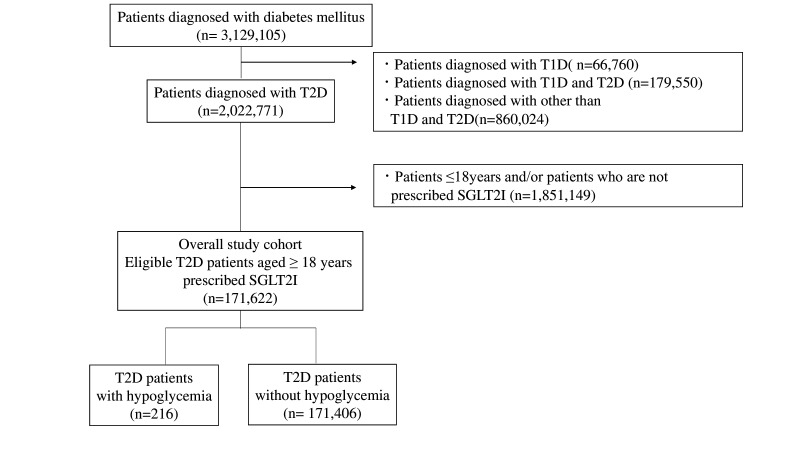
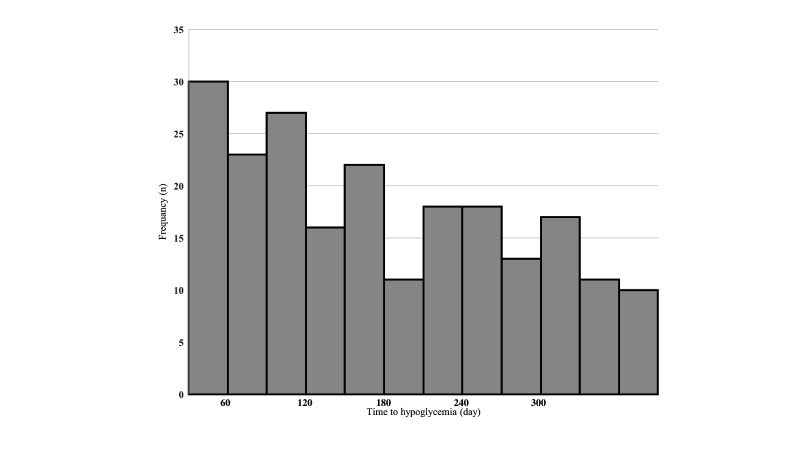
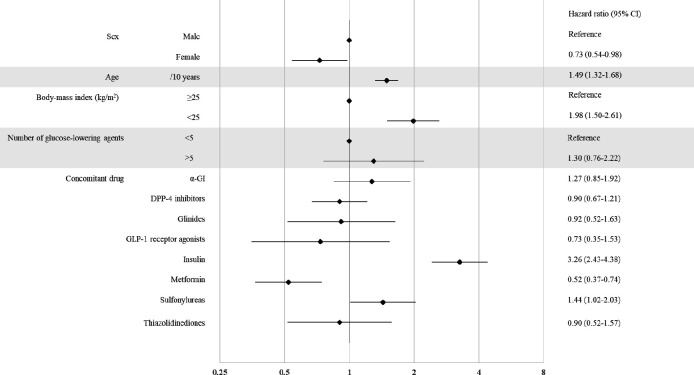
Of 171 622 patients prescribed SGLT2 inhibitors, hypoglycemia-related hospitalization occurred in 216 (0.13%), with 0.60 incidences per 100 person-years. The risk of SGLT2 inhibitor-associated hypoglycemia was higher with each 10-year increase in age (HR 1.49; 95% CI 1.32 to 1.68) and high in patients with body mass index <25 kg/m (HR 1.98; 95% CI 1.50 to 2.61), insulin use (HR 3.26; 95% CI 2.43 to 4.38), and sulfonylurea use (HR 1.44; 95% CI 1.02 to 2.03). The risk was lower in women than in men (HR 0.73; 95% CI 0.54 to 0.98) and low in concomitant metformin users (HR 0.52; 95% CI 0.37 to 0.74).
These findings may help minimize the risk of hypoglycemia-related hospitalization due to T2D treatment with SGLT2 inhibitors. We revealed that the risk of hypoglycemia may be higher when combining SGLT2 inhibitors with sulfonylureas and/or insulin. Furthermore, we discovered a high risk of hypoglycemia in older and non-obese patients. These findings may assist in maximizing the benefits of SGLT2 inhibitors for the treatment of T2D.
钠-葡萄糖共转运蛋白 2(SGLT2)抑制剂被认为可降低血糖水平并抑制与 2 型糖尿病(T2D)相关的心血管事件。为了最大程度地发挥其益处,必须将由此产生的低血糖风险降至最低;然而,这种风险的程度尚不清楚。在这里,我们旨在确定与接受 SGLT2 抑制剂治疗的日本 T2D 患者发生低血糖风险增加相关的临床因素。
这是一项使用日本医疗数据视野数据库进行的真实世界回顾性队列研究。我们确定了自 2014 年 4 月至 2019 年 10 月期间在该数据库中接受 SGLT2 抑制剂治疗的 T2D 患者。使用 Cox 多变量回归分析确定与 SGLT2 抑制剂相关的低血糖相关住院治疗相关的人口统计学和临床因素。
在接受 SGLT2 抑制剂治疗的 171622 名患者中,有 216 名(0.13%)发生低血糖相关住院治疗,每 100 人年发生 0.60 例。年龄每增加 10 岁,SGLT2 抑制剂相关低血糖的风险就会增加 1.49(95%CI 1.32 至 1.68),身体质量指数(BMI)<25kg/m2 的患者风险更高(HR 1.98;95%CI 1.50 至 2.61),使用胰岛素(HR 3.26;95%CI 2.43 至 4.38)和使用磺脲类药物(HR 1.44;95%CI 1.02 至 2.03)。女性的风险低于男性(HR 0.73;95%CI 0.54 至 0.98),同时使用二甲双胍的风险较低(HR 0.52;95%CI 0.37 至 0.74)。
这些发现可能有助于最大程度地降低因 SGLT2 抑制剂治疗 T2D 而导致低血糖相关住院治疗的风险。我们发现,当 SGLT2 抑制剂与磺酰脲类药物和/或胰岛素联合使用时,低血糖的风险可能更高。此外,我们发现老年和非肥胖患者低血糖风险较高。这些发现可能有助于最大程度地发挥 SGLT2 抑制剂治疗 T2D 的益处。