Alhassan Robert Kaba, Nketiah-Amponsah Edward, Spieker Nicole, Arhinful Daniel Kojo, Rinke de Wit Tobias F
Amsterdam Institute for Global Health and Development, University of Amsterdam, Amsterdam, Netherlands.
Department of Epidemiology, Noguchi Memorial Institute for Medical Research, University of Ghana, Legon, Accra, Ghana.
PLoS One. 2016 Jul 20;11(7):e0158541. doi: 10.1371/journal.pone.0158541. eCollection 2016.
Health worker density per 1000 population in Ghana is one of the lowest in the world estimated to be 2.3, below the global average of 9.3. Low health worker motivation induced by poor working conditions partly explain this challenge. Albeit the wage bill for public sector health workers is about 90% of domestic government expenditure on health in countries such as Ghana, staff motivation and performance output remain a challenge, suggesting the need to complement financial incentives with non-financial incentives through a community-based approach. In this study, a systematic community engagement (SCE) intervention was implemented to engage community groups in healthcare quality assessment to promote mutual collaboration between clients and healthcare providers, and enhance health worker motivation levels. SCE involves structured use of existing community groups and associations to assess healthcare quality in health facilities. Identified quality gaps are discussed with healthcare providers, improvements made and rewards given to best performing facilities for closing quality care gaps.
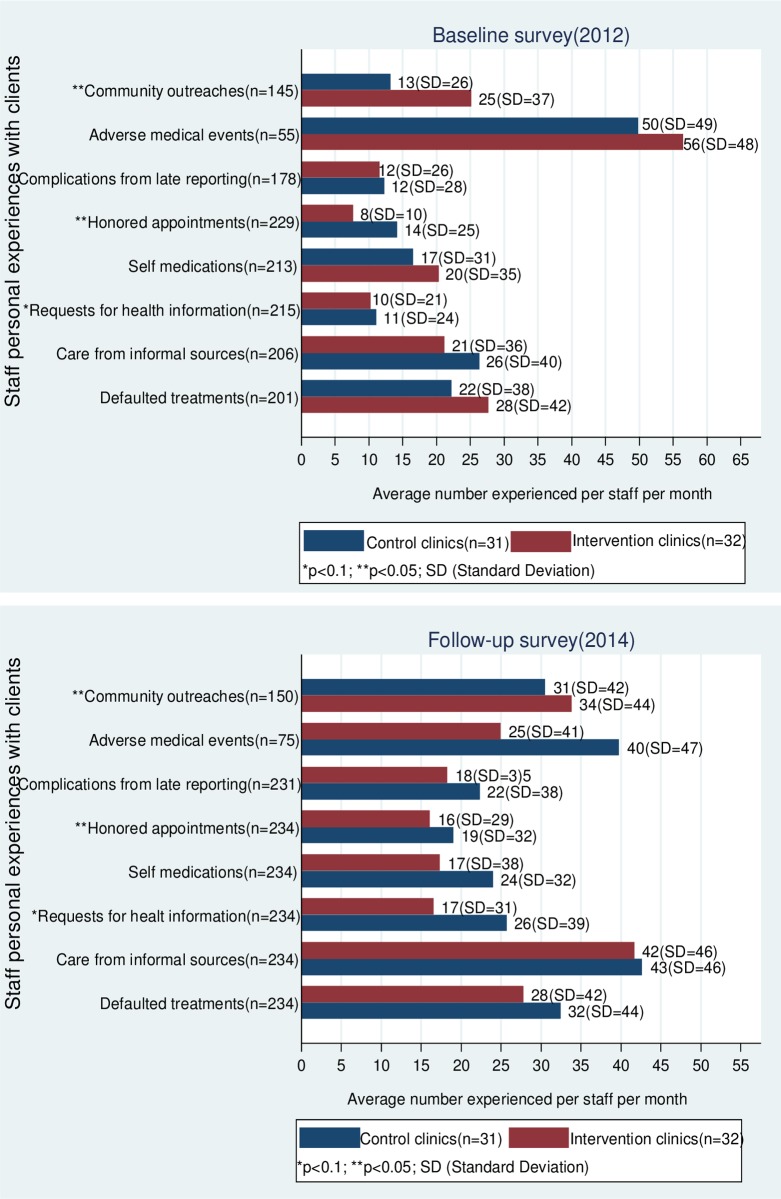
To evaluate the effect of SCE interventions on health worker motivation and experiences with clients.
The study is a cluster randomized trial involving health workers in private (n = 38) and public (n = 26) primary healthcare facilities in two administrative regions in Ghana. Out of 324 clinical and non-clinical staff randomly interviewed at baseline, 234 (72%) were successfully followed at end-line and interviewed on workplace motivation factors and personal experiences with clients. Propensity score matching and difference-in-difference estimations were used to estimate treatment effect of the interventions on staff motivation.
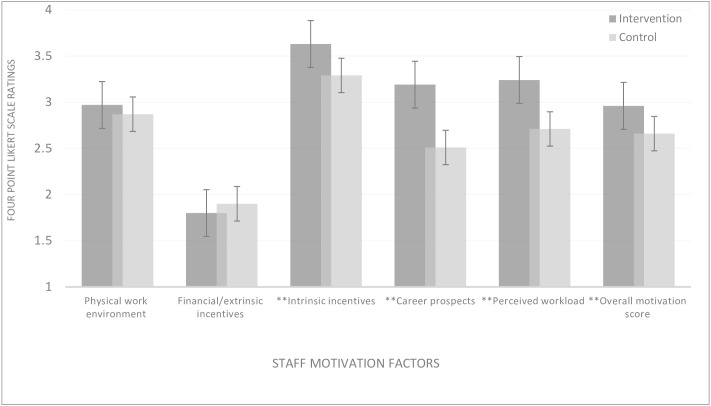
Intrinsic (non-financial) work incentives including cordiality with clients and perceived career prospects appeared to be prime sources of motivation for health staff interviewed in intervention health facilities while financial incentives were ranked lowest. Intervention health facilities that were assessed by female community groups (Coef. = 0.2720, p = 0.0118) and informal groups with organized leadership structures like Artisans (Coef. = 0.2268, p = 0.0368) associated positively with higher intrinsic motivation levels of staff.
Community-based approach to health worker motivation is a potential complementary strategy that needs policy deliberation to explore its prospects. Albeit financial incentives remain critical sources of staff motivation, innovative non-financial approaches like SCE should complement the latter.
加纳每千人口的卫生工作者密度是世界上最低的之一,估计为2.3,低于全球平均水平9.3。工作条件差导致卫生工作者积极性低下,这在一定程度上解释了这一挑战。尽管在加纳等国家,公共部门卫生工作者的工资支出约占政府国内卫生支出的90%,但员工的积极性和绩效产出仍然是一个挑战,这表明需要通过基于社区的方法,用非财务激励措施补充财务激励措施。在本研究中,实施了系统的社区参与(SCE)干预措施,让社区团体参与医疗质量评估,以促进客户与医疗服务提供者之间的相互协作,并提高卫生工作者的积极性水平。SCE包括有组织地利用现有的社区团体和协会来评估卫生设施的医疗质量。与医疗服务提供者讨论确定的质量差距,进行改进,并对在缩小优质护理差距方面表现最佳的设施给予奖励。
评估SCE干预措施对卫生工作者积极性和与客户互动体验的影响。
该研究是一项整群随机试验,涉及加纳两个行政区的私立(n = 38)和公立(n = 26)初级卫生保健设施中的卫生工作者。在基线时随机采访的324名临床和非临床工作人员中,有234名(72%)在终点时成功随访,并就工作场所的激励因素和与客户的个人经历进行了访谈。倾向得分匹配和差异估计用于估计干预措施对员工积极性的治疗效果。
内在(非财务)工作激励因素,包括与客户的融洽关系和感知的职业前景,似乎是干预卫生设施中接受采访的卫生工作人员积极性的主要来源,而财务激励因素排名最低。由女性社区团体评估的干预卫生设施(系数 = 0.2720,p = 0.0118)以及具有工匠等有组织领导结构的非正式团体(系数 = 0.2268,p = 0.0368)与员工较高的内在积极性水平呈正相关。
基于社区的卫生工作者激励方法是一种潜在的补充策略,需要政策审议以探索其前景。尽管财务激励仍然是员工积极性的关键来源,但像SCE这样的创新非财务方法应该补充后者。