Dipartimento di Matematica "Giuseppe Peano", Università di Torino, Italy.
Heliyon. 2016 May 9;2(5):e00101. doi: 10.1016/j.heliyon.2016.e00101. eCollection 2016 May.
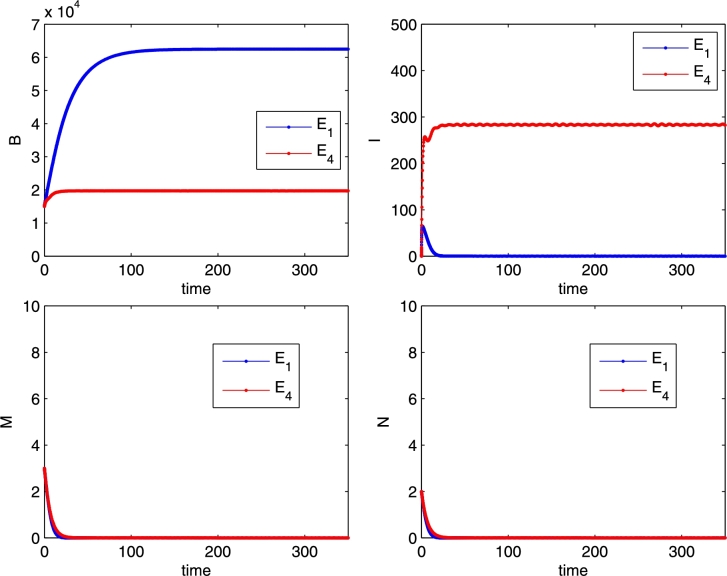
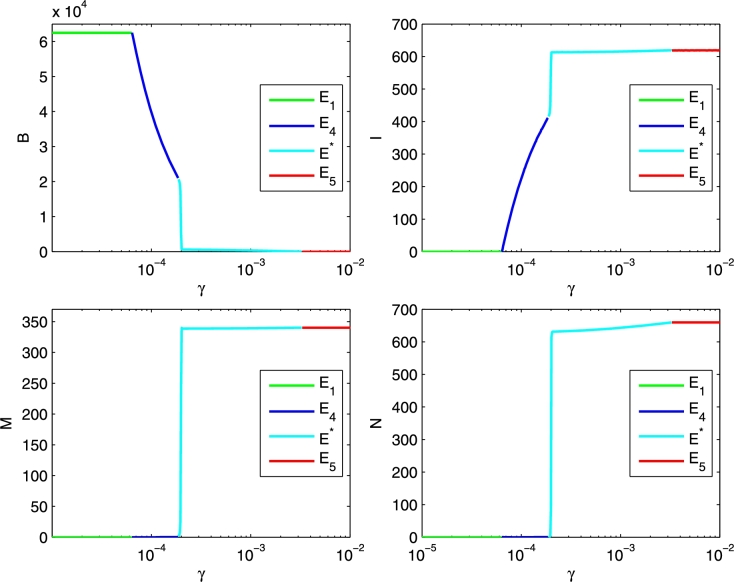
The ectoparasitic mite Varroa destructor has become one of the major worldwide threats for apiculture. Varroa destructor attacks the honey bee Apis mellifera weakening its host by sucking hemolymph. However, the damage to bee colonies is not strictly related to the parasitic action of the mite but it derives, above all, from its action as vector increasing the transmission of many viral diseases such as acute paralysis (ABPV) and deformed wing viruses (DWV), that are considered among the main causes of CCD (Colony Collapse Disorder). In this work we discuss an [Formula: see text] model that describes how the presence of the mite affects the epidemiology of these viruses on adult bees. The acronym [Formula: see text] means that the disease affects both populations. In fact it accounts for the bee and mite populations, that are each divided among the S (susceptible) and I (infected) states. We characterize the system behavior, establishing that ultimately either only healthy bees survive, or the disease becomes endemic and mites are wiped out. Another dangerous alternative is the Varroa invasion scenario with the extinction of healthy bees. The final possible configuration is the coexistence equilibrium in which honey bees share their infected hive with mites. The analysis is in line with some observed facts in natural honey bee colonies. Namely, these diseases are endemic. Further, if the mite population is present, necessarily the viral infection occurs. The findings of this study indicate that a low horizontal transmission rate of the virus among honey bees in beehives will help in protecting bee colonies from Varroa infestation and viral epidemics.
体外寄生螨瓦螨已成为养蜂业的全球主要威胁之一。瓦螨攻击蜜蜂,通过吸食血淋巴来削弱其宿主。然而,对蜂群的损害与螨虫的寄生作用并不严格相关,而主要源于其作为病毒传播媒介的作用,增加了许多病毒性疾病的传播,如急性麻痹症(ABPV)和变形翅膀病毒(DWV),这些疾病被认为是 CCD(蜂群崩溃失调症)的主要原因之一。在这项工作中,我们讨论了一个描述螨虫对成年蜜蜂中这些病毒的流行病学影响的[Formula: see text]模型。缩写[Formula: see text]表示疾病同时影响两个种群。实际上,它考虑了蜜蜂和螨虫种群,每个种群分为 S(易感)和 I(感染)状态。我们描述了系统的行为,确定最终要么只有健康的蜜蜂存活,要么疾病成为地方性疾病,螨虫被消灭。另一种危险的选择是螨虫入侵的情景,健康的蜜蜂灭绝。最终可能的配置是共存平衡,其中蜜蜂与螨虫共同分享感染的蜂巢。该分析与在自然蜜蜂群体中观察到的一些事实相符。即,这些疾病是地方性的。此外,如果螨虫种群存在,病毒感染必然会发生。这项研究的结果表明,蜂巢中蜜蜂之间病毒的低水平横向传播率将有助于保护蜂群免受螨虫侵害和病毒流行。