Chen Chieh-Li, Zhang Anqi, Bojikian Karine D, Wen Joanne C, Zhang Qinqin, Xin Chen, Mudumbai Raghu C, Johnstone Murray A, Chen Philip P, Wang Ruikang K
Department of Bioengineering, University of Washington, Seattle, Washington, United States 2Department of Ophthalmology, University of Washington, Seattle, Washington, United States.
Department of Bioengineering, University of Washington, Seattle, Washington, United States.
Invest Ophthalmol Vis Sci. 2016 Jul 1;57(9):OCT475-85. doi: 10.1167/iovs.15-18909.
To investigate the vascular microcirculation changes in the retinal nerve fiber layer (RNFL) in normal, glaucoma suspect, and open-angle glaucoma (OAG) groups using optical coherence tomography-based microangiography (OMAG).
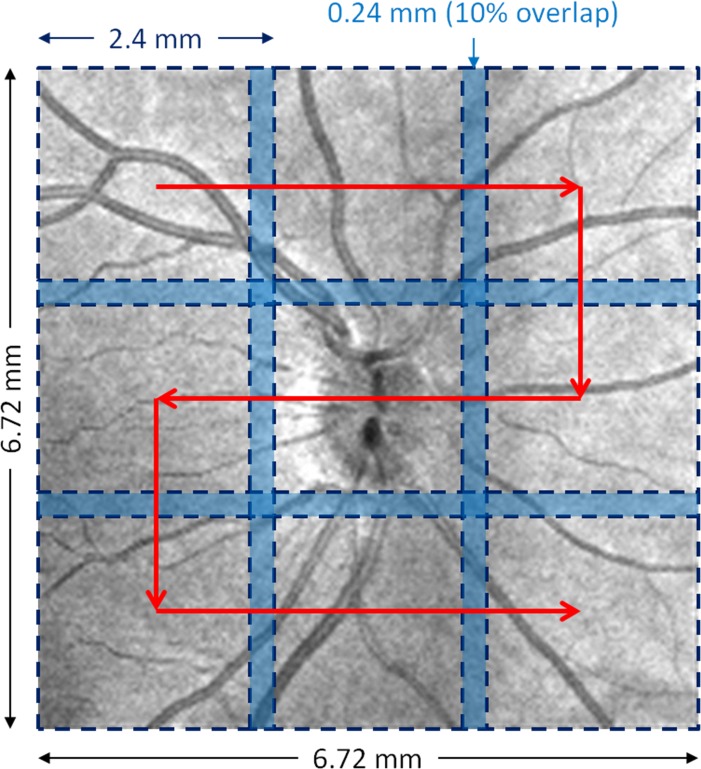
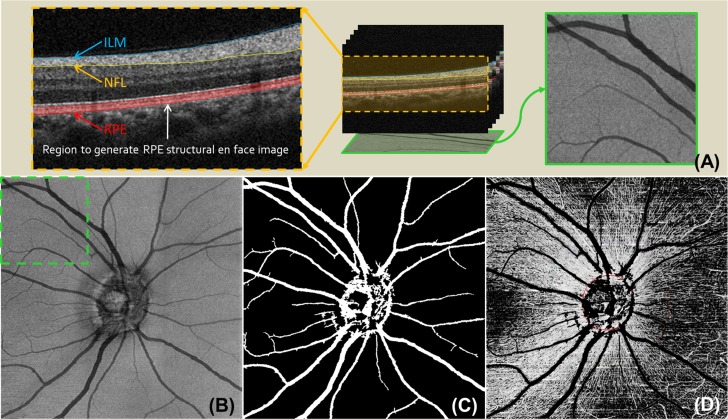
One eye from each subject was scanned with a Cirrus HD-OCT 5000-based OMAG prototype system montage scanning protocol centered at the optic nerve head (ONH). Blood flow signals were extracted using OMAG algorithm. Retinal nerve fiber layer vascular microcirculation was measured by calculating the blood flux index and vessel area density within a 1.2-mm width annulus centered at the ONH with exclusion of big retinal vessels. One-way ANOVA were performed to analyze the RNFL microcirculation among groups. Linear-regression models were constructed to analyze the correlation between RNFL microcirculation and clinical parameters. Discrimination capabilities of the flow metrics were assessed with the area under the receiver operating characteristic curve (AROC).
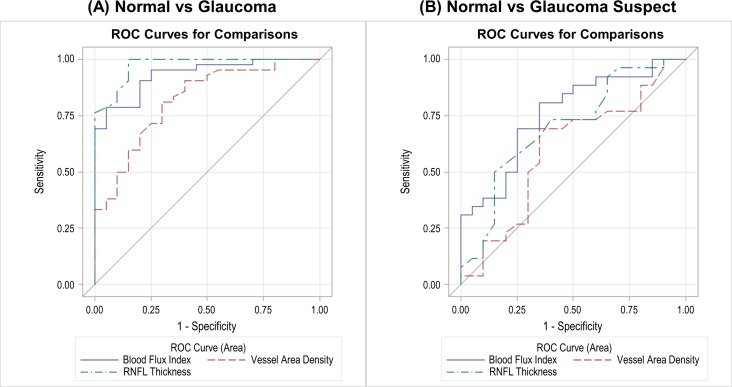
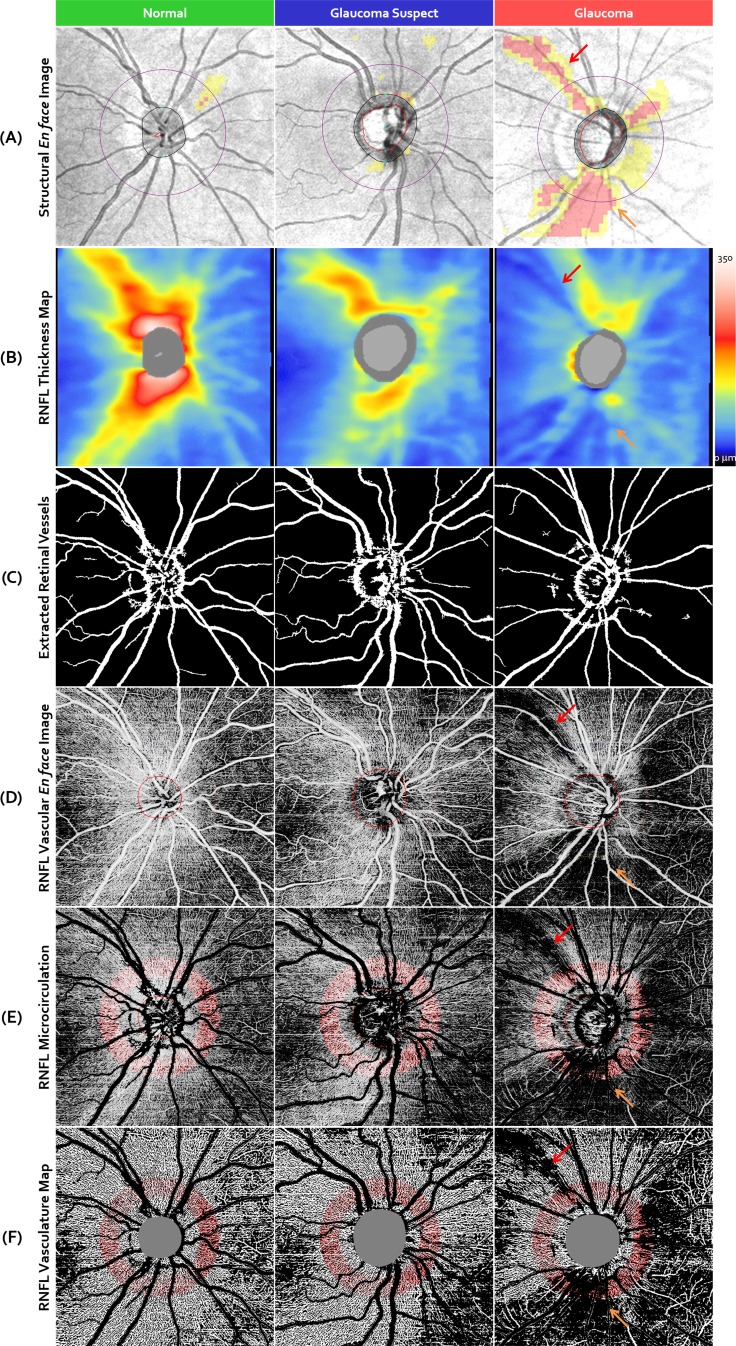
Twenty normal, 26 glaucoma suspect, and 42 OAG subjects were enrolled. Eyes from OAG subjects and glaucoma suspects showed significantly lower blood flux index compared with normal eyes (P ≤ 0.0015). Retinal nerve fiber layer blood flow metrics showed significant correlations with visual field indices and structural changes in glaucomatous eyes (P ≤ 0.0123). Similar discrimination capability of blood flux index compared with RNFL thickness was found in both disease groups.
Peripapillary RNFL vascular microcirculation measured as blood flux index by OMAG showed significant differences among OAG, glaucoma suspect, and normal controls and was significantly correlated with functional and structural defects. Retinal nerve fiber layer microcirculation measurement using OMAG may help physicians monitor glaucoma.
使用基于光学相干断层扫描的微血管造影(OMAG)技术,研究正常组、青光眼可疑组和开角型青光眼(OAG)组视网膜神经纤维层(RNFL)的血管微循环变化。
使用基于Cirrus HD-OCT 5000的OMAG原型系统,以视神经乳头(ONH)为中心的蒙太奇扫描协议对每个受试者的一只眼睛进行扫描。使用OMAG算法提取血流信号。通过计算以ONH为中心、宽度为1.2毫米的环形区域内(排除视网膜大血管)的血流指数和血管面积密度,来测量视网膜神经纤维层的血管微循环。采用单因素方差分析来分析各组之间的RNFL微循环情况。构建线性回归模型来分析RNFL微循环与临床参数之间的相关性。使用受试者操作特征曲线下面积(AROC)评估血流指标的鉴别能力。
纳入20名正常受试者、26名青光眼可疑受试者和42名OAG受试者。与正常眼睛相比,OAG受试者和青光眼可疑受试者的眼睛血流指数显著降低(P≤0.0015)。在青光眼患者眼中,视网膜神经纤维层血流指标与视野指标和结构变化显著相关(P≤0.0123)。在两个疾病组中,发现血流指数与RNFL厚度具有相似的鉴别能力。
通过OMAG测量的视乳头周围RNFL血管微循环血流指数在OAG组、青光眼可疑组和正常对照组之间存在显著差异,并且与功能和结构缺陷显著相关。使用OMAG测量视网膜神经纤维层微循环可能有助于医生监测青光眼。