Mason Michael, Mennis Jeremy, Light John, Rusby Julie, Westling Erika, Crewe Stephanie, Way Thomas, Flay Brian, Zaharakis Nikola
Department of Psychiatry, Commonwealth Institute for Child and Family Studies, Virginia Commonwealth University, PO Box 980489, Richmond, VA 23298-0489, USA.
J Child Fam Stud. 2016 May;25(5):1441-1450. doi: 10.1007/s10826-015-0344-y. Epub 2015 Dec 19.
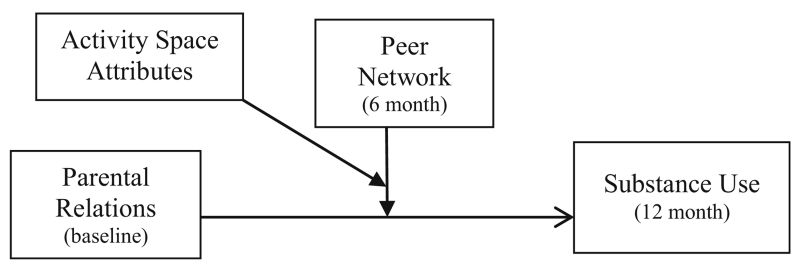
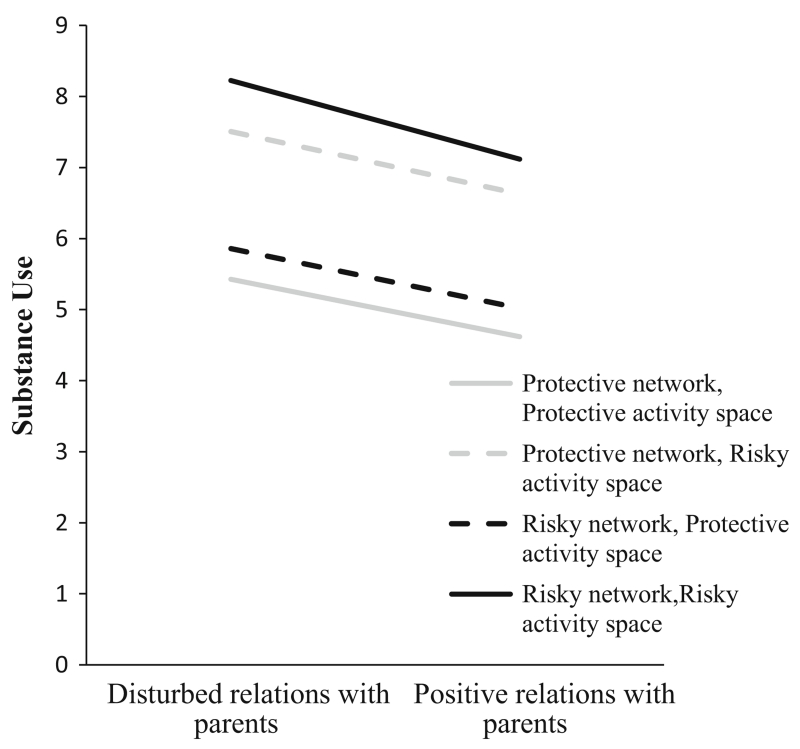
Limited research is available that explains complex contextual and interactive effects of microsystems such as family relationships, peer networks, and place-based influences have on urban adolescent substance use. We contend that research into these complex processes is improved by integrating psychological, social, and geographic data to better understand urban adolescent substance use involvement. Accordingly, we tested a longitudinal, 3-way moderation model to determine if the direct effect of teen-parent relationships on substance use involvement is moderated by peer network characteristics, which in turn is moderated by the risk and protective attributes within urban adolescents' activity spaces, among a sample of 248 adolescents. Results revealed that peer networks moderate the effects of relations with parents on substance use involvement for those adolescents with higher levels of risk attributes within their activity space, but not for those who spend time in locations with less risk. Thus, the teen-parent relationship interacts with peer net-work characteristics, for those urban adolescents whose activity space is constituted within high-risk environments. We conclude that peer networks have important interactive effects with family relationships that influence substance use, and that this is particularly salient for young adolescents who are exposed to risky environments. This finding underscores the importance of continued study into the interrelations among microsystems of urban adolescents, and provides further support that substance use is a social practice that is constituted within the unique geography of young adolescents' lives.
关于家庭关系、同伴网络和基于地点的影响等微观系统对城市青少年物质使用的复杂情境和交互作用的研究有限。我们认为,通过整合心理、社会和地理数据来更好地理解城市青少年物质使用情况,有助于改进对这些复杂过程的研究。因此,我们测试了一个纵向的三向调节模型,以确定在248名青少年样本中,青少年与父母的关系对物质使用的直接影响是否会受到同伴网络特征的调节,而同伴网络特征又是否会受到城市青少年活动空间内风险和保护属性的调节。结果显示,对于那些在活动空间内风险属性较高的青少年,同伴网络会调节亲子关系对物质使用的影响,但对于那些在风险较低地点活动的青少年则不然。因此,对于那些活动空间处于高风险环境中的城市青少年来说, 亲子关系与同伴网络特征相互作用。我们得出结论,同伴网络与影响物质使用的家庭关系具有重要的交互作用,对于身处风险环境的青少年来说尤为显著。这一发现强调了持续研究城市青少年微观系统之间相互关系的重要性,并进一步支持了物质使用是一种在青少年独特生活地理环境中形成的社会实践这一观点。