Kuenzel Katharina, Friedrich Oliver, Gilbert Daniel F
Department of Chemical and Biological Engineering, Institute of Medical Biotechnology, Friedrich-Alexander-Universität Erlangen-NürnbergErlangen, Germany; Erlangen Graduate School in Advanced Optical Technologies, Friedrich-Alexander-Universität Erlangen-NürnbergErlangen, Germany.
Front Mol Neurosci. 2016 Jun 28;9:51. doi: 10.3389/fnmol.2016.00051. eCollection 2016.
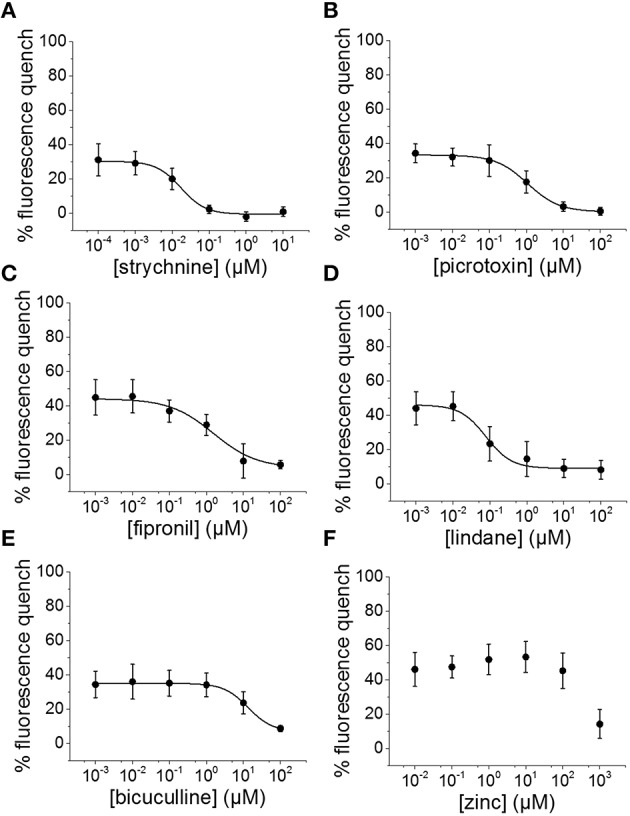
GABAARs and GlyRs are considered attractive drug targets for therapeutic intervention and are also increasingly recognized in the context of in vitro neurotoxicity (NT) and developmental neurotoxicity (DNT) testing. However, systematic human-specific GABAAR and GlyR-targeted drug screening and toxicity testing is hampered due to lack of appropriate in vitro models that express native GABAARs and GlyRs. We have established a human pluripotent stem cell line (NT2) stably expressing YFP-I152L, a halide-sensitive variant of yellow fluorescent protein (YFP), allowing for fluorescence-based functional analysis of chloride channels. Upon stimulation with retinoic acid, NT2 cells undergo neuronal differentiation and allow pharmacological and toxicological evaluation of native GABAARs and GlyRs at different stages of brain maturation. We applied the cell line in concentration-response experiments with the neurotransmitters GABA and glycine as well as with the drugs strychnine, picrotoxin, fipronil, lindane, bicuculline, and zinc and demonstrate that the established in vitro model is applicable to GABAAR and GlyR-targeted pharmacological and toxicological profiling. We quantified the proportion of GABAAR and GlyR-sensitive cells, respectively, and identified percentages of approximately 20% each within the overall populations, rendering the cells a suitable model for systematic in vitro GABAAR and GlyR-targeted screening in the context of drug development and NT/DNT testing.
γ-氨基丁酸A型受体(GABAARs)和甘氨酸受体(GlyRs)被认为是治疗干预的有吸引力的药物靶点,并且在体外神经毒性(NT)和发育神经毒性(DNT)测试中也越来越受到认可。然而,由于缺乏表达天然GABAARs和GlyRs的合适体外模型,系统性的针对人类特异性GABAAR和GlyR的药物筛选和毒性测试受到阻碍。我们建立了一种稳定表达黄色荧光蛋白(YFP)卤化物敏感变体YFP-I152L的人类多能干细胞系(NT2),从而能够对氯离子通道进行基于荧光的功能分析。在用视黄酸刺激后,NT2细胞会发生神经元分化,并允许在脑成熟的不同阶段对天然GABAARs和GlyRs进行药理学和毒理学评估。我们将该细胞系应用于使用神经递质γ-氨基丁酸(GABA)和甘氨酸以及药物士的宁、印防己毒素、氟虫腈、林丹、荷包牡丹碱和锌的浓度-反应实验,并证明所建立的体外模型适用于针对GABAAR和GlyR的药理学和毒理学分析。我们分别量化了对GABAAR和GlyR敏感的细胞比例,并在总体细胞群体中确定了各自约20%的比例,这使得这些细胞成为在药物开发和NT/DNT测试背景下进行系统性体外GABAAR和GlyR靶向筛选的合适模型。