Department of Physiology, Shihezi University School of Medicine, Shihezi 832002, Xinjiang Uygur Autonomous Region, China ; Key Laboratory of Xinjiang Endemic and Ethnic Disease, Shihezi University School of Medicine, Shihezi 832002, Xinjiang Uygur Autonomous Region, China.
Department of Physiology, Shihezi University School of Medicine, Shihezi 832002, Xinjiang Uygur Autonomous Region, China ; Key Laboratory of Xinjiang Endemic and Ethnic Disease, Shihezi University School of Medicine, Shihezi 832002, Xinjiang Uygur Autonomous Region, China ; Fundamental Medical School of Wuhan University, Wuhan 430071, Hubei Province, China.
Neural Regen Res. 2012 Nov 15;7(32):2492-9. doi: 10.3969/j.issn.1673-5374.2012.32.002.
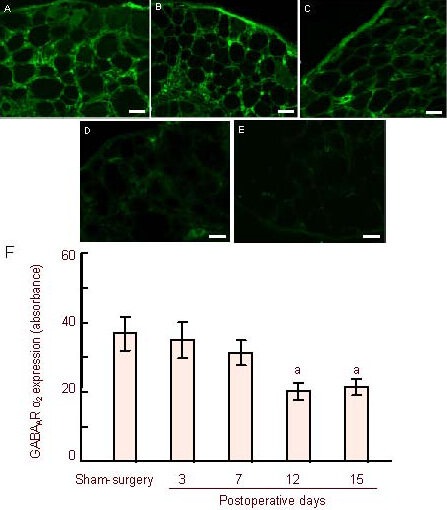
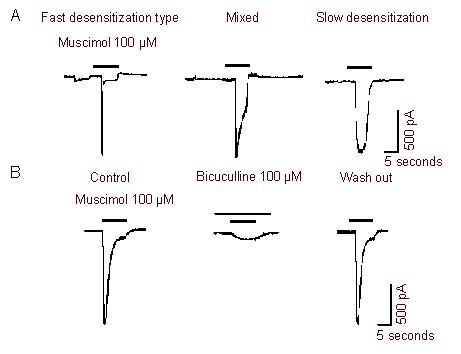
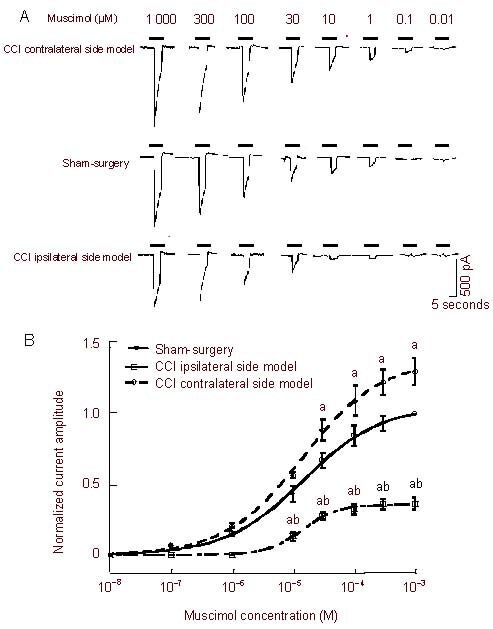
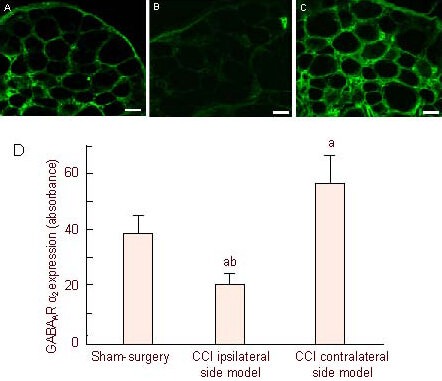
The γ-aminobutyric acid neurotransmitter in the spinal cord dorsal horn plays an important role in pain modulation through primary afferent-mediated presynaptic inhibition. The weakening of γ-aminobutyric acid-mediated presynaptic inhibition may be an important cause of neuropathic pain. γ-aminobutyric acid-mediated presynaptic inhibition is related to the current strength of γ-aminobutyric acid A receptor activation. In view of this, the whole-cell patch-clamp technique was used here to record the change in muscimol activated current of dorsal root ganglion neurons in a chronic constriction injury model. Results found that damage in rat dorsal root ganglion neurons following application of muscimol caused concentration-dependent activation of current, and compared with the sham group, its current strength and γ-aminobutyric acid A receptor protein expression decreased. Immunofluorescence revealed that γ-aminobutyric acid type A receptor α2 subunit protein expression decreased and was most obvious at 12 and 15 days after modeling. Our experimental findings confirmed that the γ-aminobutyric acid type A receptor α2 subunit in the chronic constriction injury model rat dorsal root ganglion was downregulated, which may be one of the reasons for the reduction of injury in dorsal root ganglion neurons following muscimol-activated currents.
脊髓背角中的γ-氨基丁酸神经递质通过初级传入介导的突触前抑制在疼痛调制中发挥重要作用。γ-氨基丁酸介导的突触前抑制减弱可能是神经病理性疼痛的重要原因。γ-氨基丁酸介导的突触前抑制与γ-氨基丁酸 A 受体激活的电流强度有关。有鉴于此,本研究采用全细胞膜片钳技术记录慢性缩窄性损伤模型背根神经节神经元中 muscimol 激活电流的变化。结果发现,应用 muscimol 后大鼠背根神经节神经元损伤导致电流呈浓度依赖性激活,与假手术组相比,其电流强度和γ-氨基丁酸 A 受体蛋白表达降低。免疫荧光显示γ-氨基丁酸 A 型受体α2 亚基蛋白表达降低,在造模后 12 和 15 天最为明显。我们的实验结果证实,慢性缩窄性损伤模型大鼠背根神经节中的γ-氨基丁酸 A 型受体α2 亚基下调,这可能是 muscimol 激活电流后背根神经节神经元损伤减少的原因之一。