Retamal Mauricio A
Centro de Fisiología Celular e Integrativa, Facultad de Medicina, Clínica Alemana Universidad del Desarrollo Santiago, Chile.
Front Physiol. 2016 Jun 28;7:259. doi: 10.3389/fphys.2016.00259. eCollection 2016.
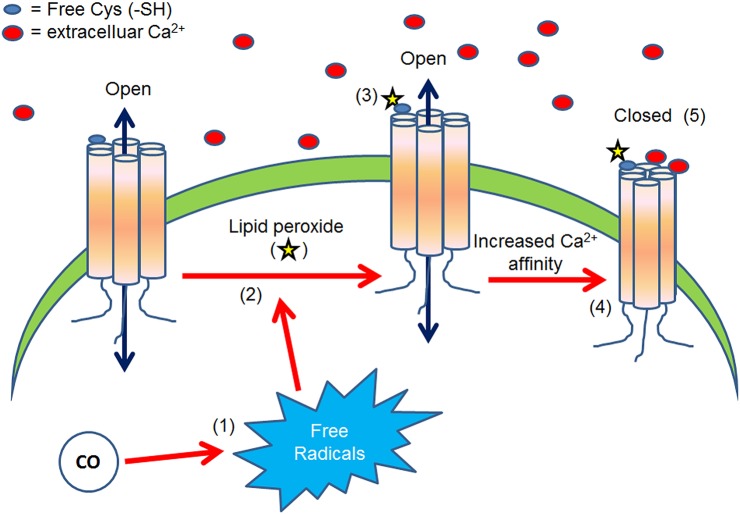
Hemichannels are ion channels composed of six connexins (Cxs), and they have the peculiarity to be permeable not only to ions, but also to molecules such as ATP and glutamate. Under physiological conditions they present a low open probability, which is sufficient to enable them to participate in several physiological functions. However, massive and/or prolonged hemichannel opening induces or accelerates cell death. Therefore, the study of the molecular mechanisms that control hemichannel activity appears to be essential for understanding several physiological and pathological processes. Carbon monoxide (CO) is a gaseous transmitter that modulates many cellular processes, some of them through modulation of ion channel activity. CO exerts its biological actions through the activation of guanylate cyclase and/or inducing direct carbonylation of proline, threonine, lysine, and arginine. It is well accepted that guanylate cyclase dependent pathway and direct carbonylation, are not sensitive to reducing agents. However, it is important to point out that CO-through a lipid peroxide dependent process-can also induce a secondary carbonylation in cysteine groups, which is sensitive to reducing agents. Recently, in our laboratory we demonstrated that the application of CO donors to the bath solution inhibited Cx46 hemichannel currents in Xenopus laevis oocytes, a phenomenon that was fully reverted by reducing agents. Therefore, a plausible mechanism of CO-induced Cx46 hemichannel inhibition is through Cx46-lipid oxidation. In this work, I will present current evidence and some preliminary results that support the following hypothesis: Carbon monoxide inhibits Cx46 HCs through a lipid peroxidation-dependent process. The main goal of this paper is to broaden the scientific community interest in studying the relationship between CO-Fatty acids and hemichannels, which will pave the way to more research directed to the understanding of the molecular mechanism(s) that control the opening and closing of hemichannels in both physiological and pathological conditions.
半通道是由六个连接蛋白(Cxs)组成的离子通道,其特点是不仅对离子具有通透性,而且对ATP和谷氨酸等分子也具有通透性。在生理条件下,它们的开放概率较低,这足以使其参与多种生理功能。然而,大量和/或长时间的半通道开放会诱导或加速细胞死亡。因此,研究控制半通道活性的分子机制对于理解多种生理和病理过程似乎至关重要。一氧化碳(CO)是一种气体递质,可调节许多细胞过程,其中一些是通过调节离子通道活性来实现的。CO通过激活鸟苷酸环化酶和/或诱导脯氨酸、苏氨酸、赖氨酸和精氨酸的直接羰基化来发挥其生物学作用。人们普遍认为,鸟苷酸环化酶依赖性途径和直接羰基化对还原剂不敏感。然而,需要指出的是,CO通过脂质过氧化物依赖性过程也可在半胱氨酸基团中诱导对还原剂敏感的二级羰基化。最近,在我们实验室中,我们证明将CO供体应用于浴液可抑制非洲爪蟾卵母细胞中的Cx46半通道电流,这一现象可被还原剂完全逆转。因此,CO诱导Cx46半通道抑制的一种合理机制是通过Cx46-脂质氧化。在这项工作中,我将展示当前的证据和一些初步结果,这些证据和结果支持以下假设:一氧化碳通过脂质过氧化依赖性过程抑制Cx46半通道。本文的主要目的是拓宽科学界对研究CO-脂肪酸与半通道之间关系的兴趣,这将为更多旨在理解在生理和病理条件下控制半通道开闭的分子机制的研究铺平道路。