Centro de Fisiología Celular e Integrativa, Facultad de Medicina Clínica Alemana,Universidad del Desarrollo, Santiago 7690000, Chile.
Programa de Doctorado en Ciencias e Innovación en Medicina, Facultad de Medicina, Clínica Alemana Universidad del Desarrollo, Santiago, Chile.
Int J Mol Sci. 2020 Jun 30;21(13):4698. doi: 10.3390/ijms21134698.
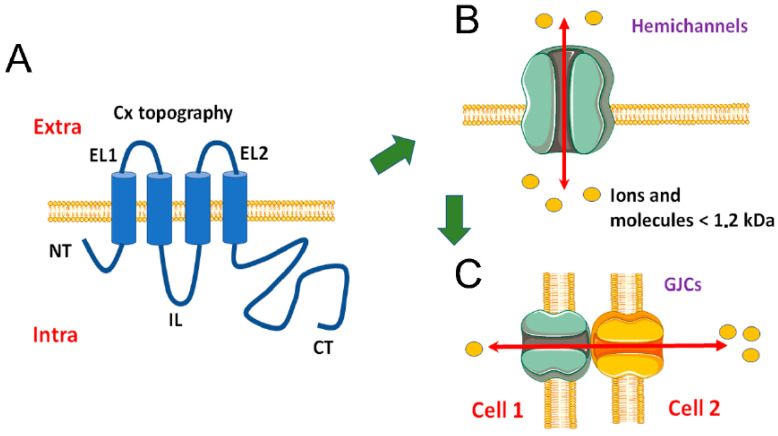
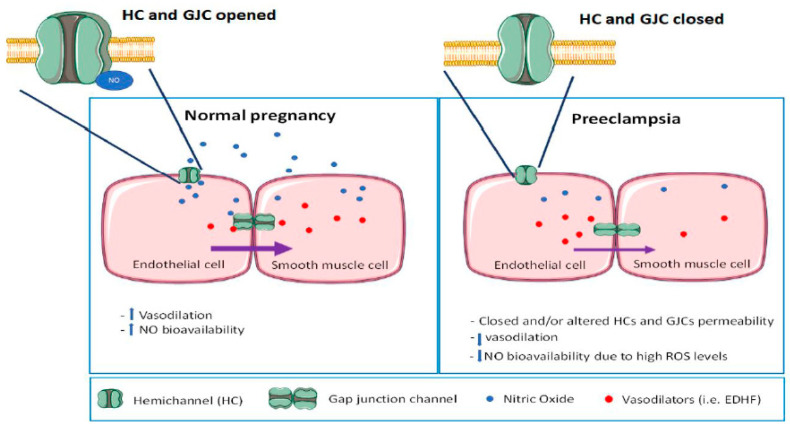
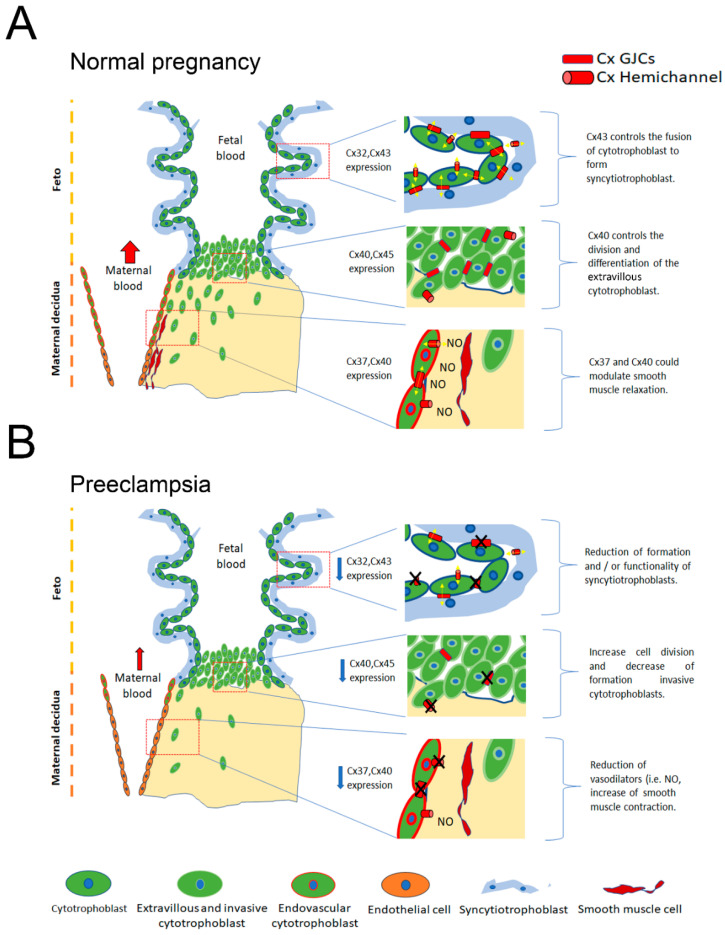
Preeclampsia is a pregnancy complication that appears after 20 weeks of gestation and is characterized by hypertension and proteinuria, affecting both mother and offspring. The cellular and molecular mechanisms that cause the development of preeclampsia are poorly understood. An important feature of preeclampsia is an increase in oxygen and nitrogen derived free radicals (reactive oxygen species/reactive nitrogen species (ROS/RNS), which seem to be central players setting the development and progression of preeclampsia. Cell-to-cell communication may be disrupted as well. Connexins (Cxs), a family of transmembrane proteins that form hemichannels and gap junction channels (GJCs), are essential in paracrine and autocrine cell communication, allowing the movement of signaling molecules between cells as well as between the cytoplasm and the extracellular media. GJCs and hemichannels are fundamental for communication between endothelial and smooth muscle cells and, therefore, in the control of vascular contraction and relaxation. In systemic vasculature, the activity of GJCs and hemichannels is modulated by ROS and RNS. Cxs participate in the development of the placenta and are expressed in placental vasculature. However, it is unknown whether Cxs are modulated by ROS/RNS in the placenta, or whether this potential modulation contributes to the pathogenesis of preeclampsia. Our review addresses the possible role of Cxs in preeclampsia, and the plausible modulation of Cxs-formed channels by ROS and RNS. We suggest these factors may contribute to the development of preeclampsia.
子痫前期是一种妊娠并发症,出现在妊娠 20 周后,其特征是高血压和蛋白尿,影响母婴双方。导致子痫前期发展的细胞和分子机制尚未完全清楚。子痫前期的一个重要特征是氧和氮衍生的自由基(活性氧/活性氮物质 (ROS/RNS) 的增加,这些自由基似乎是引发子痫前期发展和进展的核心因素。细胞间通讯也可能受到干扰。连接蛋白 (Cxs) 是一类形成半通道和间隙连接通道 (GJCs) 的跨膜蛋白,在旁分泌和自分泌细胞通讯中至关重要,允许信号分子在细胞之间以及细胞质和细胞外介质之间移动。GJCs 和半通道对于内皮细胞和平滑肌细胞之间的通讯以及血管收缩和舒张的控制至关重要。在全身血管中,GJCs 和半通道的活性受 ROS 和 RNS 调节。Cxs 参与胎盘的发育,并在胎盘血管中表达。然而,尚不清楚 Cxs 是否被 ROS/RNS 在胎盘中调节,或者这种潜在的调节是否有助于子痫前期的发病机制。我们的综述探讨了 Cxs 在子痫前期中的可能作用,以及 ROS 和 RNS 对 Cxs 形成的通道的可能调节。我们认为这些因素可能导致子痫前期的发生。