Hannon Erin E, Lévêque Yohana, Nave Karli M, Trehub Sandra E
Department of Psychology, University of Nevada Las Vegas Las Vegas, NV, USA.
Centre de Recherche en Neurosciences de Lyon, Institut National de la Santé et de la Recherche Médicale, Lyon 1 University Lyon, France.
Front Psychol. 2016 Jun 21;7:939. doi: 10.3389/fpsyg.2016.00939. eCollection 2016.
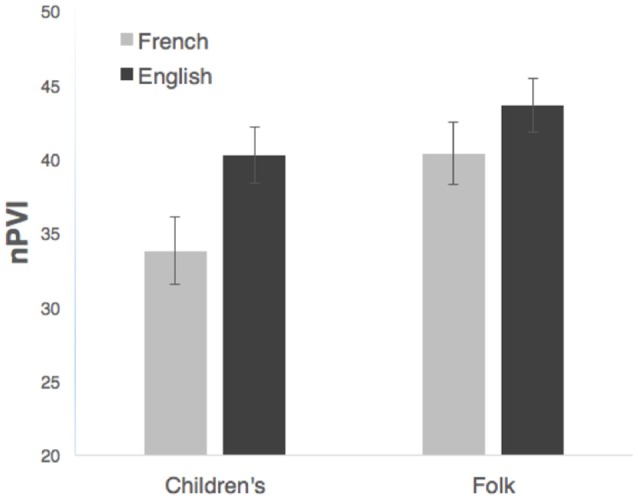
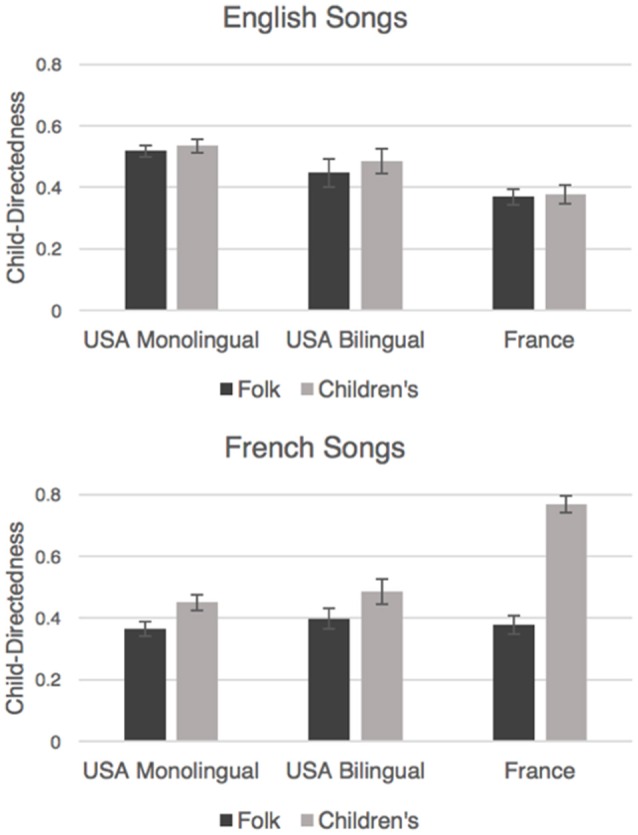
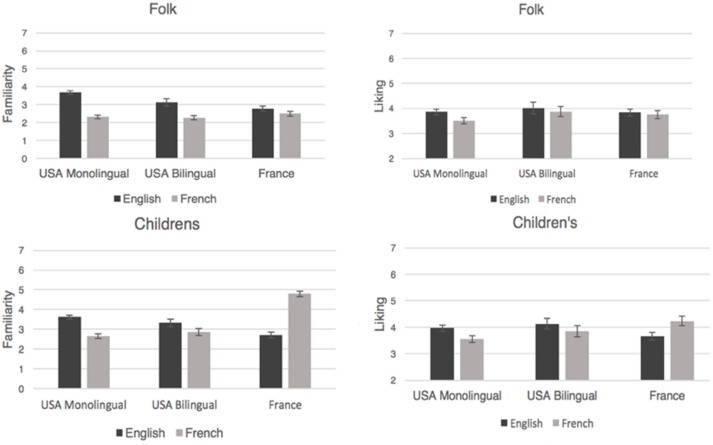
The available evidence indicates that the music of a culture reflects the speech rhythm of the prevailing language. The normalized pairwise variability index (nPVI) is a measure of durational contrast between successive events that can be applied to vowels in speech and to notes in music. Music-language parallels may have implications for the acquisition of language and music, but it is unclear whether native-language rhythms are reflected in children's songs. In general, children's songs exhibit greater rhythmic regularity than adults' songs, in line with their caregiving goals and frequent coordination with rhythmic movement. Accordingly, one might expect lower nPVI values (i.e., lower variability) for such songs regardless of culture. In addition to their caregiving goals, children's songs may serve an intuitive didactic function by modeling culturally relevant content and structure for music and language. One might therefore expect pronounced rhythmic parallels between children's songs and language of origin. To evaluate these predictions, we analyzed a corpus of 269 English and French songs from folk and children's music anthologies. As in prior work, nPVI values were significantly higher for English than for French children's songs. For folk songs (i.e., songs not for children), the difference in nPVI for English and French songs was small and in the expected direction but non-significant. We subsequently collected ratings from American and French monolingual and bilingual adults, who rated their familiarity with each song, how much they liked it, and whether or not they thought it was a children's song. Listeners gave higher familiarity and liking ratings to songs from their own culture, and they gave higher familiarity and preference ratings to children's songs than to other songs. Although higher child-directedness ratings were given to children's than to folk songs, French listeners drove this effect, and their ratings were uniquely predicted by nPVI. Together, these findings suggest that language-based rhythmic structures are evident in children's songs, and that listeners expect exaggerated language-based rhythms in children's songs. The implications of these findings for enculturation processes and for the acquisition of music and language are discussed.
现有证据表明,一种文化的音乐反映了主流语言的语音节奏。归一化成对变异指数(nPVI)是衡量连续事件之间时长对比的指标,可应用于语音中的元音和音乐中的音符。音乐与语言的相似性可能对语言和音乐的习得有影响,但尚不清楚母语节奏是否体现在儿童歌曲中。一般来说,儿童歌曲比成人歌曲表现出更大的节奏规律性,这与它们的照顾目的以及与节奏运动的频繁协调一致。因此,无论文化如何,人们可能会预期此类歌曲的nPVI值较低(即变异性较低)。除了照顾目的外,儿童歌曲还可能通过为音乐和语言塑造与文化相关的内容和结构来发挥直观的教育功能。因此,人们可能会预期儿童歌曲与起源语言之间存在明显的节奏相似性。为了评估这些预测,我们分析了一个由269首来自民间和儿童音乐选集的英语和法语歌曲组成的语料库。与之前的研究一样,英语儿童歌曲的nPVI值显著高于法语儿童歌曲。对于民歌(即非儿童歌曲),英语和法语歌曲的nPVI差异较小且符合预期方向,但不显著。我们随后收集了美国和法国单语及双语成年人的评分,他们对每首歌曲的熟悉程度、喜欢程度以及是否认为它是一首儿童歌曲进行了评分。听众对来自自己文化的歌曲给出了更高的熟悉度和喜欢度评分,并且他们对儿童歌曲的熟悉度和偏好评分高于其他歌曲。尽管儿童歌曲的儿童导向评分高于民歌,但这种影响是由法国听众推动的,并且他们的评分唯一地由nPVI预测。这些发现共同表明,基于语言的节奏结构在儿童歌曲中很明显,并且听众期望儿童歌曲中有夸张的基于语言的节奏。讨论了这些发现对文化适应过程以及音乐和语言习得的影响。