Kim Seo Young, Shin Sung Bong, Lee Seong Jae, Kim Tae Uk, Hyun Jung Keun
Department of Rehabilitation Medicine, Dankook University College of Medicine, Cheonan, Korea.
Department of Rehabilitation Medicine, National Rehabilitation Center, Seoul, Korea.
Ann Rehabil Med. 2016 Jun;40(3):373-82. doi: 10.5535/arm.2016.40.3.373. Epub 2016 Jun 29.
To investigate the factors related to upper extremity functional improvement following inhibitory repetitive transcranial magnetic stimulation (rTMS) in stroke patients.
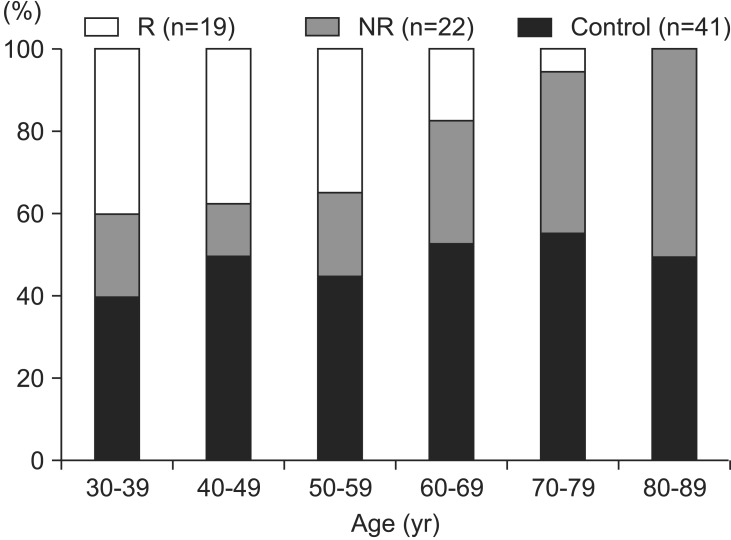
Forty-one stroke patients received low-frequency rTMS over the contralesional hemisphere according to a standard protocol, in addition to conventional physical and occupational therapy. The rTMS-treated patients were divided into two groups according to their responsiveness to rTMS measured by the self-care score of the Korean version of Modified Barthel Index (K-MBI): responded group (n=19) and non-responded group (n=22). Forty-one age-matched stroke patients who had not received rTMS served as controls. Neurological, cognitive and functional assessments were performed before rTMS and 4 weeks after rTMS treatment.
Among the rTMS-treated patients, the responded group was significantly younger than the non-responded group (51.6±10.5 years and 65.5±13.7 years, respectively; p=0.001). Four weeks after rTMS, the National Institutes of Health Stroke Scale, the Brunnstrom recovery stage and upper extremity muscle power scores were significantly more improved in the responded group than in the control group. Besides the self-care score, the mobility score of the K-MBI was also more improved in the responded group than in the non-responded group or controls.
Age is the most obvious factor determining upper extremity functional responsiveness to low-frequency rTMS in stroke patients.
探讨抑制性重复经颅磁刺激(rTMS)治疗后卒中患者上肢功能改善的相关因素。
41例卒中患者除接受常规物理和职业治疗外,还按照标准方案在对侧半球进行低频rTMS治疗。根据改良Barthel指数韩国版(K-MBI)的自我护理评分所测得的对rTMS的反应性,将接受rTMS治疗的患者分为两组:反应组(n = 19)和无反应组(n = 22)。41例年龄匹配但未接受rTMS治疗的卒中患者作为对照组。在rTMS治疗前及治疗4周后进行神经、认知和功能评估。
在接受rTMS治疗的患者中,反应组明显比无反应组年轻(分别为51.6±10.5岁和65.5±13.7岁;p = 0.001)。rTMS治疗4周后,反应组的美国国立卫生研究院卒中量表、Brunnstrom恢复阶段及上肢肌力评分改善程度明显高于对照组。除自我护理评分外,反应组K-MBI的活动能力评分改善程度也高于无反应组和对照组。
年龄是决定卒中患者上肢功能对低频rTMS反应性的最明显因素。