Department of Virology, Central Veterinary Institute Lelystad, Wageningen UR , Lelystad , Netherlands.
Boehringer Ingelheim Animal Health Operations BV , Weesp , Netherlands.
Front Vet Sci. 2016 Jun 30;3:52. doi: 10.3389/fvets.2016.00052. eCollection 2016.
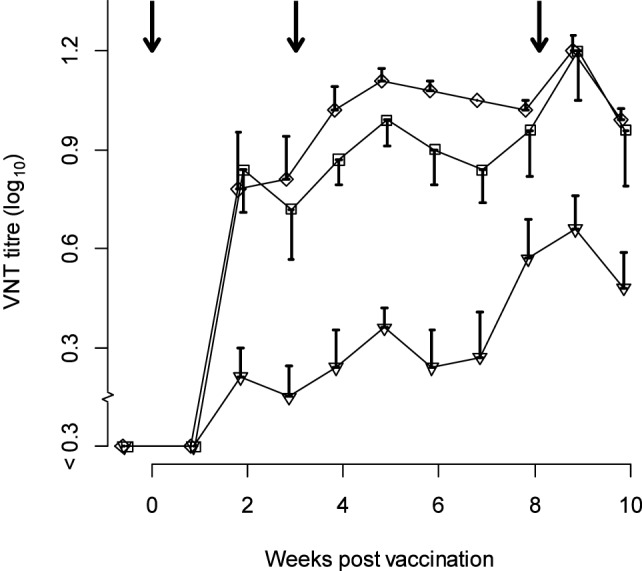
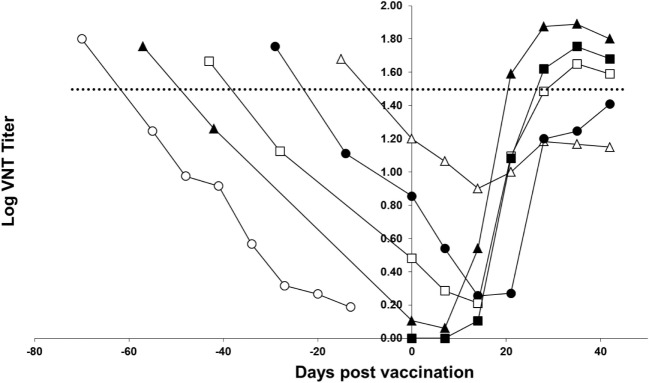
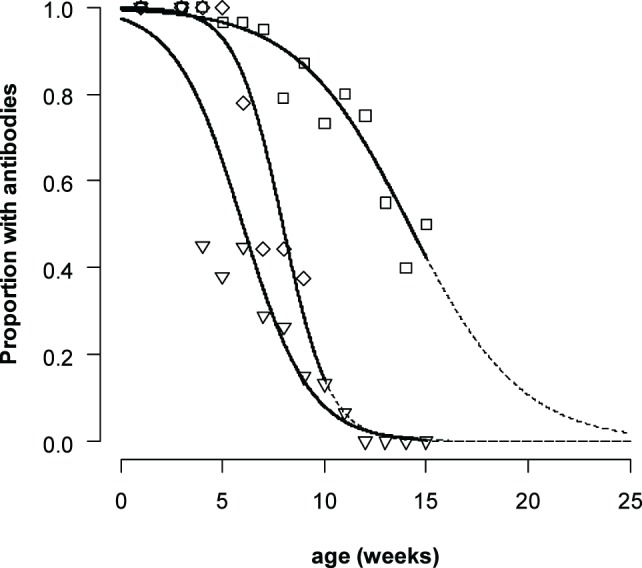
We investigated to what extent maternally derived antibodies interfere with foot-and-mouth disease (FMD) vaccination in order to determine the factors that influence the correct vaccination for piglets. Groups of piglets with maternally derived antibodies were vaccinated at different time points following birth, and the antibody titers to FMD virus (FMDV) were measured using virus neutralization tests (VNT). We used 50 piglets from 5 sows that had been vaccinated 3 times intramuscularly in the neck during pregnancy with FMD vaccine containing strains of FMDV serotypes O, A, and Asia-1. Four groups of 10 piglets were vaccinated intramuscularly in the neck at 3, 5, 7, or 9 weeks of age using a monovalent Cedivac-FMD vaccine (serotype A TUR/14/98). One group of 10 piglets with maternally derived antibodies was not vaccinated, and another group of 10 piglets without maternally derived antibodies was vaccinated at 3 weeks of age and served as a control group. Sera samples were collected, and antibody titers were determined using VNT. In our study, the antibody responses of piglets with maternally derived antibodies vaccinated at 7 or 9 weeks of age were similar to the responses of piglets without maternally derived antibodies vaccinated at 3 weeks of age. The maternally derived antibody levels in piglets depended very strongly on the antibody titer in the sow, so the optimal time for vaccination of piglets will depend on the vaccination scheme and quality of vaccine used in the sows and should, therefore, be monitored and reviewed on regular basis in countries that use FMD prophylactic vaccination.
我们研究了母源抗体在多大程度上干扰口蹄疫(FMD)疫苗接种,以确定影响仔猪正确接种的因素。将具有母源抗体的仔猪分组,在出生后不同时间点进行接种,并使用病毒中和试验(VNT)测量针对 FMD 病毒(FMDV)的抗体滴度。我们使用了来自 5 头母猪的 50 头仔猪,这些母猪在怀孕期间已在颈部肌肉内接种了 3 次含有 FMDV 血清型 O、A 和亚洲-1 型的 FMD 疫苗。将 4 组 10 头仔猪分别在颈部肌肉内以 3、5、7 或 9 周龄时使用单价 Cedivac-FMD 疫苗(血清型 A TUR/14/98)进行接种。一组 10 头具有母源抗体的仔猪未进行接种,另一组 10 头无母源抗体的仔猪在 3 周龄时进行接种,并作为对照组。采集血清样本,并使用 VNT 测定抗体滴度。在我们的研究中,7 或 9 周龄时接种且具有母源抗体的仔猪的抗体反应与 3 周龄时接种且无母源抗体的仔猪的反应相似。具有母源抗体的仔猪的母源抗体水平非常强烈地取决于母猪的抗体滴度,因此仔猪的最佳接种时间将取决于母猪使用的疫苗接种方案和疫苗质量,因此,在使用 FMD 预防性接种的国家中,应定期监测和审查。