Chin Cheen Fei, Tan Kaiquan, Onishi Masayuki, Chew YuanYuan, Augustine Beryl, Lee Wei Ren, Yeong Foong May
Department of Biochemistry, Yong Loo Lin School of Medicine, National University of Singapore, Singapore.
Department of Genetics, Stanford University School of Medicine, Stanford, California, United States of America.
PLoS Genet. 2016 Jul 22;12(7):e1006195. doi: 10.1371/journal.pgen.1006195. eCollection 2016 Jul.
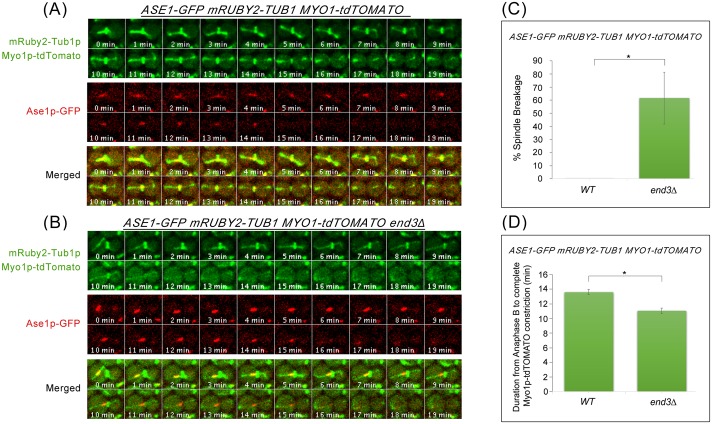
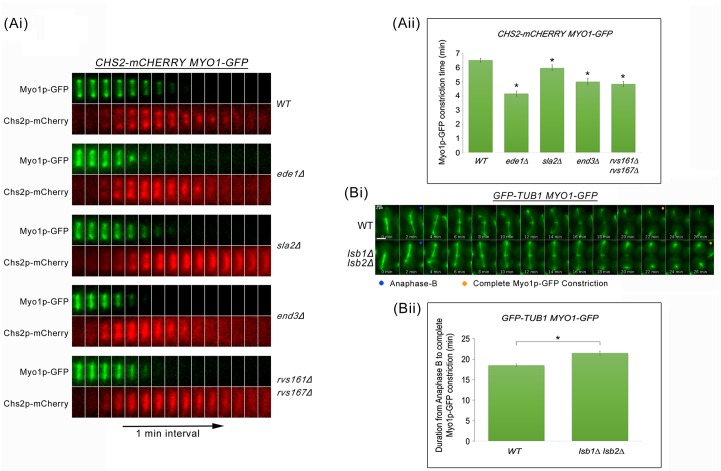
Cytokinesis requires the spatio-temporal coordination of membrane deposition and primary septum (PS) formation at the division site to drive acto-myosin ring (AMR) constriction. It has been demonstrated that AMR constriction invariably occurs only after the mitotic spindle disassembly. It has also been established that Chitin Synthase II (Chs2p) neck localization precedes mitotic spindle disassembly during mitotic exit. As AMR constriction depends upon PS formation, the question arises as to how chitin deposition is regulated so as to prevent premature AMR constriction and mitotic spindle breakage. In this study, we propose that cells regulate the coordination between spindle disassembly and AMR constriction via timely endocytosis of cytokinetic enzymes, Chs2p, Chs3p, and Fks1p. Inhibition of endocytosis leads to over accumulation of cytokinetic enzymes during mitotic exit, which accelerates the constriction of the AMR, and causes spindle breakage that eventually could contribute to monopolar spindle formation in the subsequent round of cell division. Intriguingly, the mitotic spindle breakage observed in endocytosis mutants can be rescued either by deleting or inhibiting the activities of, CHS2, CHS3 and FKS1, which are involved in septum formation. The findings from our study highlight the importance of timely endocytosis of cytokinetic enzymes at the division site in safeguarding mitotic spindle integrity during mitotic exit.
胞质分裂需要在分裂位点进行膜沉积和初生隔膜(PS)形成的时空协调,以驱动肌动球蛋白环(AMR)收缩。已经证明,AMR收缩总是仅在有丝分裂纺锤体解体后才发生。还确定在有丝分裂退出期间,几丁质合酶II(Chs2p)在颈部的定位先于有丝分裂纺锤体的解体。由于AMR收缩依赖于PS形成,因此就出现了一个问题,即几丁质沉积是如何被调节以防止AMR过早收缩和有丝分裂纺锤体断裂的。在本研究中,我们提出细胞通过及时内吞胞质分裂酶Chs2p、Chs3p和Fks1p来调节纺锤体解体与AMR收缩之间的协调。内吞作用的抑制导致有丝分裂退出期间胞质分裂酶过度积累,这加速了AMR的收缩,并导致纺锤体断裂,最终可能导致后续细胞分裂轮次中形成单极纺锤体。有趣的是,通过删除或抑制参与隔膜形成的CHS2、CHS3和FKS1的活性,可以挽救在内吞作用突变体中观察到的有丝分裂纺锤体断裂。我们研究的结果突出了在分裂位点及时内吞胞质分裂酶在有丝分裂退出期间维护有丝分裂纺锤体完整性的重要性。