Browning Robert B, McGillicuddy John W, Treiber Frank A, Taber David J
J Am Pharm Assoc (2003). 2016 Jul-Aug;56(4):450-454.e1. doi: 10.1016/j.japh.2016.03.017.
To assess smartphone ownership, use of mobile health (mHealth) applications, and willingness to use this technology to facilitate medication management after kidney transplantation.
A survey was developed with the use of previously validated questions and administered to stable adult kidney recipients from May to July 2015. Descriptive and comparative statistics were used to assess willingness to utilize mHealth technology as it related to sociodemographics, medication adherence, and medication side effects. Comparisons were also made to a survey administered in 2012. The primary outcome was the incidence of cell phone and smartphone ownership, willingness to use mHealth, immunosuppressant side effects, and self-reported nonadherence.
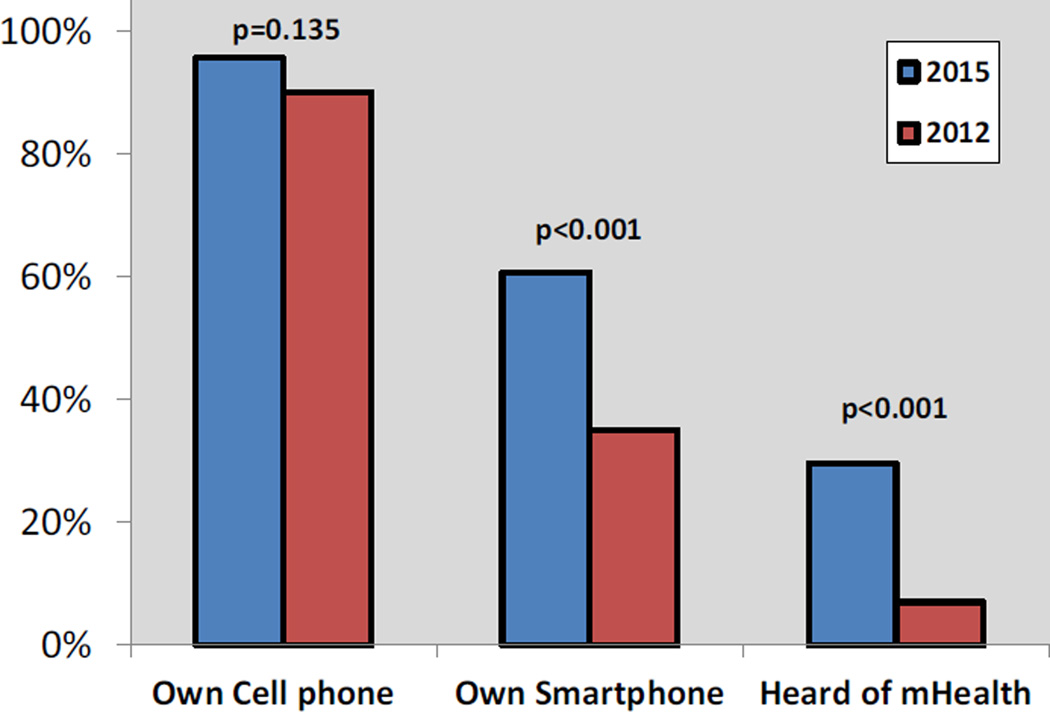
A total of 142 patients were approached, and 139 (98%) agreed to participate; 96% of respondents indicated mobile phone ownership, 61% owned a smartphone, 30% had prior knowledge of mHealth, and 7% were already using an mHealth app; 78% reported a positive attitude toward the use of mHealth for medication management. Smartphone ownership has nearly doubled since 2012 (61% vs. 35%; P <0.001). Patients <55 years of age were more likely to own smartphones (75% vs. 46%; P <0.001) and to strongly agree with the use of mHealth (62% vs. 36%; P = 0.015). Self-reported nonadherence or severe medication side effects did not appreciably influence a patient's willingness to use mHealth.
Among recipients of kidney transplants, smartphone ownership has dramatically increased, and recipients have a positive attitude toward the use of mHealth for medication management.
评估肾移植后智能手机的拥有情况、移动健康(mHealth)应用程序的使用情况,以及使用该技术促进药物管理的意愿。
使用先前经过验证的问题制定了一项调查,并于2015年5月至7月对稳定的成年肾移植受者进行了调查。使用描述性和比较性统计数据来评估使用mHealth技术的意愿,因为它与社会人口统计学、药物依从性和药物副作用有关。还与2012年进行的一项调查进行了比较。主要结果是手机和智能手机的拥有率、使用mHealth的意愿、免疫抑制剂副作用以及自我报告的不依从情况。
共接触了142名患者,139名(98%)同意参与;96%的受访者表示拥有手机,61%拥有智能手机,30%对mHealth有先验知识,7%已经在使用mHealth应用程序;78%的受访者对使用mHealth进行药物管理持积极态度。自2012年以来,智能手机的拥有率几乎翻了一番(61%对35%;P<0.001)。年龄小于55岁的患者更有可能拥有智能手机(75%对46%;P<0.001),并且更强烈地同意使用mHealth(62%对36%;P=0.015)。自我报告的不依从或严重药物副作用并未明显影响患者使用mHealth的意愿。
在肾移植受者中,智能手机的拥有率显著提高,并且受者对使用mHealth进行药物管理持积极态度。