Megna Bryant W, Carney Patrick R, Nukaya Manabu, Geiger Pete, Kennedy Gregory D
Department of Surgery, School of Medicine and Public Health, University of Wisconsin, Madison, Wisconsin.
Department of Surgery, School of Medicine and Public Health, University of Wisconsin, Madison, Wisconsin.
J Surg Res. 2016 Jul;204(1):47-54. doi: 10.1016/j.jss.2016.04.021. Epub 2016 Apr 22.
Even with colonoscopy screening and preventive measures becoming more commonplace, colorectal cancer (CRC) remains the third leading cause of oncologic death in the United States as of 2014. Many chemotherapeutics exist for the treatment of colorectal cancer, though they often come with significant side effect profiles or narrow efficacy ranges in terms of patient profile. Dietary phytochemicals such as glucobrassicin and its metabolite indole-3-carbinol (I3C) have been implicated in tumor prevention in many preclinical models across a variety of gastrointestinal tumors and represent an intriguing new class of natural chemotherapeutics for CRC. I3C has been identified as a ligand of the aryl hydrocarbon receptor (AHR), and we aimed to characterize this AHR activation in relation to its cytotoxic properties.
Human colorectal cancer cell lines DLD1, HCT116, HT-29, LS513, and RKO were treated with indole-3-carbinol or vehicle. Cell viability was assessed via a fluorescent product assay, and apoptotic activity was assessed via a luminescent signal tied to a ratio of caspase-3 and caspase-7 activity. Gene expression of AHR and CYP1A1 messenger ribonucleic acid (mRNA) was measured using quantitative real-time polymerase chain reaction. Small interfering RNA stable expression lines were established on a HCT116 background using a laboratory-developed transfection protocol as published elsewhere.
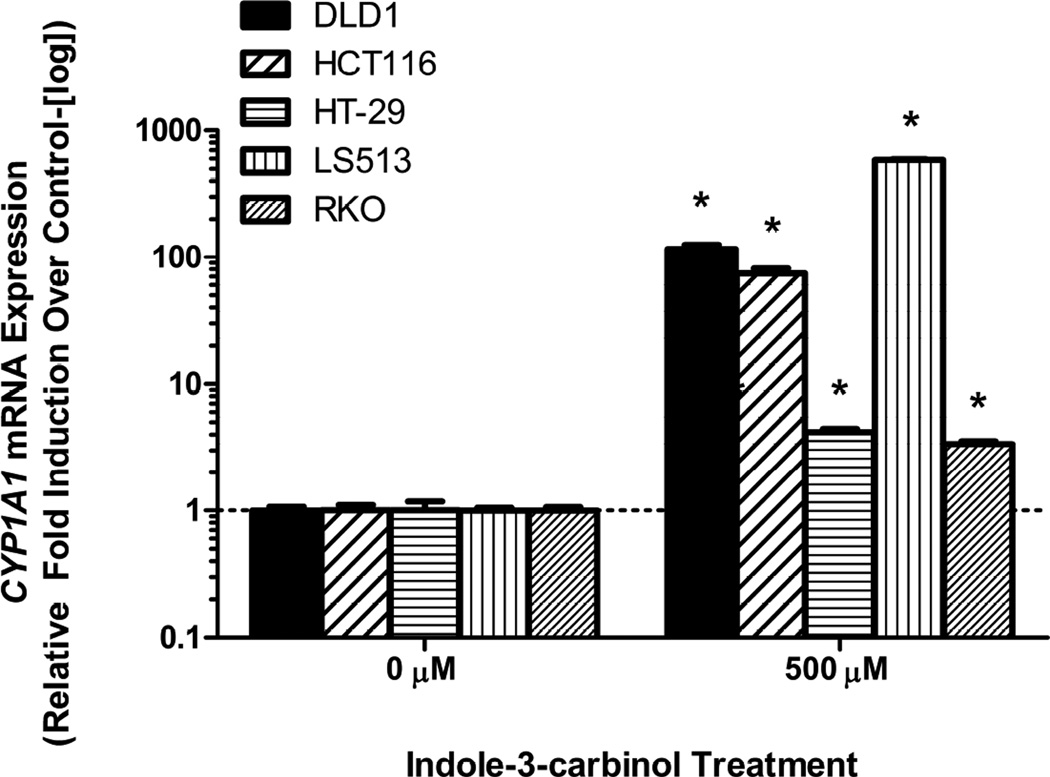
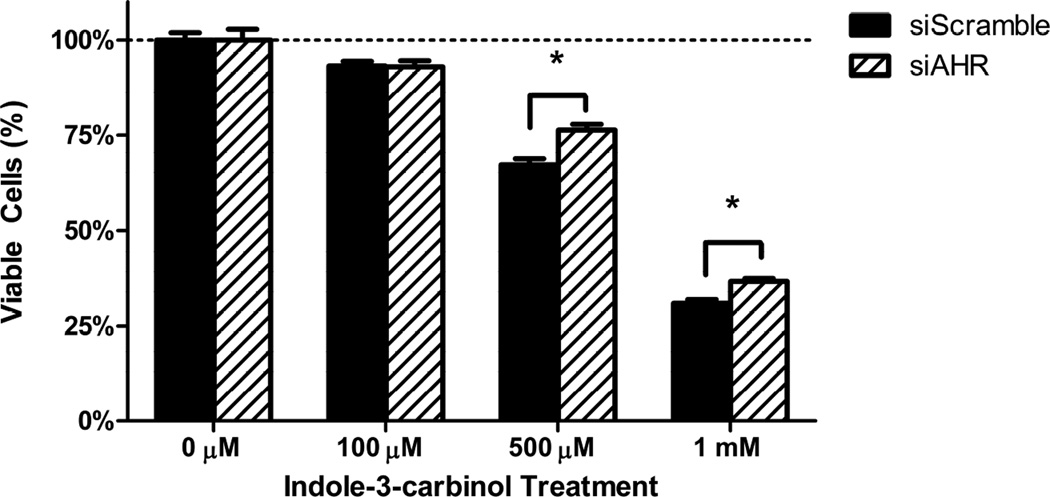
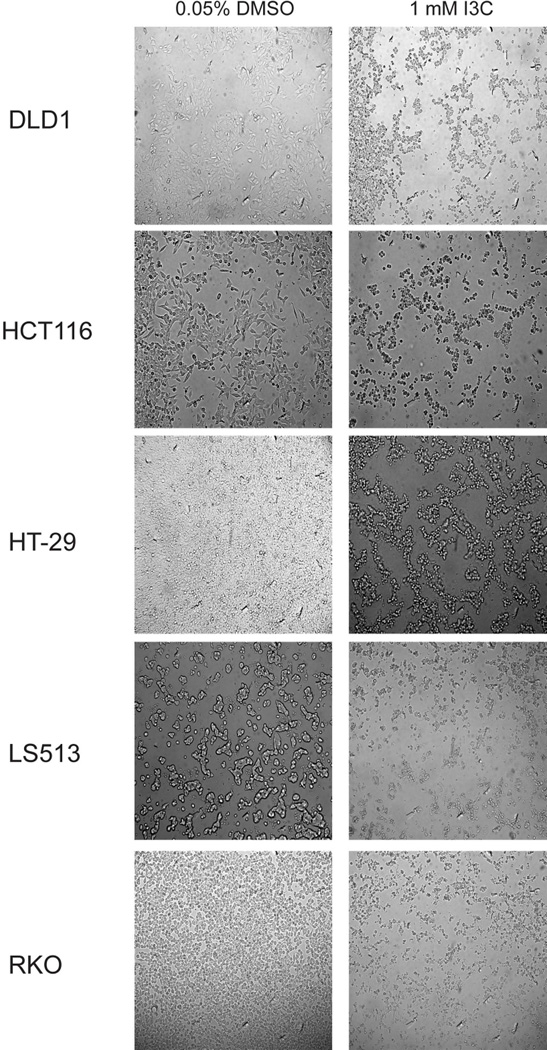
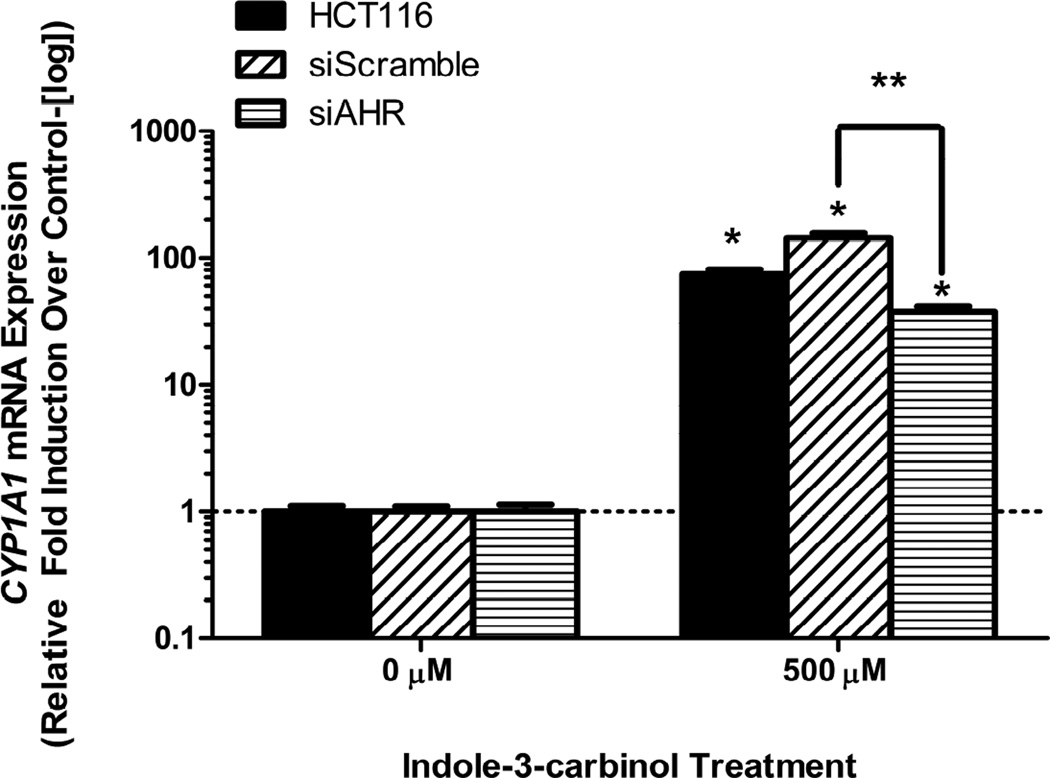
Multiple colorectal cancer cell types express increased CYP1A1 mRNA levels (a specific marker of AHR-driven activity) after treatment with I3C, characterizing I3C treatment as agonistic of this pathway. Also, I3C induced a dose-dependent decrease in cell viability as well as inducing apoptosis. Furthermore, using small interfering RNA interference to knockdown AHR responsiveness generated a significant resistance to the chemotherapeutic actions of indole-3-carbinol regarding both cell viability and apoptotic activity.
Some degree of the cytotoxic and proapoptotic effects of indole-3-carbinol on colon cancer cells is dependent on activation of the aryl hydrocarbon receptor. This represents a novel mechanism for the molecular action of indole-3-carbinol and enhances our understanding of its effects in the context of colorectal cancer. Continued preclinical study of both indole-3-carbinol and the aryl hydrocarbon receptor pathway is warranted, which may one day lead to novel diet-derived colon cancer treatments that enlist the AHR.
即便结肠镜筛查和预防措施日益普及,但截至2014年,结直肠癌(CRC)仍是美国肿瘤死亡的第三大主要原因。现有多种化疗药物用于治疗结直肠癌,不过它们往往伴有显著的副作用,或者在适用患者群体方面疗效范围较窄。膳食植物化学物质,如葡萄糖异硫氰酸酯及其代谢产物吲哚 - 3 - 甲醇(I3C),在多种临床前模型中对多种胃肠道肿瘤的预防作用已得到证实,是一类引人关注的新型结直肠癌天然化疗药物。I3C已被确定为芳烃受体(AHR)的配体,我们旨在研究这种AHR激活与其细胞毒性特性之间的关系。
用吲哚 - 3 - 甲醇或赋形剂处理人结直肠癌细胞系DLD1、HCT116、HT - 29、LS513和RKO。通过荧光产物测定评估细胞活力,通过与半胱天冬酶 - 3和半胱天冬酶 - 7活性比值相关的发光信号评估凋亡活性。使用定量实时聚合酶链反应测量AHR和细胞色素P450 1A1信使核糖核酸(mRNA)的基因表达。采用实验室开发并已在其他地方发表的转染方案,在HCT116背景上建立小干扰RNA稳定表达系。
多种结直肠癌细胞类型在用I3C处理后,细胞色素P450 1A1 mRNA水平升高(AHR驱动活性的特异性标志物),表明I3C处理是该信号通路的激动剂。此外,I3C诱导细胞活力呈剂量依赖性下降,并诱导细胞凋亡。此外,使用小干扰RNA干扰降低AHR反应性后,细胞对吲哚 - 3 - 甲醇的化疗作用(包括细胞活力和凋亡活性)产生了显著抗性。
吲哚 - 3 - 甲醇对结肠癌细胞的细胞毒性和促凋亡作用在一定程度上依赖于芳烃受体的激活。这代表了吲哚 - 3 - 甲醇分子作用的一种新机制,并增进了我们对其在结直肠癌背景下作用的理解。对吲哚 - 3 - 甲醇和芳烃受体信号通路继续进行临床前研究是有必要的,这可能有朝一日会带来借助AHR的新型饮食源性结肠癌治疗方法。