Kleberg Johan Lundin, Thorup Emilia, Falck-Ytter Terje
Department of Psychology, Uppsala University, Uppsala, Sweden.
Department of Women's and Children's Health, Center of Neurodevelopmental Disorders at Karolinska Institutet (KIND), Karolinska institutet, Stockholm, Sweden.
Autism Res. 2017 Feb;10(2):246-250. doi: 10.1002/aur.1668. Epub 2016 Jul 25.
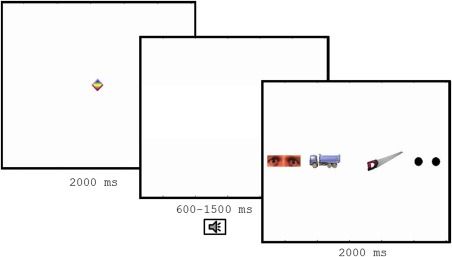
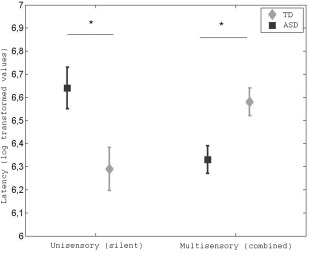
Autism Spectrum Disorder (ASD) has been associated with reduced orienting to social stimuli such as eyes, but the results are inconsistent. It is not known whether atypicalities in phasic alerting could play a role in putative altered social orienting in ASD. Here, we show that in unisensory (visual) trials, children with ASD are slower to orient to eyes (among distractors) than controls matched for age, sex, and nonverbal IQ. However, in another condition where a brief spatially nonpredictive sound was presented just before the visual targets, this group effect was reversed. Our results indicate that orienting to social versus nonsocial stimuli is differently modulated by phasic alerting mechanisms in young children with ASD. Autism Res 2017, 10: 246-250. © 2016 The Authors Autism Research published by Wiley Periodicals, Inc. on behalf of International Society for Autism Research.
自闭症谱系障碍(ASD)与对眼睛等社交刺激的定向减少有关,但结果并不一致。目前尚不清楚相位警觉异常是否在ASD假定的社交定向改变中起作用。在这里,我们表明,在单感官(视觉)试验中,与年龄、性别和非语言智商相匹配的对照组相比,患有ASD的儿童在(干扰物中)定向到眼睛的速度较慢。然而,在另一种情况下,即在视觉目标出现之前呈现一个短暂的空间非预测性声音,这种组间差异就会逆转。我们的结果表明,在患有ASD的幼儿中,相位警觉机制对社交刺激与非社交刺激的定向调节方式不同。《自闭症研究》2017年,10: 246 - 250。© 2016作者。《自闭症研究》由威利期刊公司代表国际自闭症研究协会出版。