Vassou Sophie Lorraine, Nithaniyal Stalin, Raju Balaji, Parani Madasamy
Department of Genetic Engineering, Center for DNA Barcoding, SRM University, Kattankulathur, 603203, India.
BMC Complement Altern Med. 2016 Jul 18;16 Suppl 1(Suppl 1):186. doi: 10.1186/s12906-016-1086-0.
Ayurveda is a system of traditional medicine that originated in ancient India, and it is still in practice. Medicinal plants are the backbone of Ayurveda, which heavily relies on the plant-derived therapeutics. While Ayurveda is becoming more popular in several countries throughout the World, lack of authenticated medicinal plant raw drugs is a growing concern. Our aim was to DNA barcode the medicinal plants that are listed in the Ayurvedic Pharmacopoeia of India (API) to create a reference DNA barcode library, and to use the same to authenticate the raw drugs that are sold in markets.
We have DNA barcoded 347 medicinal plants using rbcL marker, and curated rbcL DNA barcodes for 27 medicinal plants from public databases. These sequences were used to create Ayurvedic Pharmacopoeia of India - Reference DNA Barcode Library (API-RDBL). This library was used to authenticate 100 medicinal plant raw drugs, which were in the form of powders (82) and seeds (18).
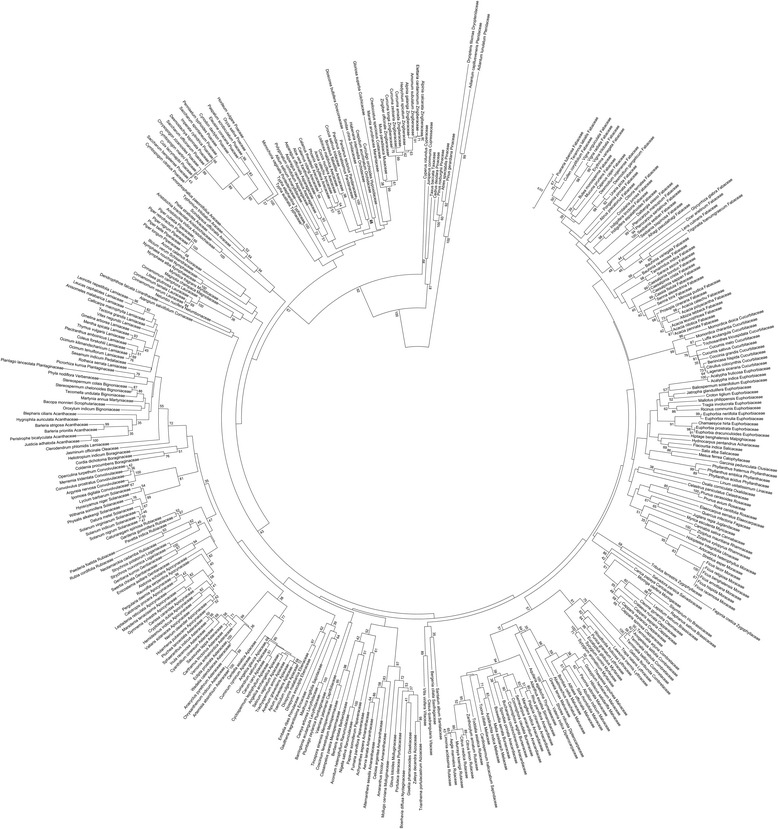
Ayurvedic Pharmacopoeia of India - Reference DNA Barcode Library (API-RDBL) was created with high quality and authentic rbcL barcodes for 374 out of the 395 medicinal plants that are included in the API. The rbcL DNA barcode differentiated 319 species (85 %) with the pairwise divergence ranging between 0.2 and 29.9 %. PCR amplification and DNA sequencing success rate of rbcL marker was 100 % even for the poorly preserved medicinal plant raw drugs that were collected from local markets. DNA barcoding revealed that only 79 % raw drugs were authentic, and the remaining 21 % samples were adulterated. Further, adulteration was found to be much higher with powders (ca. 25 %) when compared to seeds (ca. 5 %).
The present study demonstrated the utility of DNA barcoding in authenticating medicinal plant raw drugs, and found that approximately one fifth of the market samples were adulterated. Powdered raw drugs, which are very difficult to be identified by taxonomists as well as common people, seem to be the easy target for adulteration. Developing a quality control protocol for medicinal plant raw drugs by incorporating DNA barcoding as a component is essential to ensure safety to the consumers.
阿育吠陀医学是起源于古印度的传统医学体系,至今仍在应用。药用植物是阿育吠陀医学的支柱,该医学体系严重依赖植物衍生疗法。虽然阿育吠陀医学在世界上多个国家越来越受欢迎,但缺乏经过认证的药用植物原料药物正成为一个日益令人担忧的问题。我们的目的是对列入《印度阿育吠陀药典》(API)的药用植物进行DNA条形码鉴定,以创建一个参考DNA条形码库,并使用该库对市场上销售的原料药物进行鉴定。
我们使用rbcL标记对347种药用植物进行了DNA条形码鉴定,并从公共数据库中整理了27种药用植物的rbcL DNA条形码。这些序列被用于创建《印度阿育吠陀药典》-参考DNA条形码库(API-RDBL)。该库被用于鉴定100种药用植物原料药物,这些药物呈粉末状(82种)和种子状(18种)。
利用高质量且经过认证的rbcL条形码,为API中包含的395种药用植物中的374种创建了《印度阿育吠陀药典》-参考DNA条形码库(API-RDBL)。rbcL DNA条形码区分了319个物种(85%),两两差异在0.2%至29.9%之间。即使对于从当地市场收集的保存不佳的药用植物原料药物,rbcL标记的PCR扩增和DNA测序成功率也为100%。DNA条形码鉴定显示,只有79%的原料药物是正品,其余21%的样品掺假。此外,发现粉末状药物的掺假率(约25%)比种子状药物(约5%)高得多。
本研究证明了DNA条形码在鉴定药用植物原料药物方面的实用性,并发现约五分之一的市场样品掺假。粉末状原料药物很难被分类学家和普通人识别,似乎很容易成为掺假的目标。将DNA条形码作为一个组成部分纳入药用植物原料药物的质量控制方案对于确保消费者安全至关重要。