Lee Hyun Woo, Lee Jung Kyu, Kim Eunyoung, Yim Jae-Joon, Lee Chang-Hoon
Division of Pulmonary and Critical Care Medicine, Department of Internal Medicine, Seoul National University College of Medicine, Seoul National University Hospital, Seoul, 03080, Republic of Korea.
Division of Pulmonary and Critical Care Medicine, Department of Internal Medicine, Seoul Metropolitan Government-Seoul National University Boramae Medical Center, Seoul, 07061, Republic of Korea.
PLoS One. 2016 Jul 25;11(7):e0159827. doi: 10.1371/journal.pone.0159827. eCollection 2016.
Fluoroquinolone is recommended as a pivotal antituberculous agent for treating multi-drug-resistant pulmonary tuberculosis. However, its effectiveness as first-line treatment remains controversial. The present study was conducted to validate the fluoroquinolone-containing regimen for drug-sensitive pulmonary tuberculosis.
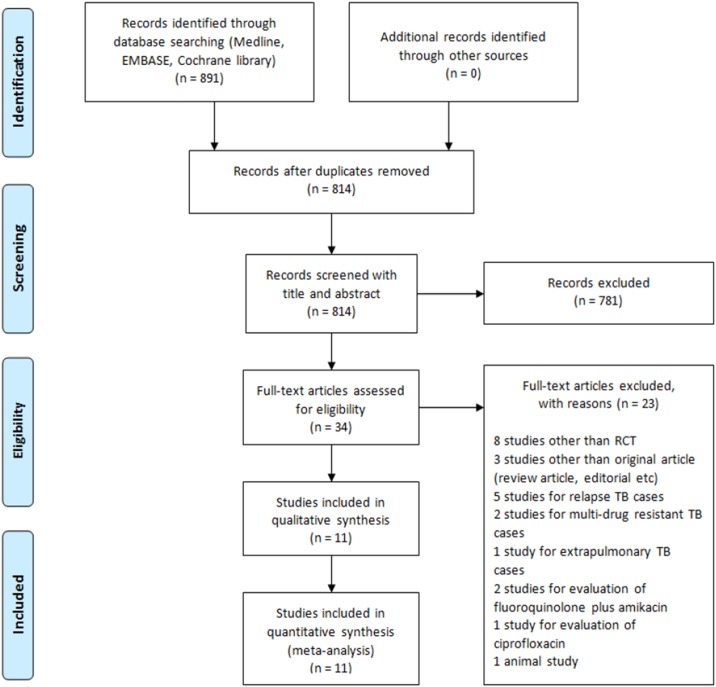
We searched MEDLINE, EMBASE, and the Cochrane Central Register of Controlled Trials until June 5, 2015. Randomized controlled trials (RCTs) that compared antituberculous regimens containing fluoroquinolone with the standard regimen were included.
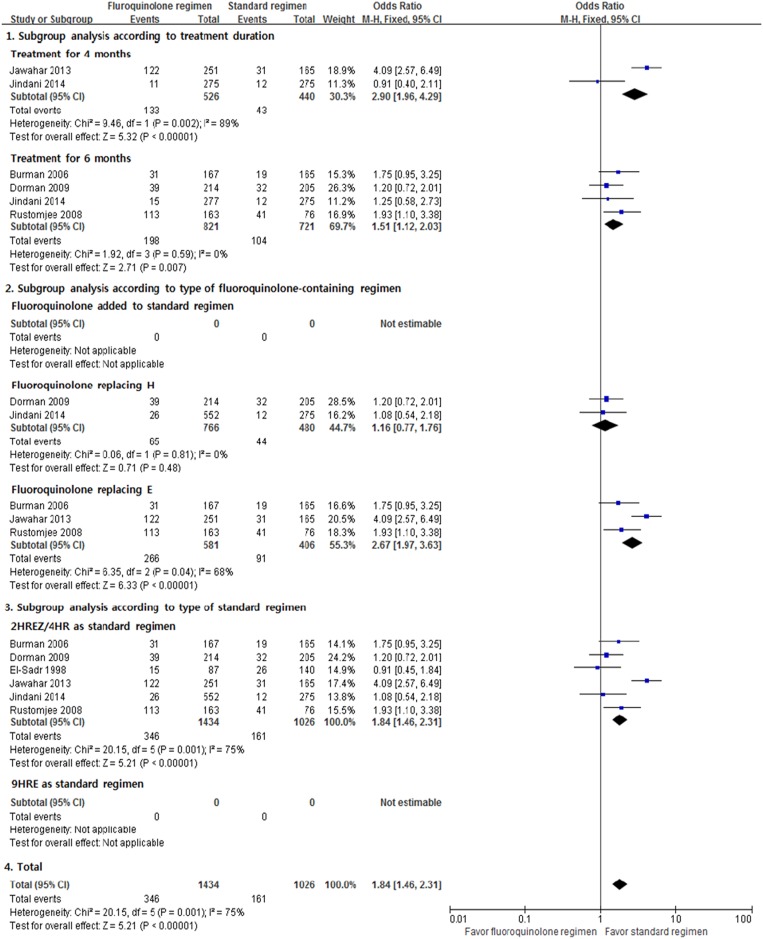
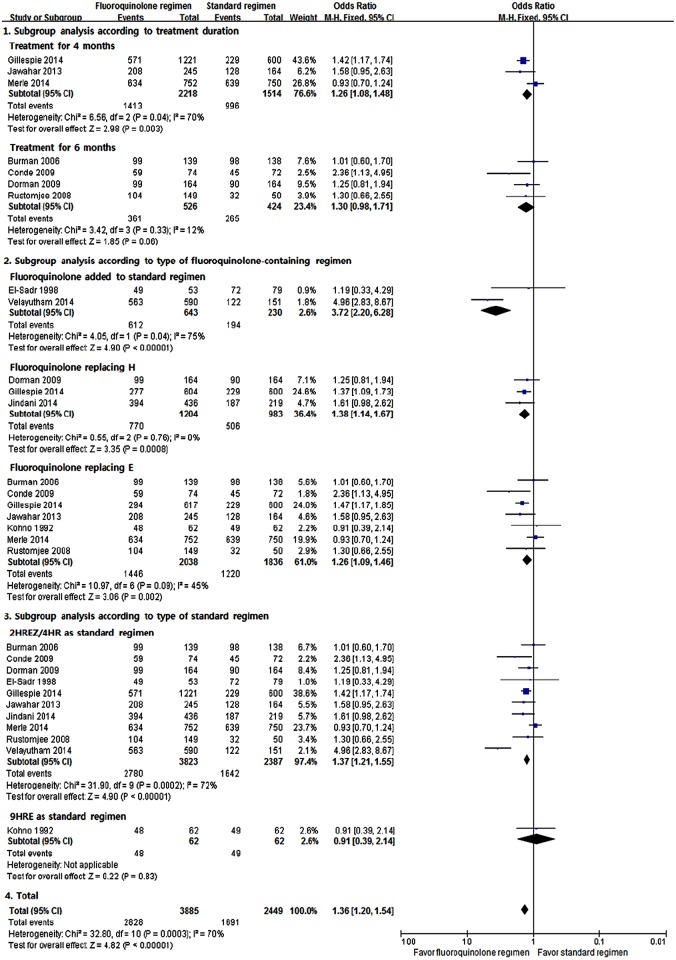
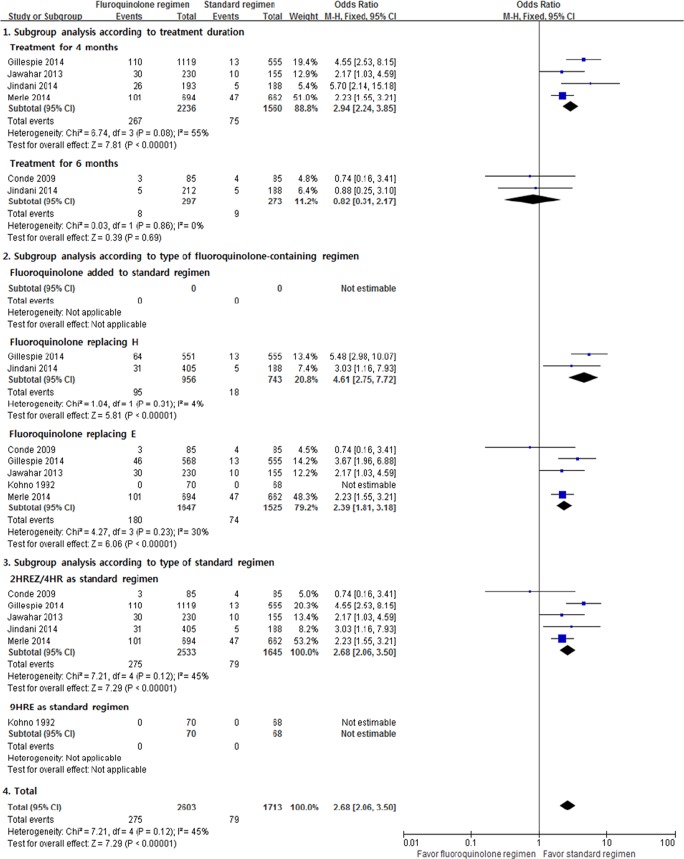
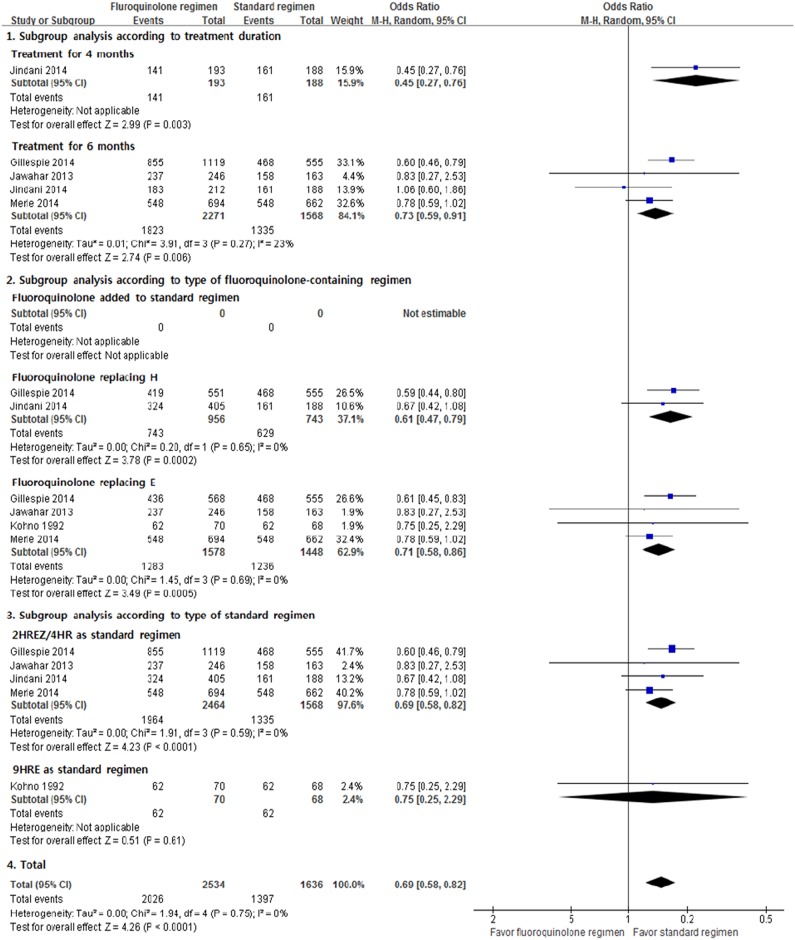
Eleven RCTs that included 6,334 patients were selected. Fluoroquinolone-containing regimens had a higher rate of sputum culture conversion at 2 months of treatment (M-H fixed odds ratio [OR], 1.36; 95% confidence interval [CI], 1.20-1.54). However, the outcomes were less favorable (M-H fixed OR, 0.69; 95% CI, 0.59-0.82) and the associated total adverse events were more frequent (M-H fixed OR, 1.84; 95% CI, 1.46-2.31) in the fluoroquinolone-containing regimen group, without a significant heterogeneity according to treatment duration. Treatment with the fluoroquinolone-containing regimen for 4 months showed a higher relapse rate.
Despite a higher culture conversion rate at 2 months of treatment, the fluoroquinolone-containing regimen had limitations, including less favorable outcomes and more adverse events, as the first-line therapy for drug-sensitive pulmonary tuberculosis.
氟喹诺酮类药物被推荐作为治疗耐多药肺结核的关键抗结核药物。然而,其作为一线治疗的有效性仍存在争议。本研究旨在验证含氟喹诺酮类药物的方案用于治疗药物敏感型肺结核的效果。
我们检索了截至2015年6月5日的MEDLINE、EMBASE和Cochrane对照试验中心注册库。纳入了比较含氟喹诺酮类药物的抗结核方案与标准方案的随机对照试验(RCT)。
选取了11项包含6334例患者的RCT。含氟喹诺酮类药物的方案在治疗2个月时痰培养转阴率更高(M-H固定比值比[OR],1.36;95%置信区间[CI],1.20-1.54)。然而,含氟喹诺酮类药物的方案组结局较差(M-H固定OR,0.69;95%CI,0.59-0.82),且相关的总不良事件更频繁(M-H固定OR,1.84;95%CI,1.46-2.31),根据治疗持续时间无显著异质性。含氟喹诺酮类药物的方案治疗4个月显示复发率更高。
尽管含氟喹诺酮类药物的方案在治疗2个月时痰培养转阴率更高,但作为药物敏感型肺结核的一线治疗方案存在局限性,包括结局较差和不良事件更多。