Public Health Virology, Forensic and Scientific Services, Department of Health, Queensland Government, PO Box 594, Archerfield, 4108, QLD, Australia.
Australian Infectious Diseases Research Centre, School of Chemistry and Molecular Biosciences, The University of Queensland, St Lucia, 4072, QLD, Australia.
Parasit Vectors. 2016 Jul 25;9(1):414. doi: 10.1186/s13071-016-1683-2.
Insect-specific viruses do not replicate in vertebrate cells, but persist in mosquito populations and are highly prevalent in nature. These viruses may naturally regulate the transmission of pathogenic vertebrate-infecting arboviruses in co-infected mosquitoes. Following the isolation of the first Australian insect-specific flavivirus (ISF), Palm Creek virus (PCV), we investigated routes of infection and transmission of this virus in key Australian arbovirus vectors and its impact on replication and transmission of West Nile virus (WNV).
Culex annulirostris, Aedes aegypti and Aedes vigilax were exposed to PCV, and infection, replication and transmission rates in individual mosquitoes determined. To test whether the virus could be transmitted vertically, progeny reared from eggs oviposited by PCV-inoculated Cx. annulirostris were analysed for the presence of PCV. To assess whether prior infection of mosquitoes with PCV could also suppress the transmission of pathogenic flaviviruses, PCV positive or negative Cx. annulirostris were subsequently exposed to WNV.
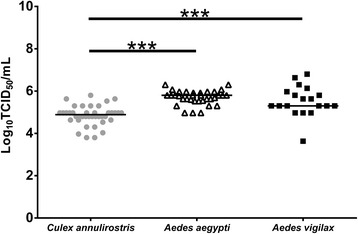
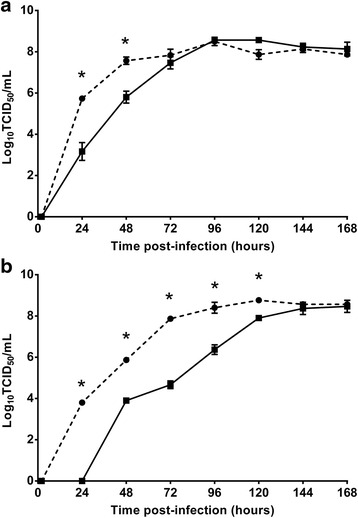
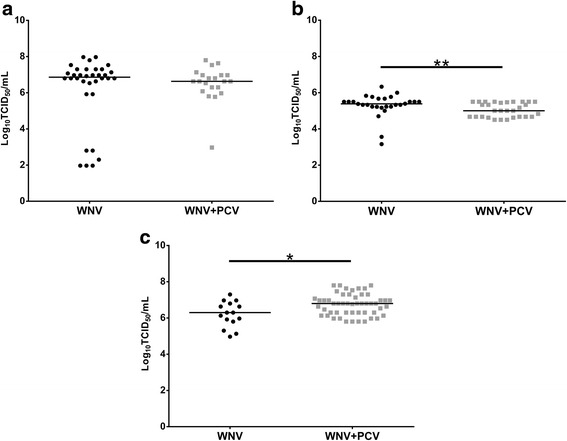
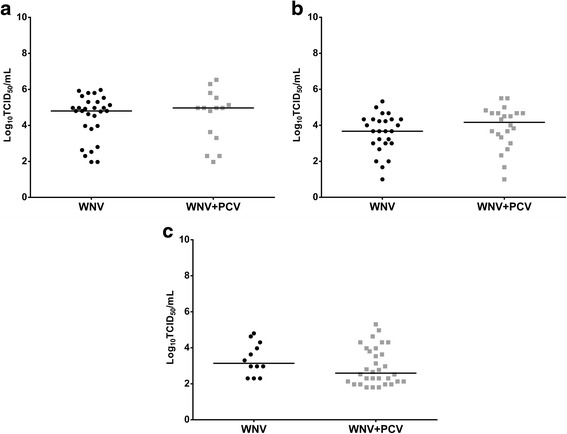
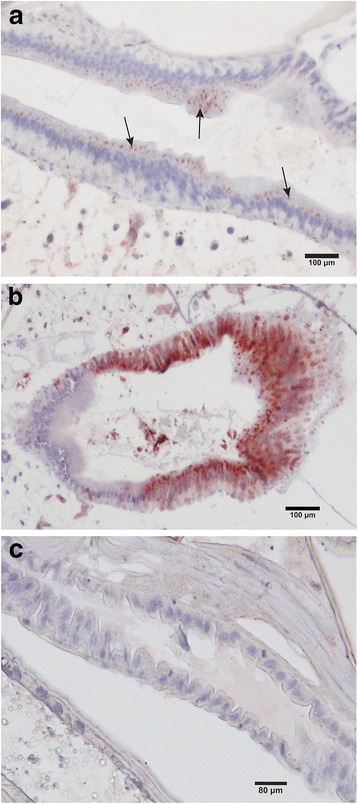
No PCV-infected Cx. annulirostris were detected 16 days after feeding on an infectious blood meal. However, when intrathoracically inoculated with PCV, Cx. annulirostris infection rates were 100 %. Similar rates of infection were observed in Ae. aegypti (100 %) and Ae. vigilax (95 %). Notably, PCV was not detected in any saliva expectorates collected from any of these species. PCV was not detected in 1038 progeny reared from 59 PCV-infected Cx. annulirostris. After feeding on a blood meal containing 10(7) infectious units of WNV, significantly fewer PCV-infected Cx. annulirostris were infected or transmitted WNV compared to PCV negative mosquitoes. Immunohistochemistry revealed that PCV localized in the midgut epithelial cells, which are the first site of infection with WNV.
Our results indicate that PCV cannot infect Cx. annulirostris via the oral route, nor be transmitted in saliva or vertically to progeny. We also provide further evidence that prior infection with insect-specific viruses can regulate the infection and transmission of pathogenic arboviruses.
昆虫特异性病毒不会在脊椎动物细胞中复制,但在蚊子种群中持续存在,并且在自然界中高度流行。这些病毒可能会自然调节受感染蚊子中致病性脊椎动物感染虫媒病毒的传播。在分离出第一种澳大利亚昆虫特异性黄病毒(ISF),即棕榈溪病毒(PCV)之后,我们研究了该病毒在关键澳大利亚虫媒病毒载体中的感染和传播途径及其对西尼罗河病毒(WNV)复制和传播的影响。
用 PCV 感染库蚊、埃及伊蚊和致倦库蚊,并确定个体蚊子的感染、复制和传播率。为了测试该病毒是否可以垂直传播,分析了由感染了 PCV 的库蚊产卵所孵育的后代中是否存在 PCV。为了评估蚊子先前感染 PCV 是否也能抑制致病性黄病毒的传播,用 PCV 阳性或阴性的库蚊暴露于 WNV。
在感染后 16 天,没有检测到感染 PCV 的库蚊。然而,当经胸内接种 PCV 时,库蚊的感染率为 100%。在埃及伊蚊(100%)和致倦库蚊(95%)中也观察到相似的感染率。值得注意的是,从这些物种中采集的任何唾液中都未检测到 PCV。从 59 只感染了 PCV 的库蚊中孵育的 1038 只后代中未检测到 PCV。在感染了 10(7)个感染性单位的 WNV 血餐后,与 PCV 阴性蚊子相比,感染或传播 WNV 的 PCV 感染库蚊明显减少。免疫组织化学显示,PCV 定位于中肠上皮细胞,这是 WNV 的第一个感染部位。
我们的结果表明,PCV 不能通过口腔途径感染库蚊,也不能在唾液中传播或垂直传播给后代。我们还提供了进一步的证据表明,先前感染昆虫特异性病毒可以调节致病性虫媒病毒的感染和传播。