Blitvich Bradley J, Firth Andrew E
Department of Veterinary Microbiology and Preventive Medicine, College of Veterinary Medicine, Iowa State University, Ames, IA 50011, USA.
Department of Pathology, University of Cambridge, Cambridge CB2 1QP, UK.
Viruses. 2015 Apr 10;7(4):1927-59. doi: 10.3390/v7041927.
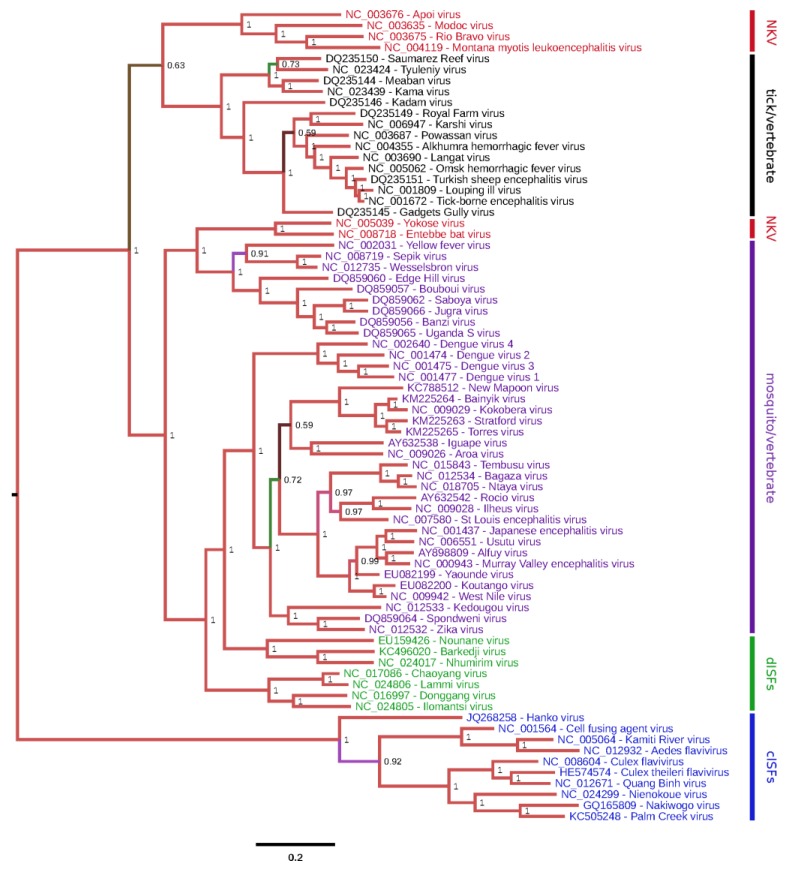
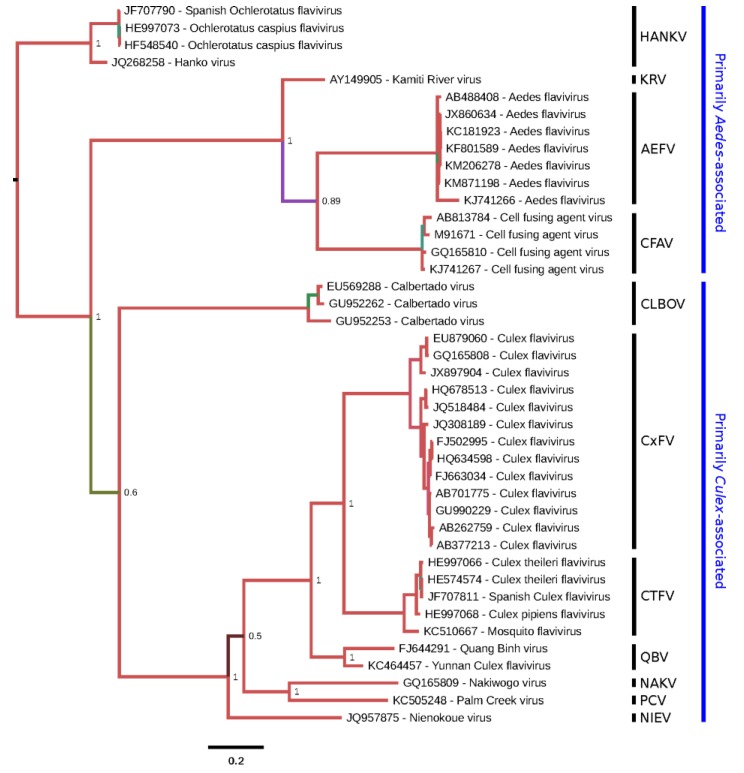
There has been a dramatic increase in the number of insect-specific flaviviruses (ISFs) discovered in the last decade. Historically, these viruses have generated limited interest due to their inability to infect vertebrate cells. This viewpoint has changed in recent years because some ISFs have been shown to enhance or suppress the replication of medically important flaviviruses in co-infected mosquito cells. Additionally, comparative studies between ISFs and medically important flaviviruses can provide a unique perspective as to why some flaviviruses possess the ability to infect and cause devastating disease in humans while others do not. ISFs have been isolated exclusively from mosquitoes in nature but the detection of ISF-like sequences in sandflies and chironomids indicates that they may also infect other dipterans. ISFs can be divided into two distinct phylogenetic groups. The first group currently consists of approximately 12 viruses and includes cell fusing agent virus, Kamiti River virus and Culex flavivirus. These viruses are phylogenetically distinct from all other known flaviviruses. The second group, which is apparently not monophyletic, currently consists of nine viruses and includes Chaoyang virus, Nounané virus and Lammi virus. These viruses phylogenetically affiliate with mosquito/vertebrate flaviviruses despite their apparent insect-restricted phenotype. This article provides a review of the discovery, host range, mode of transmission, superinfection exclusion ability and genomic organization of ISFs. This article also attempts to clarify the ISF nomenclature because some of these viruses have been assigned more than one name due to their simultaneous discoveries by independent research groups.
在过去十年中,昆虫特异性黄病毒(ISF)的发现数量急剧增加。从历史上看,由于这些病毒无法感染脊椎动物细胞,它们引起的关注有限。近年来,这种观点发生了变化,因为一些ISF已被证明在共同感染的蚊子细胞中可增强或抑制医学上重要的黄病毒的复制。此外,ISF与医学上重要的黄病毒之间的比较研究可以提供一个独特的视角,以解释为什么一些黄病毒具有感染人类并导致毁灭性疾病的能力,而另一些则没有。ISF仅从自然界的蚊子中分离出来,但在白蛉和摇蚊中检测到ISF样序列表明它们也可能感染其他双翅目昆虫。ISF可分为两个不同的系统发育组。第一组目前约有12种病毒,包括细胞融合剂病毒、卡米蒂河病毒和库蚊黄病毒。这些病毒在系统发育上与所有其他已知的黄病毒不同。第二组显然不是单系的,目前有9种病毒,包括朝阳病毒、努纳内病毒和拉米病毒。尽管这些病毒具有明显的昆虫限制表型,但它们在系统发育上与蚊子/脊椎动物黄病毒相关。本文综述了ISF的发现、宿主范围、传播方式、超感染排除能力和基因组结构。本文还试图澄清ISF的命名,因为其中一些病毒由于被独立研究小组同时发现而被赋予了不止一个名称。