Sun Run-Lu, Huang Can-Xia, Bao Jin-Lan, Jiang Jie-Yu, Zhang Bo, Zhou Shu-Xian, Cai Wei-Bin, Wang Hong, Wang Jing-Feng, Zhang Yu-Ling
From the Cardiovascular Medicine Department.
Intensive Care Unit, and.
J Biol Chem. 2016 Sep 9;291(37):19532-44. doi: 10.1074/jbc.M116.714279. Epub 2016 Jul 25.
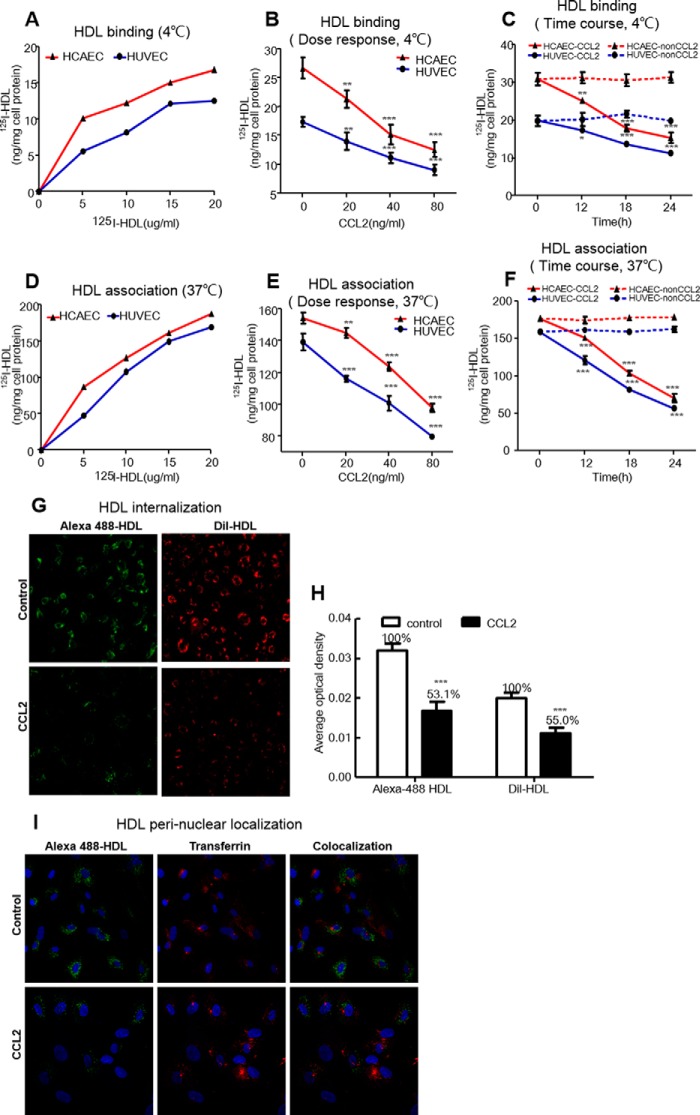
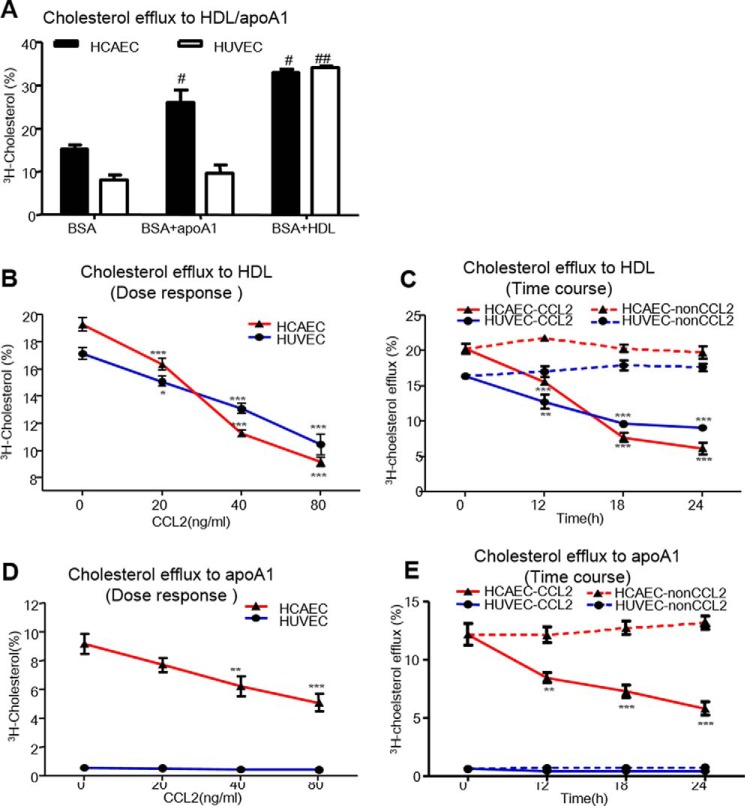
High density lipoprotein (HDL) has been proposed to be internalized and to promote reverse cholesterol transport in endothelial cells (ECs). However, the mechanism underlying these processes has not been studied. In this study, we aim to characterize HDL internalization and cholesterol efflux in ECs and regulatory mechanisms. We found mature HDL particles were reduced in patients with coronary artery disease (CAD), which was associated with an increase in CC-chemokine ligand 2 (CCL2). In cultured primary human coronary artery endothelial cells and human umbilical vein endothelial cells, we determined that CCL2 suppressed the binding (4 °C) and association (37 °C) of HDL to/with ECs and HDL cellular internalization. Furthermore, CCL2 inhibited [(3)H]cholesterol efflux to HDL/apoA1 in ECs. We further found that CCL2 induced CC-chemokine receptor 2 (CCR2) expression and siRNA-CCR2 reversed CCL2 suppression on HDL binding, association, internalization, and on cholesterol efflux in ECs. Moreover, CCL2 induced p42/44 mitogen-activated protein kinase (MAPK) phosphorylation via CCR2, and p42/44 MAPK inhibition reversed the suppression of CCL2 on HDL metabolism in ECs. Our study suggests that CCL2 was elevated in CAD patients. CCL2 suppressed HDL internalization and cholesterol efflux via CCR2 induction and p42/44 MAPK activation in ECs. CCL2 induction may contribute to impair HDL function and form atherosclerosis in CAD.
高密度脂蛋白(HDL)已被提出可被内皮细胞(ECs)内化并促进胆固醇逆向转运。然而,这些过程背后的机制尚未得到研究。在本研究中,我们旨在表征ECs中HDL的内化和胆固醇流出及其调节机制。我们发现冠心病(CAD)患者体内成熟HDL颗粒减少,这与CC趋化因子配体2(CCL2)增加有关。在原代培养的人冠状动脉内皮细胞和人脐静脉内皮细胞中,我们确定CCL2抑制HDL在4℃时与ECs的结合以及在37℃时与ECs的缔合和HDL的细胞内化。此外,CCL2抑制ECs中[³H]胆固醇向HDL/载脂蛋白A1的流出。我们进一步发现CCL2诱导CC趋化因子受体2(CCR2)表达,并且小干扰RNA-CCR2可逆转CCL2对HDL结合、缔合、内化以及对ECs中胆固醇流出的抑制作用。此外,CCL2通过CCR2诱导p42/44丝裂原活化蛋白激酶(MAPK)磷酸化,并且抑制p42/44 MAPK可逆转CCL2对ECs中HDL代谢的抑制作用。我们的研究表明CAD患者体内CCL2升高。CCL2通过在ECs中诱导CCR2和激活p42/44 MAPK来抑制HDL内化和胆固醇流出。CCL2的诱导可能导致CAD患者HDL功能受损并形成动脉粥样硬化。