Sinha Antara, Nagel Corey L, Thomas Evan, Schmidt Wolf P, Torondel Belen, Boisson Sophie, Clasen Thomas F
Faculty of Infectious and Tropical Diseases, London School of Hygiene and Tropical Medicine, London, United Kingdom.
School of Public Health, Oregon Health and Science University, Portland, Oregon.
Am J Trop Med Hyg. 2016 Sep 7;95(3):720-727. doi: 10.4269/ajtmh.16-0102. Epub 2016 Jul 25.
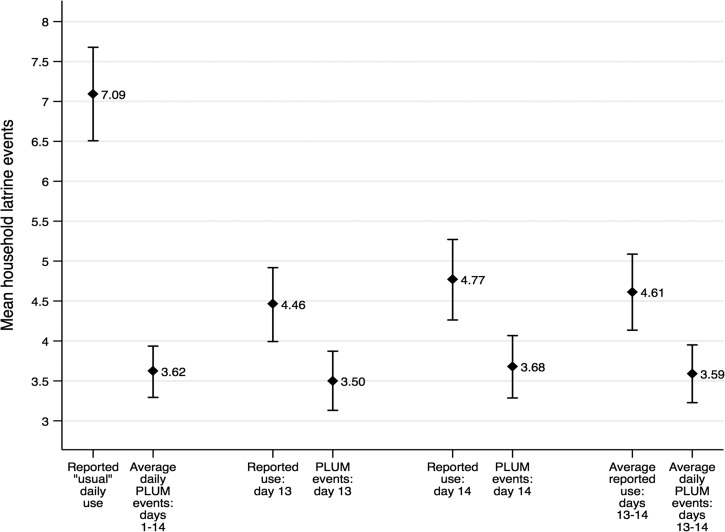
Although large-scale programs, like India's Total Sanitation Campaign (TSC), have improved latrine coverage in rural settings, evidence suggests that actual use is suboptimal. However, the reliability of methods to assess latrine use is uncertain. We assessed the reliability of reported use, the standard method, by comparing survey-based responses against passive latrine use monitors (PLUMs) through a cross-sectional study among 292 households in 25 villages in rural Odisha, India, which recently received individual household latrines under the TSC. PLUMs were installed for 2 weeks and householders responded to surveys about their latrine use behavior. Reported use was compared with PLUM results using Bland-Altman (BA) plots and concordance statistics. Reported use was higher than corresponding PLUM-recorded events across the range of comparisons. The mean reported "usual" daily events per household (7.09, 95% confidence interval [CI] = 6.51, 7.68) was nearly twice that of the PLUM-recorded daily average (3.62, 95% CI = 3.29, 3.94). There was poor agreement between "usual" daily latrine use and the average daily PLUM-recorded events (ρc = 0.331, 95% CI = 0.242, 0.427). Moderate agreement (ρc = 0.598, 95% CI = 0.497, 0.683) was obtained when comparing daily reported use during the previous 48 hours with the average daily PLUM count. Reported latrine use, though already suggesting suboptimal adoption, likely exaggerates the actual level of uptake of latrines constructed under the program. Where reliance on self-reports is used, survey questions should focus on the 48 hours prior to the date of the survey rather than asking about "usual" latrine use behavior.
尽管诸如印度的全面卫生运动(TSC)等大规模项目提高了农村地区的厕所覆盖率,但有证据表明实际使用率并不理想。然而,评估厕所使用情况的方法的可靠性尚不确定。我们通过一项横断面研究,在印度奥里萨邦农村25个村庄的292户家庭中,将基于调查的回答与被动式厕所使用监测器(PLUMs)进行比较,评估了报告使用情况(标准方法)的可靠性。这些家庭最近在TSC项目下获得了独立家庭厕所。PLUMs安装了两周,户主对关于他们厕所使用行为的调查做出了回应。使用布兰德 - 奥特曼(BA)图和一致性统计将报告的使用情况与PLUM结果进行比较。在所有比较范围内,报告的使用情况高于相应的PLUM记录事件。每户报告的“通常”每日事件平均数(7.09,95%置信区间[CI]=6.51,7.68)几乎是PLUM记录的每日平均数(3.62,95%CI = 3.29,3.94)的两倍。“通常”每日厕所使用情况与PLUM记录的每日平均事件之间的一致性较差(ρc = 0.331,95%CI = 0.242,0.427)。将前48小时报告的每日使用情况与PLUM每日平均计数进行比较时,获得了中等一致性(ρc = 0.598,95%CI = 0.497,0.683)。报告的厕所使用情况,尽管已经表明采用率不理想,但可能夸大了该项目下建造的厕所的实际使用水平。在依赖自我报告的情况下,调查问题应集中在调查日期前的48小时,而不是询问“通常”的厕所使用行为。