Prüss-Ustün Annette, Bartram Jamie, Clasen Thomas, Colford John M, Cumming Oliver, Curtis Valerie, Bonjour Sophie, Dangour Alan D, De France Jennifer, Fewtrell Lorna, Freeman Matthew C, Gordon Bruce, Hunter Paul R, Johnston Richard B, Mathers Colin, Mäusezahl Daniel, Medlicott Kate, Neira Maria, Stocks Meredith, Wolf Jennyfer, Cairncross Sandy
Department of Public Health and Environment, World Health Organization, Geneva, Switzerland.
Trop Med Int Health. 2014 Aug;19(8):894-905. doi: 10.1111/tmi.12329. Epub 2014 Apr 30.
To estimate the burden of diarrhoeal diseases from exposure to inadequate water, sanitation and hand hygiene in low- and middle-income settings and provide an overview of the impact on other diseases.
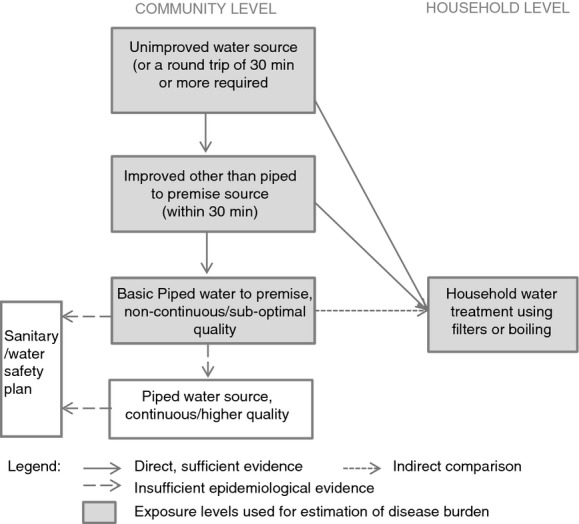
For estimating the impact of water, sanitation and hygiene on diarrhoea, we selected exposure levels with both sufficient global exposure data and a matching exposure-risk relationship. Global exposure data were estimated for the year 2012, and risk estimates were taken from the most recent systematic analyses. We estimated attributable deaths and disability-adjusted life years (DALYs) by country, age and sex for inadequate water, sanitation and hand hygiene separately, and as a cluster of risk factors. Uncertainty estimates were computed on the basis of uncertainty surrounding exposure estimates and relative risks.
In 2012, 502,000 diarrhoea deaths were estimated to be caused by inadequate drinking water and 280,000 deaths by inadequate sanitation. The most likely estimate of disease burden from inadequate hand hygiene amounts to 297,000 deaths. In total, 842,000 diarrhoea deaths are estimated to be caused by this cluster of risk factors, which amounts to 1.5% of the total disease burden and 58% of diarrhoeal diseases. In children under 5 years old, 361,000 deaths could be prevented, representing 5.5% of deaths in that age group.
This estimate confirms the importance of improving water and sanitation in low- and middle-income settings for the prevention of diarrhoeal disease burden. It also underscores the need for better data on exposure and risk reductions that can be achieved with provision of reliable piped water, community sewage with treatment and hand hygiene.
评估中低收入地区因水、环境卫生和手部卫生条件不佳导致的腹泻病负担,并概述其对其他疾病的影响。
为评估水、环境卫生和个人卫生对腹泻的影响,我们选择了既有充足全球暴露数据又有匹配暴露-风险关系的暴露水平。全球暴露数据是对2012年的估计,风险估计来自最近的系统分析。我们分别按国家、年龄和性别估算了因水、环境卫生和手部卫生条件不佳导致的归因死亡数和伤残调整生命年(DALYs),并将其作为一组风险因素进行估算。不确定性估计是基于暴露估计和相对风险的不确定性计算得出的。
2012年,估计有50.2万例腹泻死亡是由饮用水不足导致的,28万例死亡是由卫生设施不足导致的。手部卫生条件不佳导致的疾病负担最可能的估计数为29.7万例死亡。总体而言,估计这组风险因素导致了84.2万例腹泻死亡,占疾病总负担的1.5%,占腹泻病的58%。在5岁以下儿童中,可预防36.1万例死亡,占该年龄组死亡人数的5.5%。
这一估计证实了在中低收入地区改善水和环境卫生以预防腹泻病负担的重要性。它还强调需要获取更好的关于暴露和通过提供可靠的管道水、社区污水处理和手部卫生可实现的风险降低的数据。