Ghoshal Ujjala, Shukla Ratnakar, Srivastava Deepakshi, Ghoshal Uday C
Department of Microbiology, Sanjay Gandhi Postgraduate Institute of Medical Sciences, Lucknow, India.
Department of Gastroenterology, Sanjay Gandhi Postgraduate Institute of Medical Sciences, Lucknow, India.
Gut Liver. 2016 Nov 15;10(6):932-938. doi: 10.5009/gnl15588.
BACKGROUND/AIMS: Because produces methane, delaying gut transit, we evaluated loads in irritable bowel syndrome (IBS) patients and healthy controls (HC).
Quantitative real-time polymerase chain reaction for was performed on the feces of 47 IBS patients (Rome III) and 30 HC. On the lactulose hydrogen breath test (LHBT, done for 25 IBS patients), a fasting methane result ≥10 ppm using 10 g of lactulose defined methane-producers.
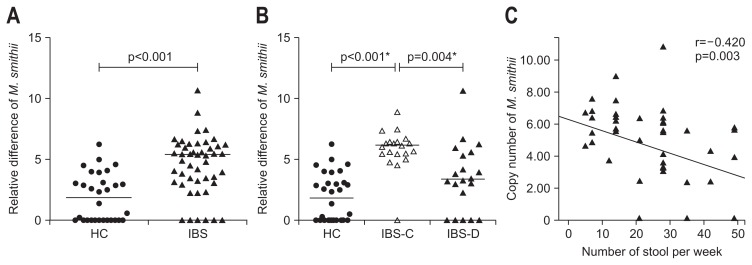
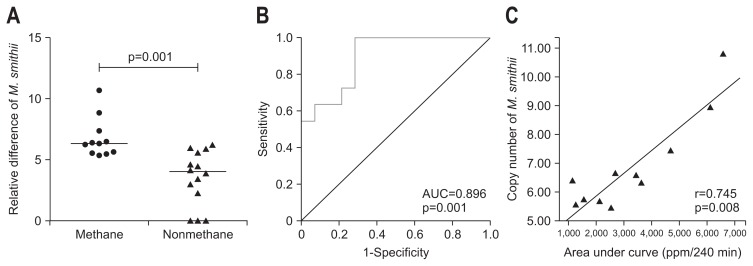
Of 47, 20 had constipation (IBS-C), 20 had diarrhea (IBS-D) and seven were not sub-typed. The copy number was higher among IBS patients than HC (Log₁₀5.4, interquartile range [IQR; 3.2 to 6.3] vs 1.9 [0.0 to 3.4], p<0.001), particularly among IBS-C compared to IBS-D patients (Log₁₀6.1 [5.5 to 6.6] vs 3.4 [0.6 to 5.7], p=0.001); the copy number negatively correlated with the stool frequency (R=-0.420, p=0.003). The copy number was higher among methane-producers than nonproducers (Log₁₀6.4, IQR [5.7 to 7.4] vs 4.1 [1.8 to 5.8], p=0.001). Using a receiver operating characteristic curve, the best cutoff for among methane producers was Log₁₀6.0 (sensitivity, 64%; specificity, 86%; area under curve [AUC], 0.896). The AUC for breath methane correlated with the copy number among methane producers (r=0.74, p=0.008). Abdominal bloating was more common among methane producers (n=9/11 [82%] vs 5/14 [36%], p=0.021).
Patients with IBS, particularly IBS-C, had higher copy numbers of than HC. On LHBT, breath methane levels correlated with loads.
背景/目的:由于[某种物质]会产生甲烷,从而延缓肠道运输,我们评估了肠易激综合征(IBS)患者和健康对照者(HC)体内[该物质]的含量。
对47例IBS患者(罗马III型)和30例HC的粪便进行[该物质]的定量实时聚合酶链反应。在乳果糖氢呼气试验(LHBT,对25例IBS患者进行)中,使用10克乳果糖时,空腹甲烷结果≥10 ppm定义为甲烷产生者。
47例患者中,20例有便秘(IBS-C),20例有腹泻(IBS-D),7例未分型。IBS患者的[该物质]拷贝数高于HC(Log₁₀5.4,四分位间距[IQR;3.2至6.3] vs 1.9 [0.0至3.4],p<0.001),尤其是IBS-C患者与IBS-D患者相比(Log₁₀6.1 [5.5至6.6] vs 3.4 [0.6至5.7],p = 0.001);拷贝数与大便频率呈负相关(R = -0.420,p = 0.003)。甲烷产生者的[该物质]拷贝数高于非产生者(Log₁₀6.4,IQR [5.7至7.4] vs 4.1 [1.8至5.8],p = 0.001)。使用受试者工作特征曲线,甲烷产生者中[该物质]的最佳截断值为Log₁₀6.0(敏感性,64%;特异性,86%;曲线下面积[AUC],0.896)。呼气甲烷的AUC与甲烷产生者中的[该物质]拷贝数相关(r = 0.74,p = 0.008)。甲烷产生者中腹胀更为常见(n = 9/11 [82%] vs 5/14 [36%],p = 0.021)。
IBS患者,尤其是IBS-C患者,其[该物质]的拷贝数高于HC。在LHBT中,呼气甲烷水平与[该物质]含量相关。